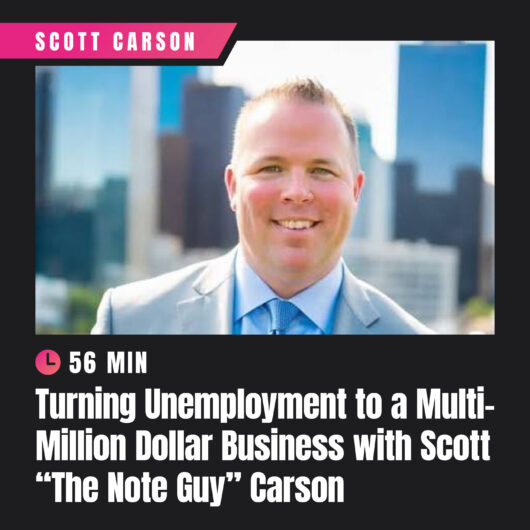
Podcast Episode 11
Turning Unemployment to a Multi-Million Dollar Business with Scott “The Note Guy” Carson
To be a guest on the show, email podcast@postcardmania.com
Listen and watch on your favorite podcast applications.




Episode Overview
Host Chris Foster talks with Scott Carson, the investor known across the country as “The Note Guy,” about losing a six-figure job and nearly losing his own home, building a business buying distressed mortgage debt from banks, and why delivered always beats perfected when it comes to marketing.
Podcast
Episode Transcript
Here’s the transcription below of today’s episode, a conversation between host Chris Foster and Scott Carson, the investor known across the country as “The Note Guy,” about losing a six-figure job and nearly losing his own home, building a business buying distressed mortgage debt from banks, and why delivered always beats perfected when it comes to marketing.
Note: This transcription has been formatted from the original episode transcript for readability.
Transcript
Chris: Well, all right — Scott Carson, welcome in to the Everywhere Small Business Podcast.
Scott: Hey, honored to be here, buddy. Glad we could get this thing scheduled, and just so grateful to be here this morning and to share any wisdom I can with your amazing network. You guys do an amazing job, and of course, you know I’m a huge fan. So glad to share any knowledge or nuggets we can provide to your listeners out there today.
Chris: Not just knowledge and nuggets, bro. You’re going to drop some pearls — big fat pearls of wisdom — on our audience. Can’t wait to have this discussion. Tell us a bit about yourself and your business.
Scott: Yeah, so I’m a real estate investor, I guess is what you could niche me down into. But inside of that niche, I’m known across the country as the note guy. For twenty years I’ve been buying and investing in distressed mortgage debt.
What does that mean? Basically, I buy mortgages from banks and lenders where people haven’t paid for six months to six years. We buy that debt at a big discount. We don’t own the property, but we buy the actual mortgage debt and become the lender. And we actually make the majority of our money trying to work it out with the homeowner to keep them in the house, get back on track, start making payments, so it results in good cash flow for us. If that doesn’t work, we work out some type of liquidation of the asset — selling the property, a short sale, cash for keys — and then we take the property back as a foreclosure, fix it up, and sell it or hold it for a period of time.
So for twenty years now I’ve been traveling the country teaching about note investing, but we’ve also bought well over a billion dollars in distressed debt all across the United States. And of course we have an education platform where we teach other real estate investors how to become note investors. That’s why I call it the sexy side of real estate.
Chris: Of course it is. So, bro, there’s a lot to unpack with that origin story. Twenty years ago you got started, and I want to talk a little later about how you positioned, migrated, and expanded toward education, because that’s a different thing than actually just doing the business. So how did you get started in the business? What intrigued you about buying the debt of distressed properties?
Scott: So I was previously a financial advisor, and then a banker — I worked for JP Morgan Chase for a couple of years. And a buddy of mine I’d worked with previously started a mortgage company with a couple of other investors here in Austin, Texas, who were traveling the country speaking on the real estate investment circuit with Ron LeGrand, who’s actually out of Jacksonville, Florida, and has been around for forty-plus years. I liked what they were doing, so after working in the bank I said, let’s give this a try.
I left the banking profession and started doing mortgages. And for four years I really had a unique apprenticeship, I like to call it. Not only was I originating mortgages for real estate investors, but over that four-year period I was literally in front of thousands of investors across the country at all these big conventions and conferences, pitching mortgages and refinances — and I was also sitting in the back of the room absorbing as much as I could, because I found real estate investing interesting. So when I wasn’t originating mortgages, I was learning how to do creative real estate investing.
And the sponsor for us, a guy by the name of Bob Leonetti, actually taught me how to originate notes, how to create mortgages, owner financing, how to buy and sell paper. Because he’d made a lot of money and lost some money during the eighties when the whole savings and loan scandal crashed.
So when everything hit the fan in 2008 and the mortgage market dried up, I flipped from origination, as I say, to de-origination. Banks started sending me their lists of notes and mortgages they wanted to get off their books, which is a different niche than anything else out there. That’s what I started doing — I started getting these lists in. But people didn’t understand what a note is. They were like, oh, you own the property. No, I don’t own the property. They didn’t understand the difference between being the lender on a non-performing note and being the property owner.
And that’s where the education side came in. I was literally standing in front of an audience in New Orleans of about 3,000 investors who were there wanting to learn about short sales at the time, and I talked about how we could buy the note, work it out, and make a bigger return. I got bombarded as soon as I walked off stage — do you have a class? And I’m like, yeah, sure, I’ve got a class. What’s the cost? Of course I do. It’s two hundred fifty bucks a person. I mean, I just pulled that number straight out of thin air. And then a month and a half later I had 35 people in Austin learning how to do the note business from me.
I got divorced and sold everything I owned in Austin, and I thought, well, let me get on the road for a little bit. Over the next three and a half years I was traveling the country, knocking on the doors of banks and lenders and stuff like that, but also teaching all across the country. And it’s kind of funny, the marketing side of what I was doing — people would come up to me at these different real estate clubs I’d be speaking at, or networking events, and say, hey, you’re that note guy. You market real well. You’re the guy on YouTube, you’re the guy sharing all these case studies. And I’m like, yep.
That’s where the name the note guy came from. In four nights over five days, at four different investment clubs, somebody came up to me and said, hey, you’re that note guy. Okay — I don’t have to be original, I’ll take what people are calling me. They weren’t calling me a jerk, so that’s a good thing. You know what I mean?
Chris: I’d rather be the note guy than a jerk a hundred out of a hundred days. I think that’s so cool. And there are a couple of different parallels which I find really interesting. You mentioned the word apprenticeship, which I love. I love that sense of learning from the masters, or learning from someone else, a mentor, sitting in the back of the room absorbing as a student — and then suddenly X number of years later, the student becomes the teacher. So what is it about teaching, Scott, that you find so fulfilling beyond just the work of the lending? You mentioned, hey, yeah, of course I teach a class. Of course I do. Wait, I’ve got to teach a class. Okay, we’ve got this. But then clearly you fell in love with it.
Scott: Well, you have to take it further back, to 2000, 2001. I was working in finance and I got laid off after being newly married. We’d bought our first home with a hundred percent financing, a first and a second, and then my realtor was like, hey, you’ve got great credit, you should buy a couple of investment properties.
I’m like, yeah, let’s do that. So we bought two more investment properties that were going to be rentals, because I wanted to be the next landlord, right? I liked the HGTV flip-this-house kind of stuff. And I grew up in a small town in Ingleside, Texas, where my dad owned the local hardware store, so there’s basically nothing I can’t fix. I thought that would be great. Well, when you get laid off from your six-figure salary and you try to make six mortgage payments on a private school teacher’s salary, I was in default. I was a naughty borrower. I was a deadbeat borrower who couldn’t pay his mortgage.
There was about a year period where I was just doing whatever I could to survive — waiting tables, delivering for FedEx Home Delivery, going and selling plasma, whatever it took during that period. And I said, God, if you get me through this, I’ll do whatever I can. And luckily for me, we were able to save our house, got rid of the two investment properties, and I licked my wounds for a while before I went back into the financing side.
I think going through that and knowing what it feels like was actually God’s way of preparing me for later on, when I’m on the phone with borrowers who are facing foreclosure, or talking and evaluating files. I have some empathy for people, because good people go through financial hiccups all the time. So that was the thing — if I could get through that, and then the opportunity was presented to me to learn, I was like, this is a unique situation. I even think my divorce was a good thing, because it gave me the freedom to be able to travel so freely and spread the word and get out and market kind of like a politician. I wasn’t necessarily slapping hands and kissing babies, but I was kind of doing that for a period of time.
And that’s where the education side came into it, when people came to me and said, hey, do you have a class? I love this niche. And I was like, there’s not really anything else out there. Nobody’s really teaching that specific niche. With everything happening chaotically in the mortgage markets and the Great Recession, I was like, I’m not the brightest guy, but if thirty people ask me at just one event, there’s an opportunity here.
And when banks were sending me these lists of not just one note but thousands of notes at a time, that I could cherry-pick from across the country, I knew I was not big enough or smart enough to buy all that stuff. If I wanted to tap into it to close more deals, I needed to educate. I won’t say do a Vulcan mind meld with people, but it was helping people understand the opportunity, the niche. And then in turn, if they’re out marketing their own business, they’re going to get lists sent to them that they can’t take down themselves, and hopefully they’ll pick up the phone and call me. So it became a lead generation of helping people understand.
Now, are they going to buy their own stuff? Yeah. Do people worry about creating competition? I really don’t, because I come from an abundance mindset. There are plenty of deals out there. And not everybody is going to market like I do. So that’s the way I look at it. Are there more educators in the industry now? Yeah, there are — but they come and go, because they’re just not in it for the long haul, they don’t have the experience. Anybody can make money in an up cycle. But when you’re in a down cycle, that’s when you really understand the value of experience, of mentorship, of having somebody you can reach out to.
Chris: I love that. What’s interesting too is that one of the first things you mentioned was that you can step in instead of a bank, and you said you try to work with the homeowner to help them out, to get them through. I thought that was so beautiful. And that’s the first thing you said. Your first solution is — okay, a bank is going to be faceless, personless, anonymous. They’re going to worry about the bank. It was the bank that foreclosed on the Joad family in The Grapes of Wrath, right? It wasn’t a person, it was capital-T, capital-B, The Bank, the system. But you’re like, no, no, no — person. I’m Scott. I’ve got not the property, but the loan. Why don’t we work something out? And now I understand, Scott, because that comes from a place of real empathy and lived experience, where you were in that same boat.
Scott: Yeah, so true. Another thing is, you make more money keeping people in the houses, too. That way you don’t have to foreclose, you don’t have to pay money to attorneys, you don’t have foreclosure costs or rehab costs. You can actually start getting stuff cash flowing faster that way. So about seventy percent of the time, if it’s an occupied property, we’re able to keep them in the house. And that’s a good feeling, helping somebody — listen, I know you’re behind, I know what happened.
I’ve got so many amazing stories of borrowers who fell on hard times and we helped them out of the hole they were in, and they just performed. They raised their kids for eighteen years in that house. They lived in the house for thirty years. Or it was a house their father built. Or they’re a single mom with four kids whose husband just took off on them and they’ve got no place to go. Or it’s the elderly woman who’s the only heir left in her family and can’t afford the mortgage payment because of everything else going on, so we just keep her in the house for a period of time until she passes.
So having a heart is a great thing. But don’t get me wrong — I run a business, I don’t run a charity. I get people all the time: hey, will you buy my mortgage so I don’t have to pay my mortgage? I’m like, what business sense does that make? No, I can’t help you that way.
And that’s the thing. We’ve bought over a billion dollars in debt, residential and commercial. Every loan file we have has a country western song attached to it — whether it’s Waylon Jennings or Merle Haggard or Johnny Cash or the Dixie Chicks. It’s an interesting melody when it comes to making money in the note business. I’ve got to keep that. That was good. I’ve got to keep that.
Chris: No, I marked that. That could be an absolute pull quote. But the way that works — what we love about country western songs is that they’re always stories. Always. Pop songs are hooks and beats and dance. Country songs are stories, which is why people really get into them and enjoy them, because they speak some truths about the human experience. And you, in processing and dealing with thousands of notes — gosh, Scott, you’ve learned thousands of life stories.
Scott: It’s so true. And don’t get me wrong, I’d say about eighty-five, ninety percent of people just had bad things happen to them. They got laid off, they got sick, they got divorced, something like that. But then you do have that small group of people out there who are just trying to take advantage of the system. Those folks, I don’t mind foreclosing on. We have a come-to-Jesus meeting, and you can do what you want to do, but I’m going to win. The bank always wins.
We had a guy down in Cutler Bay, Florida, who hadn’t made a mortgage payment in four years when we bought the mortgage, and it took two and a half years to foreclose, and he used every excuse in the book. We would have let him stay in the house if he’d wanted to. But it was a pleasure to foreclose on him — getting jerked around like that.
But that’s the exception. Another thing you have to realize that’s different about this business is the marketing side of things. You’re not chasing foreclosure lists, you’re not targeting code enforcement liens, you’re not trying to buy into the foreclosure market. It’s a further-up-the-hill thing, where you have to really develop some marketing skills to dive into it, and not everybody is built that way. When you’re an entrepreneur coming out of a full-time J-O-B or a career doing something different, you have to understand that it takes some time to hone those marketing skills. But I say it’s easier than anything else out there. It’s just a different mindset in a lot of cases.
And that’s the one thing I think people struggle with more than anything else. It’s great to make money — by all means, it’s phenomenal, making money helps people — but you’ve got to learn how to find that deal flow, because everything starts with the deal. And knowing how to track those deals down is the first thing.
Chris: So how did you learn your marketing skills? Did that come as a natural, innate ability? Or, kind of like with your apprenticeship, did you just absorb and learn from other people and see what was happening, and model that success?
Scott: Well, I was born a marketer — give me some milk, Mom, I’ve got to change my diaper. The loudest person in the room. I’m just joking. But no, I was fortunate. I worked for some companies that had great sales trainers, and that was always good on the sales side of things. But when I was working with Bob Leonetti, there was a guy by the name of Roland Frasier who came to work with him. Roland is probably one of the smartest marketing geniuses out there.
He used to be one of the big guys at the Traffic and Conversion Summit that took place in San Diego for years. He now does a lot with business selling and stuff like that. But for that four-year period, I got to spend a lot of time with him, learning about marketing. He’s got a company that does marketing for something like two-thirds of the NFL teams — a lot with direct mail and blog writing and video. And this is way back in the day, we’re talking 2004 to 2008. Video — this is before the Ask Gary Vee show, before Facebook Lives. Podcasting was so brand new back then that nobody was really doing it. For the most part, YouTube was kind of new.
So I just took what he taught and started applying it. It wasn’t polished, but it was getting stuff out in front of people. And that was the one thing I think Roland really taught me: listen, first of all, you’re not going to be everybody’s client. Not everybody’s going to want to deal with you, and you have to understand that. But delivered is better than perfected.
If you get it out and it’s delivered, it may be seventy, eighty percent good — but it’s delivered. It’s out there, it’s churning. You can do version two, version three, version four, and it’ll get better and better and better. But if you wait around for the perfect marketing piece, the perfect mailer, the perfect podcast episode before you put anything out, you’re always going to lose by being the second person to market, or the third person to market. Somebody else is going to steal your thunder by getting the message out first.
So that’s one thing. I was like, okay, let me just start cranking out short videos, or start blogs — a HubPages blog back in the day, or short little SEO stuff. And that started literally driving business. This little Flip camera that I keep — I can’t tell you how much money this made me, from going out and walking a property, or setting it up while I’m working through a whiteboard strategy session in my office at ten o’clock at night going through a deal. Because it just allows people the eyes and ears to see over your shoulder.
Whereas most people are so scared to be on camera — everything has to be perfect, the makeup, the hair, the background. I don’t worry about that half the time. You’re here for the knowledge that’s coming out and what I’m going to share with you. That’s the most important factor. Yeah, you’ve got to be a little polished — it’s not Naked and Afraid.
Chris: But don’t let perfection be the enemy of good enough and getting it out.
Scott: That’s what it is. For probably ninety-five percent of people, they worry about perfection, and that’s what stops them from taking action and having success.
Chris: That’s wonderful. See, I told you you’d be dropping these big, huge softball-size pearls. You just dropped a beauty. So right now you’ve got a business that you’re running, plus you’ve got the education side of it. On the education piece, I find it so cool that you’re telling other people the stuff that you’re doing, knowing that they’re going to do it and they could take deals away from you. But you’re like, you know what, I’ve got an abundance mentality, the market’s big enough. When you’re talking to people, are you talking to folks who are brand new getting in, or are they experienced and need more polish, or is it a mix and match? What does your audience look like?
Scott: It’s a mix and match. I’d say it’s almost split fifty-fifty down the middle — fifty percent women, fifty percent men. The Judys and the Steves, as we like to call our audience out there. A lot of them are still working at their job or looking at retirement, and they want to do something different, or they hate their job, they hate their career, and it’s not making enough money. There’s more month left at the end of their paycheck than paycheck at the end of the month.
And we do get a lot of people who are experienced in real estate also — fix-and-flippers, private lenders. We’re getting a lot of apartment syndicators who were investors in the apartment meltdown we’re seeing, getting out of that space, wanting to do something they can control better with their own money. So we have a mixture of experience and a mixture of new people who want to get into real estate investing, or have dabbled a little bit, done a couple of fix-and-flips and didn’t like it, dealt with a couple of rentals and didn’t want to be the landlord, didn’t want to deal with toilets, tenants and trash — they’d rather be more passive and be the lender. So it’s a good mix of seasoned, experienced people and people brand new to the space.
But here’s a stat I love to quote from the American Marketing Institute: eighty percent of sales are made after the fifth contact, the fifth through the twelfth contact. You’ve got to follow up, follow up, follow up. Only forty-eight percent of people make a follow-up phone call. So I know most people aren’t going to do it — half of our audience isn’t going to pick up the phone and call a bank, or even go on LinkedIn and connect with people, or drop a postcard out to an IRA investor list that we show them how to pull for free. So those rare people who do get to that fifth touch, that fifth follow-up — hey, great, that’s fine.
There’s a lot of competition for low-hanging fruit, the stuff that doesn’t require you to market. And those aren’t really deals these days. You’ve got to step it up and market and follow up and build. We’ve got an email database of about sixty-five thousand people, and we’ve been drip marketing to that database at least once a week for twenty years, for the most part. Out of that list, about four to five thousand are asset managers. They get an email once or twice a month from us — they call it the green email, because it’s green branded with our logo and colors.
Does everybody have something for us? No. It may be once a year, it might be once a month. But they know when they have something to reach out to this crazy guy called Scott Carson. Yeah, the note guy.
Chris: The note guy. They know the note guy. So much of marketing is simply about promotion and showing up. So tell me about that, since we’re talking about marketing, Scott. And first of all, fantastic working with you at PostcardMania. Tell me about the marketing you’re doing and how you’ve found it to be so successful.
Scott: Well, I think the number one tool out there is still email marketing to this day. It’s a forty-four hundred percent return on every dollar you spend on it, if you’re doing it consistently and following up. We also do a lot with social media — you’ve got to be on there. LinkedIn is one of our number one sources. We’re capped out at thirty thousand connections on there, and we have about thirty-five thousand followers. That took eight to ten years to get up to, just continuously marketing daily on that platform.
With what we do on deal flow, we don’t do a lot of direct mail marketing to asset managers and banks, because they’ve got to go through a whole system — you’re not going to send out postcards or letters the way you would for a foreclosure list. So we target those on LinkedIn and then email blasts. When we’re looking to raise capital — people always ask us how we fund our deals — then we do marketing out to IRA investors at the county level, and to real estate investors. We’ll drip market postcards and then deal case studies and stuff like that, and that raises capital for us.
So it’s a little bit of a mixture of direct mail, but also social media and online. We’ve got the number one YouTube channel and the number one podcast in the note industry, which always really helps as well — eleven hundred plus episodes, just under ten thousand subscribers on our YouTube channel. And we consistently crank out content.
One of the big things we’re seeing a boost from right now is that a lot of people will talk theory, they’ll talk a little bit about nuts and bolts, but they won’t dive into really getting your hands dirty in this niche — like, how do you evaluate a note versus a property, or how do you break down a list of a hundred to find the top five or six deals in it? We do a lot with that, going through deals. We’re in the midst of doing 50 note deals in 50 days. So every day we’re doing a different case study. Here’s a deal, here’s a note, here are the details behind it, here are the one, two or three exit strategies that go well with this, here are the returns. Is this a deal or is it a dud? Is this a deal you only want to use with your own money? Or is this a deal that would allow you to raise capital and go splitsies?
Those videos are eight to fifteen minutes long, some a little longer, but there’s that consistency, and people like it, because that’s where people learn — in that consistency. Learn and learn and learn and learn and learn again, and then take action with it. And that leads to people thinking, wow, if this guy’s doing such a great job on these deals for free, what are his classes like? What’s his coaching like? Or, hey, can I invest some money with him, because I don’t necessarily have the time and experience to do it myself?
So that continuous marketing on a regular basis helps out tenfold. That’s why we keep kind of a lean note-buying machine, not having the huge overhead a lot of others do. I’ve had the corner office before and a full-time staff. But it’s 2026, not 1996 — so you can use the tools that are available today.
Chris: You use the tools you’ve got. That’s right. I think it’s awesome to do 50 deals in 50 days. You really open up the hood so customers or people can see how the engine actually works — how the sausage is made, whatever metaphor you want to use. That is so practical. So I’ve got a question. Do you have a deal going on today?
Scott: I’ve got a bunch going on today.
Chris: Tell me about one of those deals. In a handful of minutes, kind of say, here’s a deal in particular that I’m going to analyze, and this is why it’s either a deal or a dud, and this is what I’ve got.
Scott: So we had a hard money lending company here in Texas — a buddy I’ve known for twenty years, we’d seen each other’s stuff, we never really marketed to each other. He reached out and said, Scott, I’ve got fifteen million dollars in short-term mortgages that I need to cash out, so I can have money to make more loans, because lenders make more money making loans.
So he sent me a first tape of twenty-five loans, and it included six in Texas that are hard money loans at a twelve to thirteen, fourteen percent cash-on-cash return, because that’s how the notes are written. These are short-term six to nine month loans. So if you come in and you’ve got fifty grand, instead of it being in a two-year, three-year, four-year or seven-year annuity where you might get five to seven percent, you could actually invest into a first lien in Texas — which is a fast foreclosure state — on a property at sixty-five to seventy percent of value. If the borrower doesn’t pay on time or sell the property in nine to twelve months, you have the right to foreclose and take that property back, or modify the loan, or extend the loan. But you’re going to be making a double-digit return on your money, and that works out really well for a short period of time. You kind of test the waters.
Also, if you don’t have the money yourself, the way these notes are written at twelve to fourteen percent, if you market to IRA investors and find people who want to make six to eight percent on a passive return — and there are a lot of people out there who would love that — you can arbitrage. Bring them in, fund the deal, pay them their six to eight percent, and you’re making two to four percent as an arbitrage without putting your own money into it. So it’s not a two to four percent return, it’s an infinite rate of return to you, because you’re not using your own money.
It’s six to nine, six to twelve month deals where they’ve already done the underwriting, they’ve already got pictures of the property, we’re going to pull title. So literally you’re just stepping in and plug-and-playing your fifty to a hundred grand for a short period of time. At the end of the nine months or twelve months, if you want to go into another deal, you can. If not, you get the money back and go do something else with it. So we’ve got two in Houston, one in Lubbock, one in Richardson, and another three or four down in the valley that we’re evaluating right now.
Chris: That’s astonishing. You rattled that off so quickly — I was looking at the clock, that was about three minutes and twenty-two seconds. But I also now understand, Scott, why you have classes. You just threw at me, a total amateur who knows next to nothing about this stuff, a total word salad, and I was trying to pick it up. I was picking up annuities and derivatives and this percentage and that percentage and an arbitrage. So I’m keeping up with you, but this is one of those things where I’m like, I think it’s better if I just write Scott a check and he does it all for me, because I don’t get this. And then it’s like, okay, well, after I do that once or twice, now I really want to understand what you do. And now I really get that there’s this education, because brother, this is niche of niche of niche.
Scott: Well, everybody’s already on the lending side. You’re already in the note business, as I say, Chris. If you’ve got a mortgage, a car payment, student loan debt, a credit card, or you loaned your cousin Bubba down the street five hundred bucks — you’re in the note business, you’re just on the wrong side of the payment stream. You’ve got money going out. We want money coming in.
Let’s use a very simple analogy. If you’ve got a checking or savings account and you’re putting money into your savings account, what’s the bank paying you? One percent, maybe.
Chris: Nothing. Maybe. It’s hilarious when you get the statement — you just got three cents of interest.
Scott: Yeah. But they charge you a twelve dollar servicing fee or account fee. So the bank is glad to give you their one percent, or even four percent on a hundred grand if you’ll tie it up for five to ten years with them, because they’re then turning around and making mortgages at seven percent, so they’re making the difference. Or they’re lending out on auto loans at ten to twelve percent, or doing credit cards at twenty-six percent.
And so they’re just arbitraging. It’s the same thing that we do. Instead of giving you one percent — hey, investors out there, if you’ve got money in an IRA or some lazy assets, I’ll give you six to eight percent for a short period of time, like two to three years, and we’ll go find something that’s going to make us twelve, eighteen, twenty-five percent, and we’ll do all the heavy lifting. Somebody’s going to get six to eight percent for not doing anything, and they’re in a first-lien secured position.
So we arbitrage that. We make a good chunk of return, but we were the ones doing all the heavy lifting. And somebody’s making money passively without having to deal with the headaches of going and finding it or dealing with tenants. Oftentimes we’re going to give them a higher monthly cash flow without all the headaches of the three T’s.
Chris: Yeah. What’s cool about this, Scott, is that there are so many different ways to earn extra money in the world. I loved your phrase — you’ve got more month than paycheck. That happens for a lot of Americans. A lot of folks out there are like, this is tight.
And so they start doing their own side hustles. Maybe they start something on Amazon, maybe they build an e-commerce business. Maybe they do DoorDash. I know people who are supplementing with Uber — they’ve got full-time jobs, but they’re like, yeah, I Uber on the weekends because I need extra cash in my pocket for the monthlies. Or they have a family situation where suddenly they’re getting married or having kids, and it’s like, gosh, whatever we’re doing now is not going to cut it six, nine, twelve, eighteen, twenty-four months from now. I need some extra income.
So are you finding — and you mentioned it before, when you traveled around the country — that you’ve got your Judys and your Steves, and your Judys and Steves are the ones where it’s, hey, I need some extra cash, or hey, I want to transition out, or I just got laid off like you did? You got laid off working for J.P. Morgan, and then suddenly you didn’t have a job and you were kind of looking around like, what do I do now?
Scott: Those were my exact words. What the heck do I do — exactly.
Chris: Right. But this is an outlet where, Scott, you don’t have to go to college for four years. You don’t have to spend eighty grand to get an MBA. You have to simply learn what other people are doing, and the resources are available out there, so that people can say, I’m going to add significant revenue and money into my life and lifestyle. Maybe it becomes my full-time gig, I don’t know. But that’s something new that wasn’t around before. I think that’s pretty empowering. I think that’s pretty cool.
Scott: I always joked that the note business popped up in 2010 between the cracks. It’s the cracks in the system that it popped up through. Banks had all this stuff on their books they wanted to get rid of, and Wall Street wasn’t buying, so it made an opportunity for investors like me to come in and cherry-pick this stuff — buy a onesie-twosie, or ten or twenty or a hundred, or whatever.
You have similar things happening right now. You’ve got so much revolution taking place in the job market with AI and outsourcing. The world is really becoming a smaller spot. And you’ve always got to be learning. That’s the one thing I think people take for granted — I’ve worked in my career for twenty, thirty years, I don’t need to learn a new skill. Well, you’d better learn a new skill, otherwise you’re going to get laid off for somebody who comes in cheaper, or your job’s going to get AI’d, as we like to say.
And we all know costs are going up. Food, gas, housing, taxes.
Chris: You mean it’s not getting cheaper?
Scott: No, it’s not getting cheaper, unfortunately. And we don’t necessarily want it to — if we were to see things get cheaper, it would be a very bad situation. It would be a collapse of things like we saw back in 2008. And here’s a stat taken from The Big Short: for every one percent increase in unemployment, that results in forty thousand deaths.
Chris: Wow.
Scott: Think about that. A one percent increase in unemployment results in forty thousand deaths. People giving up, people doing things you don’t want to think about.
Chris: I believe it. I believe it. So look, you don’t know this about me, but I grew up in Pittsburgh in the seventies and eighties.
Scott: Steel Curtain, Terry Bradshaw — there you go.
Chris: You’re singing my song. But the other side of that, besides a fantastic, world-class, legendary football team for all your Steelers fans, is that the steel industry collapsed. My dad worked in Butler, which was a city north of Pittsburgh, a steel town. He ran the psych unit at Butler Memorial Hospital. And Scott, we would walk down the streets of Butler and everybody knew my dad. Everybody knew my dad, because they, or their family, or a friend of the family, or their cousin, was going through the psychiatric ward — because the entire town collapsed.
It taught me at that moment that big institutions can fail. My mom worked at Westinghouse. Westinghouse suddenly says, I’m going to lay off 5,000 workers in a weekend. That’s families. Those are lives. Steel mills especially, where these folks have tenure and they don’t know anything else, and people said, well, just do job retraining. And I’m like, really? You’re going to job retrain a thirty-eight-year-old who’s been on the shift line for eighteen years and didn’t go to school because this was his career path? How’s that work?
And so in the midst of all these large institutional failures, there is room — especially now — for the individual entrepreneur, the individual small business to be created. For you to say, gosh, I’ve learned all this stuff, I’m going to actually share all this stuff that I know. So that you too, Janice, who just got laid off from Amazon when they laid off ten thousand workers in one push, and you’ve got a mortgage and two kids — here’s one way you can supplement your unemployment as you’re trying to find your next position. So what you’re doing, to me, is so empowering to these folks, to say there is a way to create and generate income for yourself that’s maybe non-traditional, non-standard. But you’re showing how to do it, which I think is really cool.
Scott: I wish everybody who took our class would take action. The biggest hurdle most people have is the six to seven inches between their ears. It just is.
Chris: Another softball-size pearl from Scott.
Scott: It just is. There’s another quote somebody shared with me: the only thing you guarantee by not trying is failure. I had a guy call me out of New York yesterday. He’d been notified he’s going to be laid off in ninety days, and he wants to replace a twelve-thousand-a-month income. But he has no experience in real estate, no experience in anything. He has no database, he’s worked as an IT guy for years.
And I’m just talking on the phone with him. I said, listen, I would love to help you and tell you that you could jump into this and make twelve grand in your first ninety days. But you have no database, you have no money, no savings. That’s not to say you can’t go raise capital, but the responses I’m getting from you, the answers you’re giving me, the tone — it tells me you’re not going to take action. I understand it’s depressing to go through something like that, and a lot of times we want to wallow in our suffering.
I always say, look — note investing is an equal opportunity investment. It doesn’t care what education you have. I don’t care what kind of money you have on the sidelines. There’s plenty of money out there. Good deals find money. That’s the truth. It’s all going to come down to how you market. Does that mean sending an email to people? Yes. Does it mean pulling out your phone and using the free services like TikTok or Facebook and doing a little selfie video about a property or a note deal? That works. It’s proven it works. You don’t have to have an education to do that. Look at all the gray hairs on TikTok selling t-shirts and whatnot these days on TikTok marketplace. That’s great. I love it.
But you have to have a come-to-Jesus meeting. You can either sit here and keep wishing for the way it was, or decide, I’m going to do something different. It’s an opportunity. God just gave me the biggest kick to take action. And I’m a big believer — God always provides, but God also helps those who help themselves.
So you’ve got to go take action, you’ve got to follow up. If it was so easy, everybody would be doing it. No matter what it is, it’s going to take some skills, it’s going to take some learning. And the number one thing — and I don’t care whether you’re eighty or eighteen — is that you’ve got to be coachable. The minute you stop complaining about life and how this is the way it was and we liked it — well, it’s not the way it was. If you want to go back to that, go jump on the time machine with Marty McFly and the DeLorean, or Doctor Who and the police box. But that’s not showing up for you. And nobody’s going to save you — not the Democrats, not the Republicans, nobody. I’m going to tell you right now.
Chris: No one’s going to save you — that’s the thing. One of the things I a hundred percent agree with is that small business is getting no help from the top. I’m not going to go into politics on this show, but I will guarantee you that there isn’t a big seventy-five-billion-dollar investment into small business. I haven’t seen that bill, right?
And so small business owners nationwide — and you know this, Scott, you’ve traveled the country, you’ve seen all the regions, and I want to ask you about the regional differences very quickly. But to your point about the IT guy who was laid off in New York making a six-figure income, and then AI kind of pushes him out and he’s like, what do I do? Maybe I can start this. It really is on that individual’s sense of ownership. And that individual’s sense of belief — it starts with the belief that they can get to a place they aren’t in now, that they can move away from where they are now, and that the actions they take now impact their life three, six, nine, twelve months from now. And to your point, you’ve got fifty percent who aren’t going to do anything, so there’s this small percentage who actually take action and can help themselves.
Now, regionally — you’ve traveled everywhere across the country. Do you think this type of operation is different in the southeast, or the northeast, or the Midwest? Or is it the same, and it doesn’t matter if you’re in Chattanooga or if you’re in Columbus, Ohio?
Scott: So it doesn’t matter where you office. I’ve closed deals in Austin, Texas, and Austin, Minnesota, and in the middle of the Mediterranean on a cruise ship, sipping sangria in Barcelona. I’ve done stuff from my cell phone. It doesn’t matter.
Now, I don’t buy in every state, because every state’s a little different, whether it’s a longer or shorter foreclosure timeline. In all fifty states plus Puerto Rico, we have a different foreclosure time frame. Texas is the fastest — which is great, but it also means the deals here are a little more expensive, because of the time value of money and how fast it forecloses. So we buy in about twenty to thirty states.
Since we’re coming up on college football season, and I’m a big football fan — if you’re buying in the SEC, the Southeastern Conference, we’re talking the Gulf Coast, Texas, Missouri, up into the ACC area, North Carolina and South Carolina, and the Big Ten — all great areas.
Chris: You’re talking regionally by using football conferences. I love that. All right, you keep going.
Scott: Because that’s the great thing. I buy in fast foreclosure states. I also buy in judicial states where it takes six to nine months to twelve months to foreclose. I love God’s waiting room down in Florida. Over my tenure, that’s where we’ve bought the most assets. I haven’t bought much there in the last couple of years because of everything going on, but I think there’s a lot of opportunity coming around the corner that just hasn’t hit bottom yet — lenders aren’t selling the stuff at the discount that needs to be sold yet, because it’s a longer foreclosure time frame.
I don’t buy in New York or New Jersey, because it takes forever to foreclose — New York is three years, New Jersey is two. I don’t buy in your home state of California, because it’s not friendly out there. I don’t buy up in Oregon or Washington State, because you have to have a separate license up there and they’re not friendly to foreclose. I avoid non-landlord-friendly states. It just doesn’t make sense.
And look at what’s going on in Seattle and places like that. You have so much money running out of those areas, investors leaving, because — I don’t understand why you’re double taxing investors who really do provide a great service of affordable housing and being able to get people into homes. Same thing with New York. The number one realtor for Florida this year is going to be Mamdani from New York, with all the people leaving New York and seeming to come down to Florida.
Chris: That’s hilarious.
Scott: And coming back to what you said a little earlier about small business owners — yeah, there’s not a big seventy-five-billion-dollar bill on the board, because we’re already in the greatest country when it comes to small business. It’s so easy to create things here, depending on the state you’re in. That’s why we are the land of opportunity. That’s why everybody wants to come to the United States to create things.
I’m looking at the guy across the street right now. I’ve known this guy for about five years. He shows up twice a week to mow lawns. He’s got an LLC. He’s got money. He’s making more money doing what he’s doing than where he lived in Mexico beforehand.
A lot of times people come at it from entitlement — I’m owed this. You’re not owed anything. When I was a financial advisor and a banker at JP Morgan Chase, there was a guy who owned the Asian restaurant in the mall here. Chan was his name. And Chan worked as a dishwasher for a guy for three, four years. He worked his way up, and the guy sold him the restaurant when he retired. He slept on the floor for four years in a row, got married — his wife and he both slept on the floor for four years on grass mats. They made enough money that they could either buy a home or buy another restaurant. You know what they did? They bought another restaurant and continued to sleep on the floor for two more years. Now they own a million-dollar home and have millions in the bank, because he was willing to put the work in.
Unfortunately, a lot of folks are just lazy out there. I think everybody’s got an opportunity, but also your work ethic matters. Get off and take action. Go to work. Work late at nights. Quit eating out. I guess things are more expensive, but we still have the greatest opportunity out there, with the greatest technology and the greatest things available right now. You just have to hone your skills and go to work doing something different.
The opportunity is there in front of you. It’s whether you want to open your eyes up and use that horrible four-letter word: W-O-R-K.
Chris: W-O-R-K. I knew it. I knew that’s where we were going with it. But you know what? The universe tends to reward the people who work hard. People say, he’s so lucky. Well, I’ve learned that the hardest workers usually end up being the luckiest people.
Scott: And they show up. That’s another thing. They show up on time, they’re consistent, they just show up. Luck happens to those who are showing up and prepared. Some of the best opportunities that have happened over twenty years, Chris, were just because I showed up when nobody else showed up.
I’ll give you a great example. I was attending a real estate conference in St. Louis a few years ago when a blizzard rolled through in St. Charles, Missouri. These big names — Ron LeGrand and a couple of these other big guys — were going to be there. Well, they came, saw that only about 200 people were going to be there, and left. Not worth my time. Well, I was there. I was committed. I’m from Austin, Texas, I ain’t going home, I’m going to stay here for the ice storm. And since I was only teaching one session, I ended up teaching five sessions, and it led to, I don’t know, about a half-million-dollar profit in coaching sales and classes and stuff like that — because I just showed up and I found value. I dropped my price to make it a stupidly good deal for people to be there, and it paid off, because I showed up and I was committed and I was willing to go the extra mile.
Not everybody’s willing to do that. And that’s one thing. If you show up consistently, and understand what’s going on in the marketplace, and provide a fair product, and realize, hey, it’ll come back to you — that’s one of the most valuable tools you can have. Just stay there and follow up and follow up and follow up.
Chris: All right, that is your third big softball-size pearl that you’ve dropped. What a fantastic way to close. That was marvelous. Scott, I’m so grateful that you spent time with us here on the Everywhere Small Business Podcast. You’ve dropped so many great lessons about the challenges you’ve overcome, some of the personal things you had to go through. You’ve dropped some huge softball-size pearls already, but I’m going to ask you to close on one final thing.
If you’ve got someone who is a small business owner just managing their own small business — maybe it’s a landscaping business or a roofing business — and they’re trying to get to that seven hundred and fifty thousand dollars, they’re trying to get to one point two million, they’re trying to get to that next break point of revenue. If someone came down and said, hey Scott, this is what I do, I’m trying to get to over a million dollars, I’ve been in the business three or four years — what would be the one piece of advice you would give? You’d say, hey Charlie, hey Judith, let me just tell you one thing.
Scott: One thing is, market. Do more marketing, and outsource it. Because entrepreneurs, especially small business owners, we like to wear multiple hats. We’re the client-facing guy or gal, then we’re the R&D department, then we’re the bookkeeping and the marketing side. And what happens? Marketing and bookkeeping get pushed to the very end, because we don’t have the time — we’ve got to take care of the clients in front of us. Well, we can’t afford a marketing budget. Well, you can’t afford not to in today’s world.
So that would be my number one thing: if you want to hit that bump, you’ve got to increase your marketing budget. And if you don’t have the time for it, delegate it, hire it, outsource it, put some money behind a campaign — postcards, online marketing, CRM, whatever. Get somebody who has expertise in that marketing to take it off your hands. Give them time. It’s not going to happen in a week or two, but give them 30, 60, 90 days and invest in that, and I guarantee you’ll see exponential growth.
From delegating to somebody else, you’ll be like, man, that was the cheapest dollar I ever spent — because you’re worth an hourly fee, and if you’re doing it yourself, you’re costing yourself. So delegate it, increase your marketing, put marketing first instead of at the very end, and you’ll see big results.
Chris: Wonderful. I couldn’t have said that better myself. And of course, folks, you can outsource and talk to the experts here at PostcardMania. Scott.
Scott: And I’m a huge, huge, huge fan of PostcardMania. But I’m going to tell you right now — and Chris is probably not going to mention this — if you’re listening to this, I guarantee you’re getting some nuggets, because I threw some nuggets your way. But Chris and the team there at PostcardMania are just second to none out there. They answer the phone, they customize their stuff. If you’re listening to this podcast, do Chris a favor, make sure you hit the subscribe button and leave a five-star review. Not four stars, not three stars.
Chris: Pearls.
Scott: Because he’s giving you five-star content. Leave him a review, five stars, and he will appreciate it. We as podcasters like to hear that from the audience. So here’s an opportunity for you to share your love for Chris and the Everywhere Small Business Podcast.
Chris: You are the man, Scott. I love that promotion. Thank you, sir, as always. We’re huge fans of Scott Carson and We Close Notes. And my friend, I wish you all the best of success today.
Scott: Thank you. You too, Chris. Thanks for having me.
Chris: Of course. Take care. Bye bye.