Podcast Episode 9
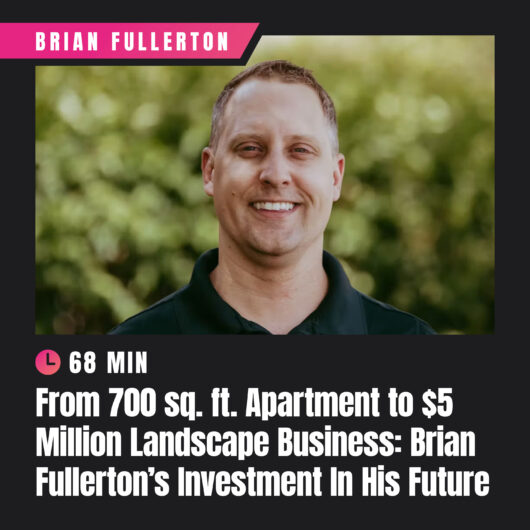
From 700 sq. ft. Apartment to $5 Million Landscape Business: Brian Fullerton’s Investment In His Future
To be a guest on the show, email podcast@postcardmania.com
Listen and watch on your favorite podcast applications.




Episode Overview
Host Chris Foster talks with Brian Fullerton, founder of Brian’s Lawn Maintenance and the Lawn Entrepreneur Academy, about turning a childhood grass-cutting hustle into a growing landscape business, building real belief before real revenue, and creating a roadmap so his employees — and his own kids — have something bigger to grow into.
Podcast
Episode Transcript
Here’s the transcription below of today’s episode, a conversation between host Chris Foster and Brian Fullerton, founder of Brian’s Lawn Maintenance and the Lawn Entrepreneur Academy, about turning a childhood grass-cutting hustle into a growing landscape business, building real belief before real revenue, and creating a roadmap so his employees — and his own kids — have something bigger to grow into.
Note: This transcription has been formatted from the original episode transcript for readability.
Transcript
Chris: Well, all right — Brian Fullerton, welcome in to the Everywhere Small Business Podcast.
Brian: Hey, thanks for having me, brother. Excited to be here — this is gonna be great.
Chris: It’s gonna be great. Tell us a little about yourself and your business before we get started.
Brian: Yeah, really simply — I run a company up here in the southeast Michigan market called Brian’s Lawn Maintenance. We do everything from lawn to snow, a little soft-scaping, a little landscaping — no design-build or anything like that, mostly maintenance and snow. We’ve been doing this for over twenty years, believe it or not. It’s been a crazy journey.
Chris: That’s fantastic. And one of the things we’ll get into is that Brian does more than maintenance — he’s onto the education piece too, we’ll get to that later. But Brian, could you tell us the origin story? How old were you when you started the business, and where did that decision come from?
Brian: Yeah, I’ll give you the unabridged version. I go all the way back to ten years old, cutting grass as a neighborhood kid just looking to make some extra money. I literally grew up in a double-wide trailer — it wasn’t quite 8 Mile, but it wasn’t much better. Single mom, three kids, no nice things, no money — hand-me-downs, shoes with holes in them, the whole deal.
Along the way I wanted to make more money — MTV was a big deal back then, and I saw some of that lifestyle and thought, I want more. My mom said, you’ve got to go work for it. I remembered one of the guys in the trailer park who used to cut grass with a little walk-behind commercial mower, out there making some money, and I thought, well, I can cut grass — I can go do that.
So I mowed my mom’s lawn, then a couple of neighbors’ lawns. I was probably ten, twelve, thirteen years old, and I had some good coin in my pocket — spent it on five-dollar foot-long Subway sandwiches, which was huge in the nineties, and fireworks, because I’m a toddler at heart who loves some good fireworks.
I did that for a couple of years, making a couple hundred bucks a weekend cutting grass and doing driveways with snowblowers on school snow days. At sixteen, there was a fork in the road — my mom said, you need to go get a real job, go work somewhere and climb the ladder. So I went and worked at a Little Caesars franchise, a corporate store. I started as a crew member, moved to assistant manager, then crew lead, and then actually became a store manager. I was about eighteen, making around forty grand a year, running a million-dollar P&L for that store. It was fun, it was fast food, and frankly it was all I knew.
Along the way I got let go from that job. I was twenty years old, the sky was falling, and I didn’t know what to do with my life. Back in the throwback days of Monster.com, I typed in “manager” and found a listing for a company called ServiceMaster with a route manager position open — sounded great, sounded glorious. What I didn’t know was that it was a fertilizer company, TruGreen, and the job was managing a route in a tanker truck spraying fertilizer. Massive lifestyle and culture shock — nights and weekends. All I really heard the guy say was, we’re starting at twelve dollars an hour, so I was interested. Five a.m. the next morning, I’m in a tanker truck doing spray training with another guy, no idea what I’m doing or what just happened to my life. Major pivot. I did that for about a year and a half, and I didn’t hate it — I actually learned a lot about sales, revenue, production, and running a route.
But along the way I knew it wasn’t going to be for me long term — I was more creative, more entrepreneurial. And funny how these things happen, but I call it my Baywatch moment. I was about to turn on the pump on the fertilizer truck to go spray a lawn — ninety degrees out, I’m in full pants, full shirt, rubber gloves, goggles, full PPE, about to go spray stinky, sticky fertilizer. Across the street, two guys about twenty years old pull up with a truck and trailer, drop the ramp, crack a Gatorade, and start cutting grass — mow, trim, edge, blow, done — and made fifty bucks. And I thought, one of us is an idiot, and it’s not them.
I don’t remember if it was that day or that week, but I thought, I used to cut grass as a kid, how hard could it be? That was the understatement of the century. Not long after, I went to my local dealer, bought a zero-turn mower, and bought a little utility trailer from Tractor Supply. My younger brother was a freshman at Michigan State at the time, which meant he couldn’t have a vehicle on campus — so I commandeered his Dodge Durango, and Brian’s Lawn Maintenance was born.
I started cutting grass, and for about a decade it was what I call the dark ages — just a single guy mowing grass, doing the deal. Then in 2014 I met and married my wife — about a two-year dating and engagement period. Around that time I realized we were completely broke as a joke, and she started talking about wanting a house, kids, a car — I always joke she wanted a car that turns off when you pull the key out, real luxury stuff. So I decided to double down on the business — what I call Brian’s Lawn Maintenance 2.0, where I really started trying to grow a real business. Around the same time I got on YouTube totally by accident and started sharing content, and those became two parallel paths over the last decade: growing the company, and documenting who we are and what we’re doing on social media. It’s been a fun, crazy journey. And really, the last eighteen to twenty-four months, I’d call it Brian’s Lawn Maintenance 3.0 — we’ve decided to really grow and scale, with a big target of a five-million-dollar regional business, multiple crews, overhead with admins and salespeople, the whole deal. We’re building out that business model right now.
Chris: Well, that’s not word vomit — that’s a beautiful origin story, Brian. There’s a lot to unpack there, personally and professionally. Interestingly, your younger brother goes off to Michigan State and you take a totally different entrepreneurial path. You must have learned something even at Little Caesars, because you ended up a shift supervisor, then a crew lead, suddenly managing people, in and out on the clock, dealing with personalities — and then you’re managing a million-dollar franchise, P&L, operations, sales. At a pretty tender age you started absorbing that business acumen. Did that come naturally, was it hard, or did you think, this is my jam, this is what I do?
Brian: It absolutely did not come naturally to me — no way. Personality-wise, believe it or not, I’m an introvert. I’m not a people person. I’m decent with math, but I don’t enjoy accounting or finance — that wasn’t my bread and butter. I liked the idea of customer service and sales more, and maybe operations from there.
I think I did strive there, but the cool part was, even where I was weak, the franchise and corporate systems were strong — they had metrics to hit, controllable and variable costs, parameters. The idea was that a nineteen-year-old kid could run a business like that, so thankfully I didn’t have to worry about all those challenges day to day.
What was more difficult was managing people. I had a team of thirty under me at the store, and the oldest person there was twenty-three — a ragtag army making pizza dough, slinging pizzas, washing dishes, selling breadsticks. Looking back, it was absurd. The turnover in fast food — I don’t think any of it came naturally, it was fight or flight, you have to learn, and I’m sure I was a square peg in a round hole plenty of times. But I always tried to approach things with the golden rule, be easy to work for, find great talent, build a fun culture — that whole “if you love what you do, you never work a day in your life” idea. Life is already crazy and high-pressure enough, I don’t need to add to it, and I don’t want anybody adding to it on top of me either.
Chris: Of course. What’s interesting to me is that you mention being an introvert, which is intriguing given your approach to social media. I also think there are times when the business owner grows as the business grows, and the business grows as the owner grows — it becomes almost its own entity, feeding you and you feeding it, telling you, hey Brian, if we’re going to get to the next level of revenue, you’re going to have to do this. So you start with Brian’s Lawn Care 1.0, same old same old, and then something shifts — probably some pressure at home, right? It stops being just Brian’s business and starts being a family business, we’re all in this as a family.
Brian: Well, I met my wife, married her — for anybody out there who’s still single, we doubled the people, but somehow our expenses tripled, Chris, I don’t know how you square that one, but the pressure to make more money was very real.
Chris: Welcome to life. Of course. So with that pressure to make more money — mentally, before that happened, were you planning to really scale and grow, or were you just operating like, this is fine, I’m good as is?
Brian: Good question. I think the next transition, when I met, got engaged to, and married my wife, the conversation was that she wanted to be a stay-at-home mom. We wanted to buy our first home — we were already about thirty at that point, she was twenty-six. As big as I saw it at the time was, I can replace your income and give you that opportunity to be a stay-at-home mom, which was one of her big dreams. I wouldn’t say the goal was to grow to a multi-million-dollar operation. I think running a good business in the blue-collar space, taking home call it sixty grand salary, maybe a hundred grand total after distributions and profit share, is a really healthy building block for a lot of folks in America — it opened a lot of doors for our family.
But the real catalyst, without getting too deep, was that I was personally sick and tired of feeling like I’d lied to my wife at the altar. I’d sold her a bill of goods, a dream, and here we were two years into marriage, living in a seven-hundred-square-foot apartment on the third floor because we thought that was awesome — didn’t realize it’d be ninety degrees up there. We had no money, we were driving beater cars, as real and practical as anyone out there getting their life going. Organic food wasn’t even a possibility in the budget. I remember, my wife and I still talk about this — we were in the pasta aisle looking at canned spaghetti sauce, debating whether we could afford the ninety-nine-cent store brand versus the dollar-seventy-nine Ragu. It’s embarrassing, it’s a wild story, but it’s the truth. So the conversation to grow was definitely rooted in trying to ease some of those financial burdens, but also, dude, I was turning thirty — it was time to grow up, time to either get a real job or make something of this business. I didn’t know what I didn’t know, and that started another journey of leveling up as an individual and as a leader.
Chris: That’s a beautiful growing-up story. I think a lot of folks don’t know what’s important to them until they have to decide what’s important to them. For you, deciding you had a wife now, that you actually wanted to start a family — the seven-hundred-square-foot apartment just wasn’t going to do it. What’s interesting is your choice was to double down on this business you maybe hadn’t fully nurtured yet. That’s different from running a business versus owning a business — you can run a business you don’t really feel like you own in your heart. It seems like this was the moment you put the business into your heart, and suddenly it becomes this living, breathing thing you have to nurture and take care of.
Brian: Yeah, I think that’s a fair analogy. Mentally, where I was at, this was Brian’s side hustle — what he does to make tall grass short, thirty, forty, fifty grand a year. It wasn’t a real business. I didn’t know any glossary terms of business, didn’t understand budgeting, let alone how to price accurately. I had one or two team members who’d come and go, extra buddies, college or high school kids. It wasn’t a tangible business — at best I was owning a job. There’s nothing wrong with that, it was a fine season for that decade, it fit the mold. But there was a maturation that needed to happen. I had to learn to lead myself first, so I could lead the company I knew I wanted to grow into.
That’s the parallel path — leveling up what I’d call Brian’s Lawn 2.0, and also getting on social media in 2016. There wasn’t some big mission to grow a YouTube channel, go viral, build a personal brand, get famous or rich — nothing like that. It was just me putting up a video reviewing a mower I was about to trade in.
Actually, to back up a little — my wife wanted to be a stay-at-home mom, and I told her, sure, but we have to figure out how to make some extra money or replace your income. She was working in audiology making about fourteen dollars an hour, and as a red-blooded male I wasn’t about to let that paycheck go easily — I said, you’re probably the breadwinner right now, honestly. So I told her, why don’t you do a YouTube channel — skincare, makeup, a tutorial channel? I bought her an eight-hundred-dollar camera at Best Buy, the little video creator kit. She jokingly hauled off and did nothing with it, afraid of what people would think — that Christmas present sat under the tree until February, because we’re the kind of weirdos who leave the tree up way longer than we should. I asked if I could use the camera to record a video, she said sure, she didn’t care. Honestly, I have no idea how that video even got to YouTube, I don’t even think I edited it — it’s still the very first video on the channel today, a 360 walkaround trading in a mower. It got two views.
Somebody left a comment: I appreciate the review, there’s another mower in the background, can you review that one too? I said sure. Long story short, one view turned into two, one subscriber turned into two, two into three, three into four. It’s not like today on TikTok where a decent video and a lucky algorithm gets you ten thousand followers overnight — I didn’t have a viral video until about six months ago, and we’re talking ten and a half years into social media at that point.
Chris: Right — and just for our listeners, if you Google “Brian’s Lawn Maintenance,” one of the first links is the YouTube channel. You’ve got two hundred fifty thousand subscribers, and a video with over 1.1 million views — the extreme mower testing one, it’s awesome.
Brian: Yeah.
Chris: I want to lean into this, because you mentioned this 2.0 version of Brian Fullerton — it’s kind of like Spider-Man, where Peter Parker and Spider-Man blend, and suddenly Brian Fullerton and Brian’s Lawn Maintenance blend into a single entity, because as you do the education on YouTube and document your growth, your business starts growing too. One of my favorite videos is the first one that pops up — how to price lawn mowing jobs accurately every time, you in front of a whiteboard in your garage, over fifty-six thousand views. What I love, and what I want you to talk about next, is that suddenly you’re not just running the business, you’re running an education arm of it for other lawn care folks ready to make that next step. Was that a deliberate design, or did it just happen?
Brian: No, Chris — looking back it looks like flawless victory, but I promise you it wasn’t the case. I really do feel like I’ve been blessed in this journey. You said something critical a minute ago that I want to revisit: as I continued to pay attention to things, things started to grow, and as things grew, I paid more attention to things. I couldn’t say it better myself.
As I documented my earlier days on the channel, around 2016 to 2018, a lot of the same questions, growth, pain points, and challenges — procuring equipment, hiring team members, losing team members, the regular rigmarole of growing a business — kept coming up. A lot of the folks watching were dealing with the exact same things, whether they were in Tennessee, Kansas City, Pennsylvania, Michigan, California, or Florida. Most, maybe ninety percent, were in maintenance, landscaping, and snow, but we’d also get golf course superintendents wanting to know about the best equipment, or people asking about business fundamentals like pricing or optimizing routes with route density — even electricians and plumbers, because a lot of those principles cross over into any service business.
So to answer your question — I was just documenting my journey, and still am today, and a lot of people wanted to follow along. And Chris, to be completely transparent, it’s a humbling experience. Here’s what I always say: if you had the ability to document your life and John Q. Public got to weigh in on every decision you make, every piece of thought process you share publicly, how much differently do you think your life could look in five or ten years, with a million people weighing in on you every month?
Chris: A lot different — because it gets very personal when you put it that way. What I love about small business, and I’ve said this before and I’ll probably sound like a broken record, is that small businesses are family businesses, and family businesses are small businesses. You can’t separate the family from the business.
Brian: Nope — right there, we’ve got it on our logo, family owned.
Chris: That’s right, on your shirt too. We’re a family business at PostcardMania as well, a small business too. When there’s no separation between family and business, every decision becomes personal, and there’s really no personal decision that isn’t a business one too. If you decide to have kids, that’s a business decision, because suddenly you’ve got a family to feed instead of one or two people — of course it affects the business. I think documenting your journey the way you have is brave, brilliant, and honest — it’s the classic hero’s journey: you go into the wilderness and come back to the tribe to tell them what you learned. This mower stinks. Hiring people is really hard. I can’t express the value of a devoted, loyal employee. Those are the things you get to share. And one of the things I love that you’ve built — folks, check out Brian’s Lawn Entrepreneur Academy. What a name.
Brian: Yeah, we’ve hemmed it all up along the way, brother — you’ve got to press in on some of these stereotypes. My media company is called Motivated Media, and I was at the bank one day and the teller just lost it laughing — you have a lawn care business and your media company is named Motivated? She thought it was so clever. We’re nerds through and through.
One thing I did want to share — another critical part of the hero’s journey is having the wise mentor or sage who helps you along the way. There were definitely people who poured into my life. I had some early mentors around 2016, 2017 who completely changed how I looked at business — one gentleman named Mike helped me get to about 2021, 2022, and then a friend named Mark came into my life, who’s one of my current mentors today. I don’t subscribe to the idea of the self-made man or self-made person — you can put in the work and kick butt, but I’m not here to reinvent the wheel. As you grow and scale a business, most of the time you just don’t know what you don’t know, and thank God for the people who came into my life at the right time — when the student is ready, the mentor appears. I’m a sum of the industry I represent and the community I’m part of, and what we’ve built from us down.
I don’t want to be thirty minutes into a podcast making it sound like we’ve got it all figured out, or that we’ve arrived, or that we’re perfect — I don’t think we try to present that in our content either. But I’ll tell you, growing a business can be lonely, there’s a lot of fear and doubt and trepidation, and I’d just tell people, there’s a community out there — PostcardMania has one for small business owners, and we’re trying to grow ours too for what we call lawn entrepreneurs. Don’t feel like you have to figure it all out on your own. The more questions you ask, the more curious you are, the more you’ll shorten timelines that took me years into weeks or months.
Chris: I love that advice. It’s a common thread — another guy I talked to said it can be really lonely being the CEO of a startup or an entrepreneur, and seeking other people out is really important. Someone I talked to yesterday who runs a soft-wash business told me he reaches out to his own affluent clients for advice — hey, I’m a nineteen-year-old entrepreneur, can you help me out — and people are willing to help. It takes a community, and the great thing about the small business community is we’re all here to help each other, because if we help each other grow, our communities get stronger. With lawn care especially, you can share the education freely, because a lawn care business in Murfreesboro, Tennessee, isn’t competing with one in Pittsburgh — they can learn from the same group. So for folks listening, just Google the Lawn Entrepreneur Academy — it’s packed with education, information, seminars, and collective growth. You’ve become someone pulling that community together so the whole industry can grow, because a rising tide lifts all the boats. What are you learning from these other entrepreneurs you’re meeting? What are they giving back to you?
Brian: Good question. What I’ll tell you is that a lot of what people bring to me has helped me empathize with where people are at in life — and I say life specifically, not business, going back to that holistic view you mentioned about family integrating into business and business into family. It’s multifaceted — how we treat our spouses, how we show up for our community and church, how we’re sons to our moms and dads, fathers to our kids, how we show up physically, how we show up with our attitude day to day. There’s this holistic thing happening around becoming better people, and yes, I hope to inspire a million people to change their stars — that’s my mission. I don’t think there’s a better vehicle for the average person to do that than a blue-collar business. Pick your trade — I just happen to know the green industry.
A lot of people have confided in me that life is tough, that there’s a lot of financial pressure. I feel personally called to help simplify finances and financial literacy for people. Other folks might be great at leading people or operations — those aren’t exactly my strengths, though I’ve rounded some corners and I put people on my team who can carry those parts of the business. But I really like talking about financial literacy, financial IQ, and how pricing and scaling work relates back to personal finances. What people have taught me is that a lot of us deal with the same struggles, and it’s not always sunshine and rainbows — not everybody is growing a three-million-dollar company netting twenty-one percent and taking home four hundred thousand. It’s honestly a little alarming how much small businesses struggle.
I think that’s where the education gap comes in, and it’s why I’m so passionate about this mission, and why you all are doing what you’re doing too. I don’t want to oversimplify it — some of these changes take twelve, eighteen, twenty-four, thirty-six months to enact — but when you make them, you can fix businesses that are struggling unnecessarily.
It really comes down to, you don’t know what you don’t know. Somebody told me once, it’s not what you know, it’s who you know, and I thought, well, I don’t know anything and I don’t know anybody, so I’m screwed. I was nineteen, I really didn’t know anyone. But I decided, if my wealth is going to be predicated on people who know me, I’m going to become somebody people want to know. And solving those financial problems wasn’t so much about operations or sales and pricing — we just weren’t talking to enough people.
My personality type is introvert, but I’ve had to, by design, realize over the last fifteen years that that’s not something to hang my hat on and hide behind — you can say “I’m not a people person” at eighteen, twenty, maybe twenty-five, but eventually, if you want to hit your dreams and goals, you have to grow up. I couldn’t rest my narrative on my feelings or how I wanted to project myself — I had to change, and honestly, it sucked. I didn’t want to learn how to remember people’s names, make eye contact, work a room or a one-on-one conversation. I’ve made a lot of strides, I’m not perfect, I’m still growing in those areas.
But I had to get over myself. What I realized was that my biggest growth, in business and in personal development, came when I started to understand the why behind what I was doing — and that stemmed from the who. I didn’t want my wife to feel like she’d married a loser. She never put that pressure on me, never gave an ultimatum, but I wanted to become the person she thought she was marrying — because that lady deserves the best. And my kids, that I didn’t even have yet — it’s not that I was anti-kids, I just never let myself imagine being a good dad, because I didn’t have one. Now I’ve got a five-year-old, a three-year-old, and a one-year-old, and I’m trying to be the dad I never had, the example I hope they need. I had to grow up, I had to figure that out over the last five, ten years, and it’s been exhausting and challenging. I don’t want to make it sound like it’s all about starting a business and getting rich — there is a financial blessing to being in business, making a profit, taking care of your team and your customers the best way you can — but I think a lot of folks are more hesitant to work on themselves than they are on the business.
Chris: That’s a wonderful insight, Brian, because the core of how we go about life drives all our decisions. When you talk about the why and then the who — like I said earlier, you put the business into your heart, but really it was your wife you put into your heart first, and you realized you were working for something bigger than yourself. When I first became a parent, I realized my life was never fully my own again — it’s these other people, this whole family, and then when your business gets wrapped up in it too, the survival and growth of your family depends on your own growth as a person. And now with a whole family business, your kids have an expectation of who you are — everybody knows you, you’re Brian Fullerton, you’re kind of famous. You don’t have to live up to any of that, it’s just business, but seeing your life differently, talking to a mentor who helped you think about business differently, suddenly there’s this belief that you can actually become the man you wanted to be, instead of it being out of reach — and that belief becomes the impetus to get moving and act, because you’ve got that purpose, that why, driving you there.
Brian: Chris, this is good stuff. What you just explained is why coaches and mentors are so important — I believe that to do what you just described, you have to have belief, and if you don’t have it yet, you can borrow somebody else’s belief until you manifest your own. That’s what those mentors did for me — they believed in me until I started believing in myself. Once you start hitting a few notches on the belt, whether that’s revenue, crews, or other accomplishments, you get that flywheel going, that flow state, and that’s where the self-perpetuating belief kicks in — call it believing your own hype, that’s fine, but if your wood’s wet, you have to dry it out first, borrow somebody else’s belief, and then keep your own belief going.
I don’t know if I’ve ever shared this on a podcast, but I heard a guy say something once that stuck with me — do you mind if I share it?
Chris: Of course, please do — this is your story.
Brian: Something that’s driven me a lot the last five or six years, since we found out we were having kids, is that I don’t want my kids, at twelve or fifteen or twenty or twenty-five, going through a tough challenge in their personal or professional life and asking Dad what to do, and me having to say, I’m not sure, honey, because I quit. I don’t want them to ever be able to say, well, Dad, you can’t tell me not to quit, you did. I don’t want them to have that excuse in marriage or business or their career. I want them to be able to say, Dad, it was tough, but you never gave up — what got you through? That’s an entirely different conversation with my kids at fifteen, twenty, twenty-five. That might not drive everybody, but it drives me. At least I know I’ve got my name and my word, and if I give it to somebody, I’m going to see it through. On my own, probably not — but with a team of people, absolutely. That’s something that gets me fired up, brother.
Chris: I love that — not only a team of people, but a family too. And you just said that for your kids, that will help them in their career, in school, in life. It’s a cliché, but they call them clichés for a reason — Rocky Balboa says nothing’s going to hit you as hard as life, the question is whether you get up. It doesn’t matter how hard or how often you get hit, it matters how often you get back up. That’s a mindset that translates into action, but the mindset has to come first. I think it’s cool that you talked about borrowed belief — sometimes it takes somebody else believing in you for you to see something in yourself you didn’t see before. I don’t want to touch a soft spot, Brian, but growing up in a double-wide trailer, you didn’t see a lot of high accomplishment around you.
Brian: No, quite the opposite, honestly — and there’s this imposter syndrome of, who do you think you are, Chris, to change your stars? Who do you think you are to believe you can do this? Don’t you know your last name, don’t you know we only do X, Y, Z, that we never graduated college, what makes you think you can? I never had anybody telling me what I couldn’t be, but I also never had anybody telling me what I could be, and I don’t know which is worse — at least if somebody tells you that you can’t, you can prove them wrong. When nobody says anything at all, the only thing speaking into you is your own thoughts, and idleness is the devil’s playground, as they say — most of us, left to our own untrained thoughts, are probably going to tear ourselves down rather than build ourselves up. I know that was my case.
When I go back into that same trailer park today to visit my mom — she’s not leaving, that’s home, I can’t bear to leave her there — every time I walk in, I pray and say, there but for the grace of God go I, because I know that thought process, I know how those folks think. There’s no better or worse in it, no indictment — honestly, some of those folks are happier than most people in million-dollar homes. But I know that thought process broadly, because I came from there. It’s not guesswork or theory — I know exactly what I had to do to get myself out of there and up a tax bracket or two. And I’m telling you, if I can do it, you guys can do it too. You do have to have that belief in yourself that you can do the thing you set out to do.
And I don’t mean that as some rah-rah, egotistical chant — frankly, most of that is garbage, and I’ve seen a lot of loud people accomplish the least. I didn’t need that, being an introvert — I just needed somebody to tell me what to do, give me the education, give me the roadmap, and I’d go do it. I didn’t need to go to a seminar and chant something, I didn’t need to announce it on Instagram and Facebook. Most of the time, by the time the world noticed anything it would call success, I was already two or three years ahead of that mentally. And you start realizing, like you said, Chris, when you have kids, everything changes — what you thought was important stops mattering, and things you never even thought about become massively important. For me, my goal became growing a great big business — not because I suddenly wanted more, but because I wanted my wife and kids financially stable and set for life, with real permanent income, enough term life insurance, and enough layers of leadership between me and the front line that I’d never have to go back into the field, so the business could keep growing without me. That’s not done yet — people ask why I work so hard, tell me I deserve a day off, and I feel guilty taking a thirty-minute cat nap. We’ve got work to do.
Chris: We’ve got a lot to do. I love that aspiration to build a big, brilliant business — I loved being a guest on your podcast, that was a joy. You talked about how some people say stay small, keep it all, and others say grow something, and we leaned into how a business owner who wants to feed and protect the tribe, bring people on, suddenly has more responsibility, especially on the marketing side — you can’t complain about not getting raises if you never grew the business because you didn’t want to invest in marketing. I checked out your website — you’ve got two job openings, crew lead, which is great, but my favorite is apprentice. I think apprentice is such a beautiful, needed position for today’s young men and women looking for a way in. Tell me about that moment when you started hiring people, your first hire, and your philosophy on bringing people onto your team.
Brian: Well, I think it’s a responsibility. Before you even hire somebody, you need to realize what you’re subscribing to and what you’re offering them — they’re going to build a financial budget around what you pay them, car payments, an apartment, maybe a mortgage, depending on the role. It’s not something you should engage in flippantly. And it’s even worse when people say, I can’t keep anybody, nobody wants to work anymore — and I think, you sound like the problem, not the people. Maybe nobody wants to work for you because you’re disorganized, because you’re not doing what you said you’d do for them when you hired them.
For me, I like to give folks a roadmap — I’m pretty simple about it. If you put out a job ad for laborer or warehouse worker or shelf stocker, the descriptions out there are terrible. But if you say landscape apprentice or plumbing apprentice, and give them a path to become a journeyman, then a master — every trade’s different, but starts at sixteen or eighteen dollars an hour, then let’s get you to twenty-five, then thirty, then thirty-five — I think people just need that guidance and mentorship, myself included. Nobody laid that roadmap out for me a decade or two ago, and that’s fine, I’m not bitter, life goes on — you can only throw fists at the sky for so long before you have to just go fix the problem.
So what we’ve done in our business, and what I’m trying to influence the industry on, is give people a roadmap for an apprenticeship — crew member, right hand, crew lead, maybe supervisor, ops manager — going from eighteen dollars an hour to seventy-five thousand a year. We’ve got people in our company this year who’ll make seventy grand. My own goal, four or five years ago, was to make sixty or seventy grand out of my business, period — now we’re paying people that much. Talk about a proud-pop moment.
There’s a lot of statistics on the trades — the replacement rate on blue-collar labor by age group is something like one person replacing every five who retire. If you’re skilled, you’re going to make top dollar over the next two decades because you’ll be in demand — full stop. But if you’re in the industry, you also bear some of the burden to help keep that trade and craft alive. We have to do something about it, and I’ve really only started scratching the surface on that in the last twelve to eighteen months.
When you give people an opportunity to come work for you, you have to give them a roadmap for where they can grow — the old saying goes, if you don’t have a big enough dream for their dream to fit inside of, they’ll leave and go somewhere else. So it’s a bit of a catch-22 — you can stay small and keep it all, that’s fine, but you’ll have a hundred percent of a grape. Or you can grow, do the hard things, build a roadmap, document your process, change and evolve, and end up with a much bigger share of a watermelon while giving your guys room to grow too. That’s the position we found ourselves in about three years ago — we decided to grow, to give our guys the opportunity to keep achieving their own dreams and goals.
Chris: And that was just three years ago — what a remarkable transformation. You mentioned the flywheel earlier, that upward spiral where positive energy begets positive energy until the momentum only builds — it takes twenty years to become an overnight success.
Brian: That’s that exponential growth — unfortunately, most people quit in the first year, two years, five years, even ten. A lot of my story was self-inflicted, honestly — what took me a decade should have taken some of you twelve to eighteen months. And what’s even crazier is getting around the younger crowd now, seventeen to twenty-two year olds who have half-a-million-dollar businesses while they’re still in high school or their dorm rooms, equipment parked in their parents’ garages, netting a hundred grand off half a million in revenue. I didn’t do that until I was thirty-five. But that’s the sign of a great leader — somebody whose successors end up with as much or more success than the person who taught them. That’s a humbling middle to be in — we’re not at the top, not at the bottom, somewhere in the middle, and I think that’s just great leadership: look two steps back, offer a hand up the ladder, don’t pull the ladder up behind you like corporate America does, leave it there, help your friend, your peer, your neighbor — and that goes full circle to building stronger communities.
Chris: A hundred percent. And I love that you’re in it for the greater good — if the greater good is taken care of, your business is going to be fine, you personally are going to be great. At PostcardMania, we talk about trying to help a million small businesses grow through education, marketing, and technology. You’re specifically trying to help lawn care business owners grow so they can learn from what you learned and shorten that timeline — I think that’s brilliant. We absolutely have to have another conversation about people, marketing, operations, but this has been a fantastic conversation, and I want to wrap it up with a final pearl for new entrepreneurs. Let’s say there’s a guy — we’ll make him up, call him Charlie Bagaman, twenty-two years old, didn’t go to college, didn’t want the military, been working odd jobs, mowed some lawns before, and thinks, I want to be my own business, I can do this — he’s outside of Macon, Georgia. If he was standing right in front of you asking, Brian, how do I get from where I am to where you are, what would you tell him?
Brian: I think there’s really only a couple of things I’d share. My biggest life tip would be: figure out the way you want to live, then work backwards. Figure out the lifestyle you want, then work the math backwards. If you want to fly private, have a two-million-dollar lake home and a four-million-dollar main home, drive Bentleys and Rolls-Royces, that’s awesome — I can’t teach you how to do that personally, I haven’t accomplished it, but I can give you the theory and the math. You might need to run a fifty-million-dollar company at ten percent net, twenty percent EBITDA, to come back with five million take-home, three and a half after taxes, and be able to carry mortgages on those homes and fly private a few times a year. Or if you want a nice three-two colonial, a wife at home, one Suburban and a nice little Lexus, and you’d rather not be self-employed, that’s awesome too — you’ll probably need to make a hundred to a hundred-twenty grand a year in a leadership-type role after learning a technical skill, maybe an engineering manager. That lifestyle can be paid for with that income.
Too often the question gets asked the wrong way — what do you want to do when you grow up, what do you want to be. I think a better question is, what way do you want to live? If you can answer that and work the math backwards, you can build blocks of assets, not just income, that end up paying for that lifestyle. I know it works because that’s all I’ve done for the last decade — my wife and I just built a custom home the last couple of years, and it was no guess what the mortgage would be, because I’d figured that out seven years earlier. I just had to build a business and an income off that business that could cover the down payment and the monthly mortgage. And I’m not college-educated, I don’t have an MBA or a PhD, I’m not in a C-suite — I’m a guy who cuts grass and plows snow for a living. If I can figure out how much the lifestyle I want costs and build a business that generates that income, almost anybody can.
The other thing I’d say, besides figuring out the life you want and working backwards, is that almost everything comes down to belief — not hope, not faith, but belief, though there’s an evolution from hope to faith to belief that’s a whole other conversation. Eventually you have to believe you can do it, that you can change your stars, and recognize that the cavalry isn’t coming. I wish there was an easy button on my desk, and hitting it got me a trust fund — people talk all day on social media about generational wealth, mommy and daddy left me this — and if somebody asks if I’m a trust fund kid, I say sure am, my mom and dad trusted me to fund my own future. There’s nothing sitting here waiting for me, and that’s no indictment on anybody — honestly, I’d love to hit that easy button, ten million dollars tomorrow, and so would you. But that’s not going to make you a bigger, better person, it’s not going to make me grow up and figure out how to play the great game of business or be a better spouse. You can buy away a lot of your problems, but you can’t buy your character — you can’t get fit watching somebody else work out. I wanted a real testimony from actually going through it, so I could relate to the people around me and to my own kids and community — if I can do it, you can do it. There’s no greater game to play than changing your own stars and then turning around and teaching, encouraging somebody else to do the same. So: figure out the way you want to live and work backwards, and figure out how to get and keep belief. As the saying goes, success is nothing more than going from failure to failure without the loss of enthusiasm — that’s my life story, brother. It’s not like we haven’t gotten kicked, gotten beat down, gotten punched in the face — sometimes more than felt fair. But you can’t keep a winner from winning, and you can’t keep a quitter from quitting. I’m going to get back up and go charge the hill on one of the noblest quests available to us today — succeeding in America. We need more people succeeding in America, brother.
Chris: I love it. To your success, and to America’s small businesses’ success — nobody could say it better than you, Brian. We absolutely have to have another conversation, you’re fantastic, and I wish you all the best. Congratulations on the growth of your business — keep going, don’t stop, can’t stop.
Brian: Thank you, we appreciate it, brother. You guys pray for us, we’ll pray for you, and I’ll see you out there on the highways and byways as you keep growing and succeeding in your own businesses. It’s been an honor to spend a few minutes with you guys today — thank you, Chris.
Chris: You got it. Take care. Bye bye.