What 128 Successful Dental Marketing Campaigns Reveal About Dental Practice Marketing
Posted on October 16, 2026
Key Findings:
- Successful dental campaigns consistently used smiling imagery, clear offers, strong calls to action and easy-to-scan messaging.
- Higher-revenue campaigns were more likely to mail repeatedly, use maps and practice photos, include reviews and pair direct mail with digital marketing.
- Longer-running campaigns generated nearly 6x higher median revenue than campaigns lasting one month or less.
- The strongest results came from treating marketing as an ongoing investment, not an occasional fix.
There is no shortage of dental marketing strategies available today. Dentists and practice managers have every ad type and tactic available to attract new patients — search ads, paid search, social media, email, SEO, direct mail, and dozens of other dental marketing channels. In fact, marketing for dentists has never been so complicated.
The challenge isn’t just finding dental marketing ideas. It is knowing which ideas actually work.
That is why we decided to look at the data.
PostcardMania may not be a dedicated dental marketing company, but we’ve worked with 7,601 dental practices nationwide since 1998.
We decided to put that experience to use.
Our dedicated Results Department collected and cataloged 128 successful dental marketing campaigns. We reviewed those campaigns to identify the traits they had in common and give dentists and dental marketers a practical, evidence-based starting point for building or improving your dental marketing plan.
Rather than offering another list of generic dental office marketing tips, this analysis reveals:
- How real practices structured campaigns that produced documented results
- What those campaigns emphasized
- Differences between the lowest- and highest-revenue campaigns
The results provide a practical picture of what successful dental campaigns tend to look like.
This analysis was not a controlled experiment, so it cannot prove that one design feature or mailing decision caused a particular result. The available information also varied slightly from campaign to campaign depending on how each practice measured its results and success.
Even given all that:
Several patterns were too strong to ignore.
Here’s what the data revealed about successful dental marketing.
What the data says about the best dental marketing strategies
Methodology: We reviewed each trait using the number of campaigns where that field was actually completed, so the denominator varies slightly by finding. This keeps each percentage tied to the campaigns with usable information rather than forcing every dental marketing statistic to use the same denominator.
1. Bullet points were nearly universal
87% (104 out of 120) of successful campaigns used bullet points.
This was the most common design trait measured. Successful dental postcards generally made information easy to scan rather than presenting services, benefits and offers in dense paragraphs—an important consideration when a household may give a mail piece only a few seconds of initial attention.
Takeaway: Dentists should organize dental postcard copy into short, clearly separated points that can be understood in seconds. Scannability helps patients quickly identify your practice, the offer, and the next step, all of which are key in effective dental practice marketing.
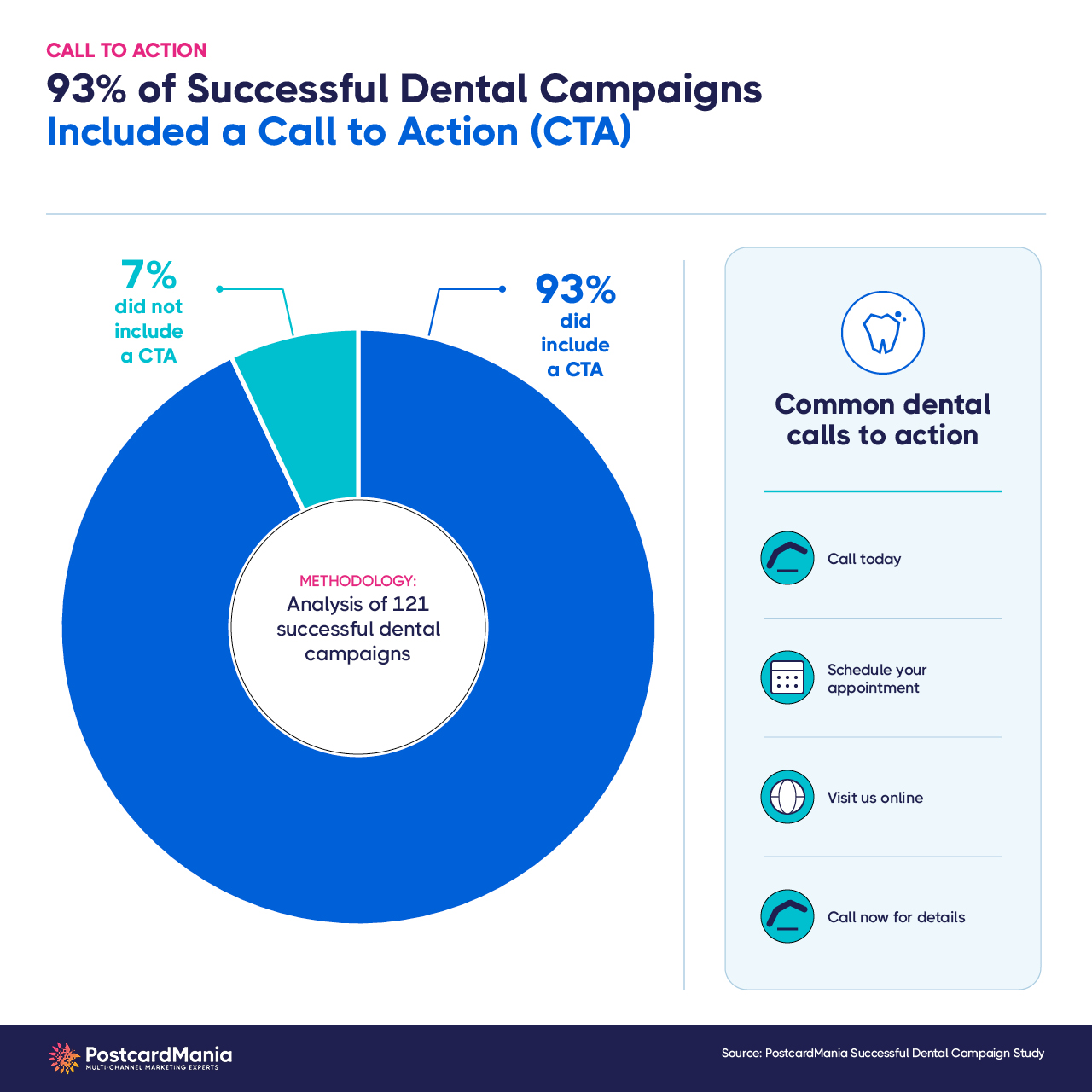
2. Almost every campaign included a clear call to action (CTA)
93% (113 out of 121) included a clear call to action (CTA), such as:
- Call today
- Schedule your appointment
- Visit us online
- Call now for details
Only eight campaigns had no identifiable CTA.
Takeaway: Every dental direct-mail piece should explicitly tell recipients what to do next. Simply listing the practice’s phone number or website is not enough; the call to action should connect the marketing message to a clear action that progress’s the customer journey.
3. Repetition was much more common than one-time mailing
82% (92 out of 112) mailed more than once, while only 18% (20 campaigns) appear to have mailed a single time.
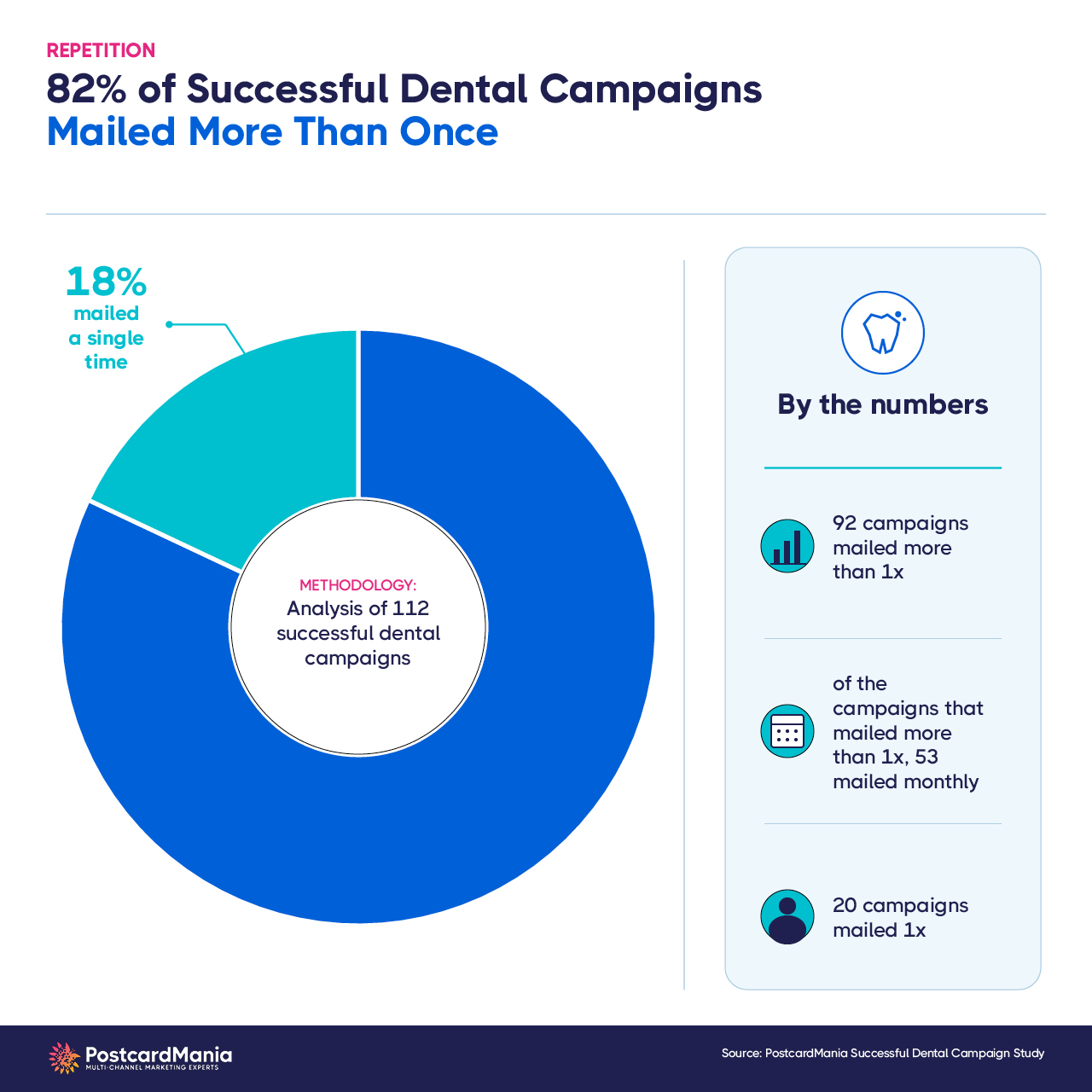
Monthly was the most frequently recorded cadence, appearing in 53 campaigns, including two entries recorded as monthly. Weekly mailing was also common.
Takeaway: Success was much more frequently associated with repeated exposure than a one-and-done postcard drop. Dentists developing a dental marketing plan should budget for a campaign rather than a single mailing and evaluate performance across multiple contacts.
4. Smiling people dominated the main imagery
66% (78 out of 118) featured someone smiling as the main photo.
The most common variations were:
- Smiling family: 24
- Smiling girl: 16
- Smiling people: 7
- Smiling couple: 5
- Smiling families: 4
Takeaway: Successful dental postcards usually illustrated the emotional outcome—a confident, attractive smile—rather than relying on photos of equipment, buildings or dental procedures. This gives prospective patients an immediate picture of the result they want, not simply the treatment being sold.
5. Benefits appeared more often than service lists
74% (88 out of 119) communicated benefits, while 65% (78 out of 120) listed specific services.
This suggests successful campaigns did not merely say, “We offer crowns, implants and whitening.” They also explained what the patient gains, such as convenience, confidence, comfort, affordability, or healthier teeth.
Takeaway: Include dental services, but frame them around the improvement patients want in their lives. Effective dental marketing communicates why the service matters—greater confidence, convenience, comfort, or better oral health.
6. Most successful campaigns presented multiple offers
Among the 120 campaigns with interpretable offer counts:
- 93% (112 out of 120) included at least one offer.
- 68% (82 out of 120) included two or more offers.
- 35% (42 out of 120) included exactly three offers.
- Only 6% (7 out of 120) had no offer.
Three offers was the single most common format.
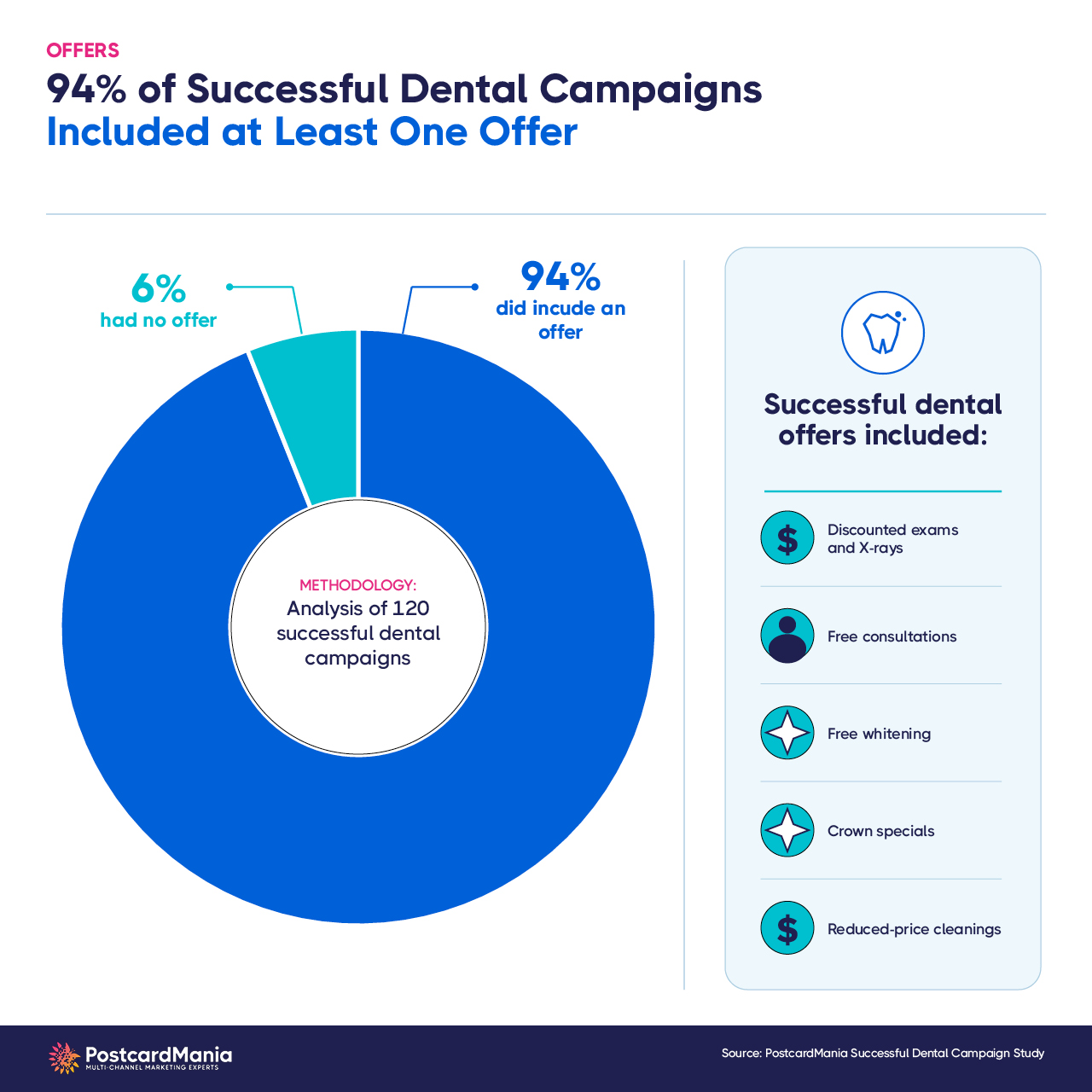
Offers to entice new patients included discounted exams and X-rays, free consultations, free whitening, crown specials, dental implant consultations, and reduced-price cleanings.
Takeaway: A strong primary offer is important, but successful dental postcard marketing frequently gave recipients several reasons to respond. A campaign might combine a low-barrier new-patient offer, a cosmetic incentive, and a higher-value treatment offer, allowing one mail piece to appeal to prospective patients with different needs.
7. Maps appeared in a majority of successful campaigns
59% (70 out of 119) included a map.
This is especially relevant for dentistry because convenience and proximity can strongly influence practice selection. For local dental office marketing, a nearby location can be a meaningful competitive advantage when patients are comparing practices.
Takeaway: A simple map can reinforce that the dental practice is local and easy to reach, particularly when mailing within a defined radius. It turns geographic targeting into a visible benefit for the patient.
8. Practice owners and staff were valuable—but not essential
53% (64 out of 121) included a photo of the owner, dentist or dentists, and staff.
That is effectively an even split, meaning both personal practice photography and polished patient-focused imagery can succeed.
Takeaway: A dentist or team photo may help establish trust, but it should not automatically replace the stronger emotional image of a smiling patient or family. Dental postcard design can use both: patient imagery to communicate the outcome and practice photography to make the office feel credible and familiar.
9. Reviews were useful, but less common than other trust elements
43% (52 out of 120) included a five-star review graphic.
That means reviews appeared in fewer than half of the successful campaigns—well below bullet points, benefits, CTAs, and smiling imagery.
Takeaway: Social proof can strengthen a dental marketing campaign, but it is not a substitute for a strong offer, clear patient benefits, and direct response instructions.
10. The 6-by-8.5-inch format was overwhelmingly dominant
Approximately 71% (89 out of 125) used a 6-by-8.5-inch or very similar postcard format.
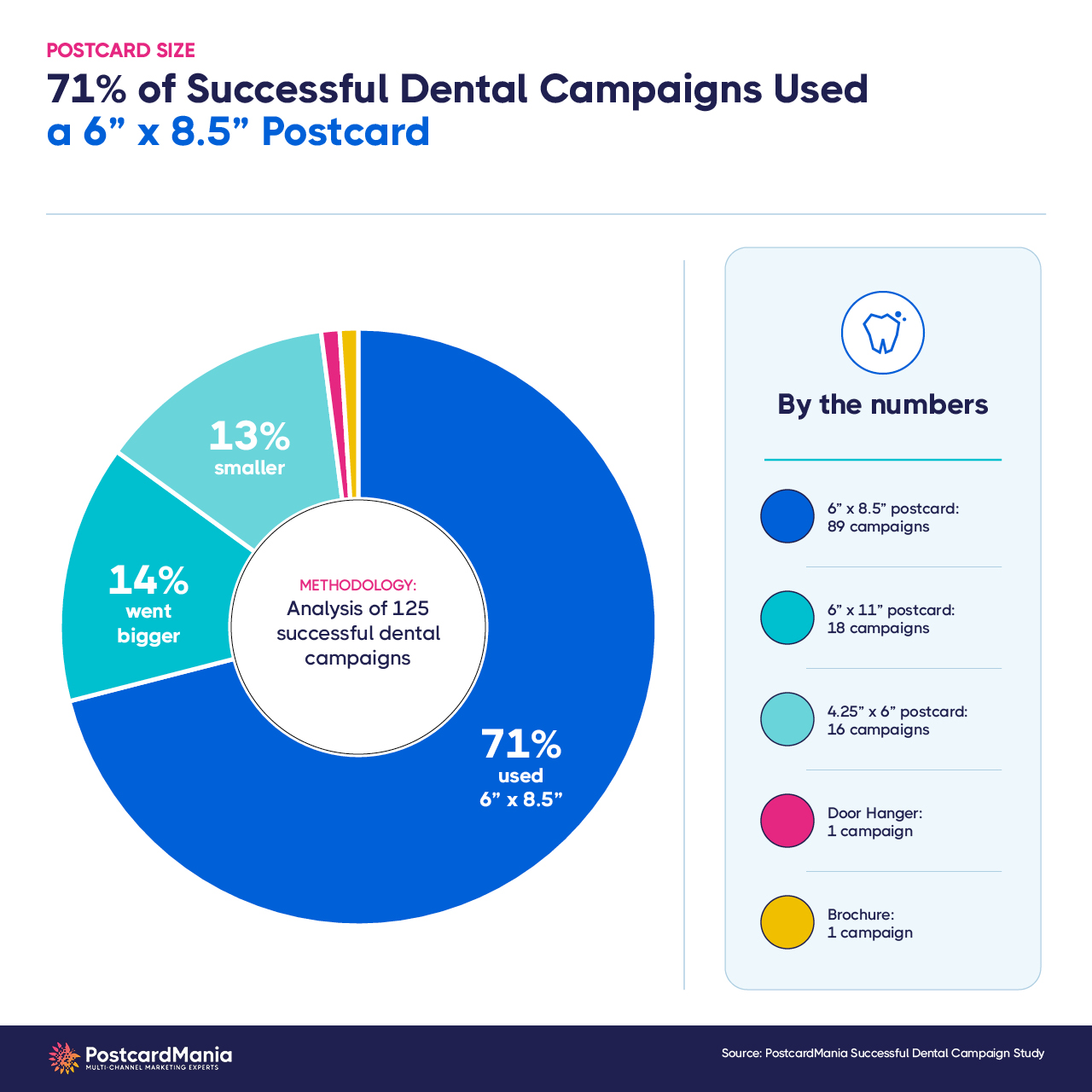
Other formats included:
- 6-by-11-inch: 18 campaigns
- Approximately 4-by-6-inch: 16 campaigns
- Door hanger: 1
- Brochure: 1
Takeaway: The mid-sized 6-by-8.5-inch dental postcard format appears to provide enough room for multiple offers, photos, benefits, service lists, and a map without requiring an oversized mail piece.
11. Location-based targeting just edges and demographic-based targeting
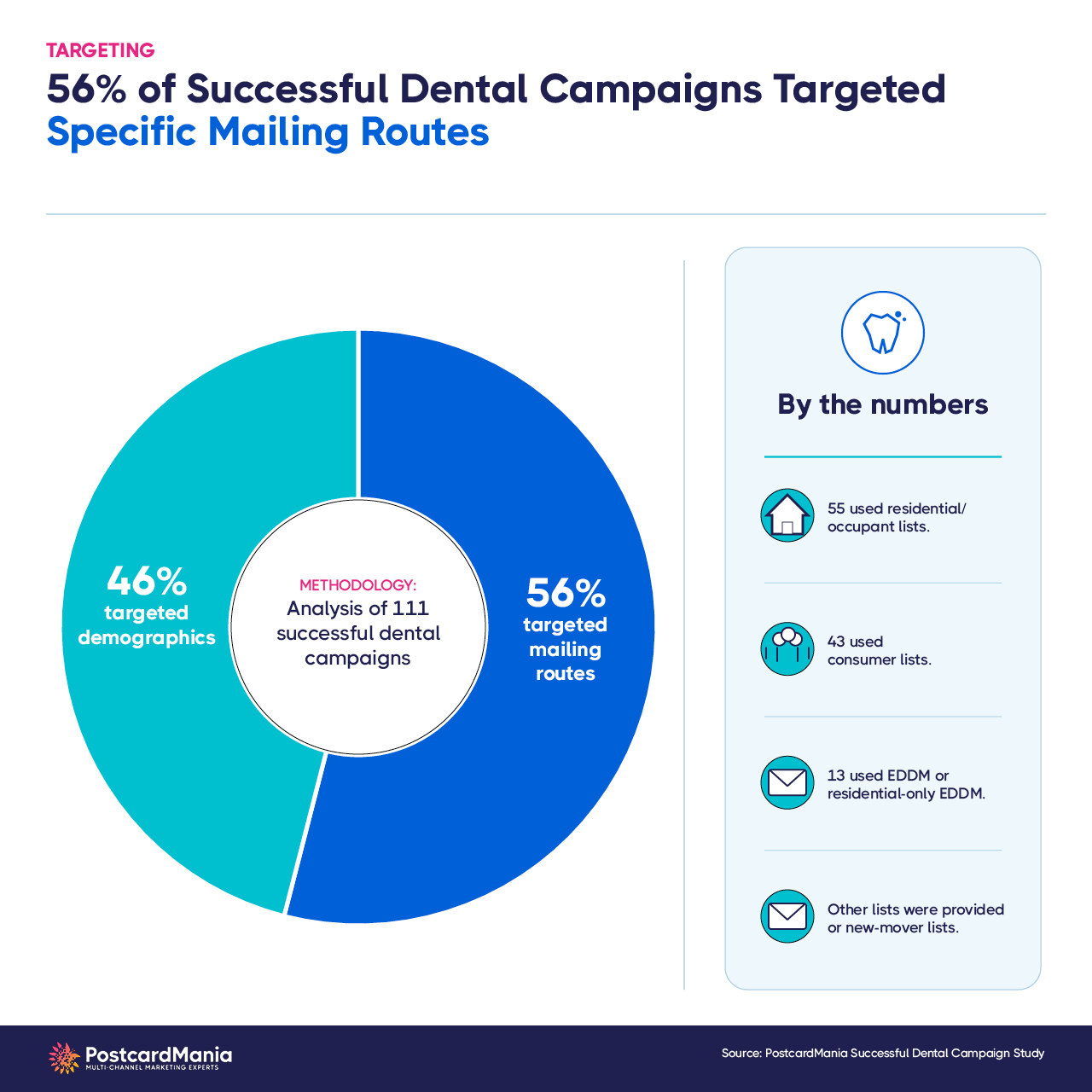
Of the 126 campaigns with a recorded list type:
- 55 used residential/occupant lists.
- 43 used consumer lists.
- 13 used EDDM or residential-only EDDM.
- The remaining campaigns used provided lists, new-mover lists, business lists, or combinations.
Together, standard residential, consumer, and EDDM approaches represented approximately 88% of the campaigns studied.
Within the additional targeting details:
- 46% (55 out of 119) referenced household income.
- 32% (38 out of 119) referenced a geographic radius or proximity.
- 21% (25 out of 119) referenced age.
Takeaway: Geography was foundational, but many successful dental practices refined their audience further using income, age, or household characteristics. The most useful targeting strategy is one that keeps the practice close enough to be convenient while filtering for households that fit the services being promoted.
12. Digital integration was present in only a minority of campaigns — but was more frequent in higher-revenue campaigns
32% (37 out of 116) included digital products alongside the mailing.
This means most campaigns succeeded using direct mail without a documented digital component, although integrated campaigns still represented a meaningful share.
However:
- 62% of higher-revenue campaigns used digital products — 8 out of 13.
- 24% of lower-revenue campaigns did — 4 out of 17.
More details on this further down as we dig further into the data.
Takeaway: Digital reinforcement may improve reach and attribution, but the dental postcard itself needs to be capable of generating a response independently. Digital marketing for a dental clinic works best when each channel shares one complete, compelling message.
13. Variable data was rare and appeared in highly personalized campaigns
Variable data is a printing technology that personalizes each postcard to the recipient beyond the address field. For example, the headline of a postcard might be <Name>, You Deserve a Beautiful Smile. If one recipient’s name is John, his postcard would read: John, You Deserve a Beautiful Smile.
The actual design varies at the time of printing to be personalized to each recipient.
Only 3% (3 out of 117) used recorded variable data.
Takeaway: Personalization was not necessary for the historical campaigns in this dataset to succeed. However, this should not be interpreted as evidence that variable data is ineffective—the sample contains too few personalized campaigns to evaluate its impact properly.
The clearest formula for successful dental marketing campaigns
The best dental practice marketing ideas are rooted in data.
If a strategy has been proven to work once, it’s worth investigating. It might be a great dental practice marketing tip or hack.
But if a strategy has been proven to work a hundred times, it should be the foundation of your next campaign.
Across all of the successful campaigns studied, the most common dental postcard marketing pattern is a mail piece that:
- Uses a smiling person or family as the primary image.
- Presents the information in bullet points.
- Communicates patient benefits, not just procedures.
- Includes one to three compelling offers.
- Gives a direct instruction to call or schedule.
- Mails repeatedly, often monthly.
- Targets nearby households, sometimes refined by income or age.
- Uses a roughly 6-by-8.5-inch format.
- Adds a map or practice photo when space permits.
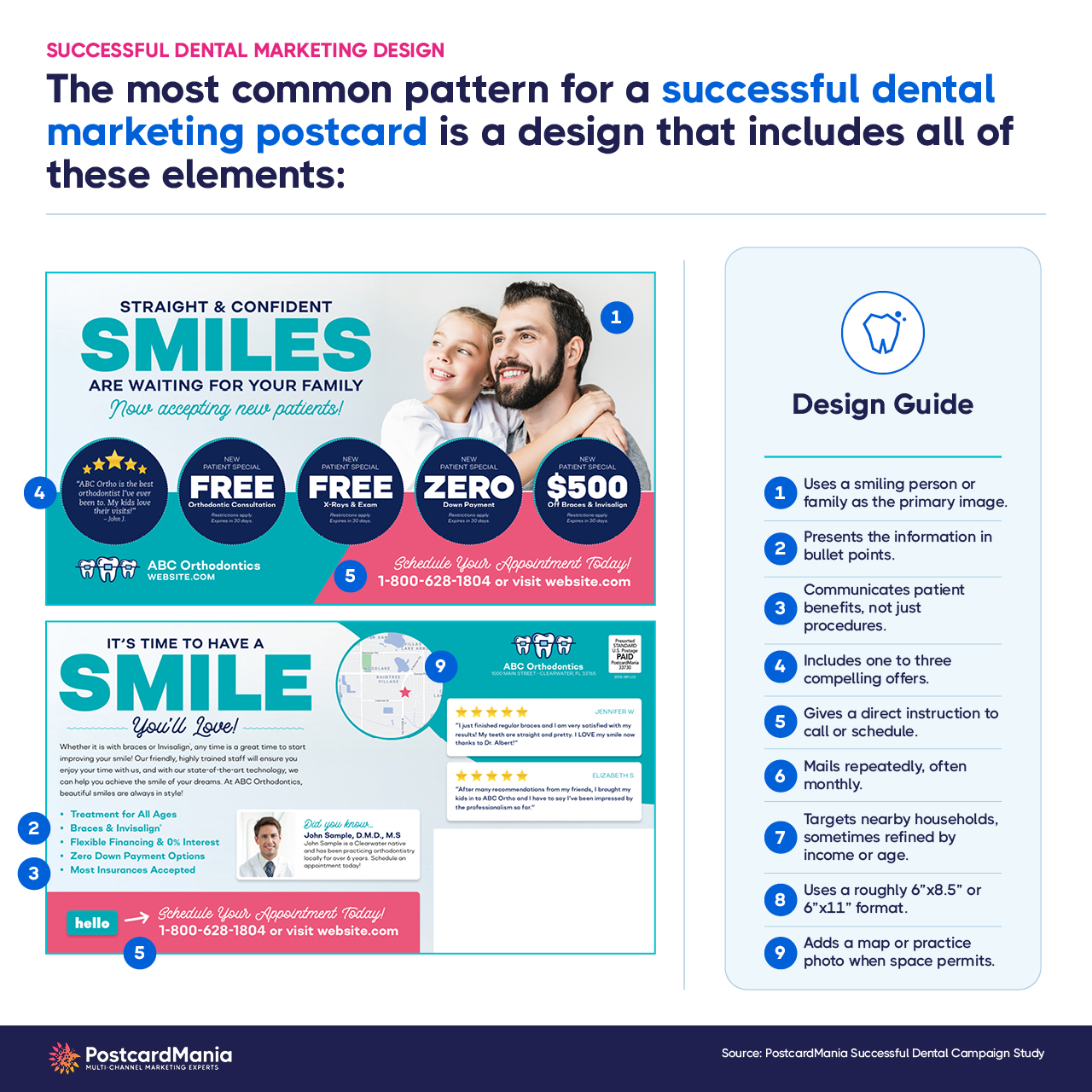
These are practical dental practice marketing tips based on data. Because the spreadsheet contains only campaigns already classified as successful, these findings show commonality among successful campaigns, not definitive causation. The data is strongest for identifying the creative and execution choices dentists and dental marketers should prioritize when building or testing a dental marketing campaign.
Digging deeper into the highest- and lower-revenue dental marketing campaigns
We’ve further broken our success data down using this information to continue analyzing useful dental marketing trends.
Among our 128 successful dental marketing campaigns, 67 had a usable total-revenue figure, and 47 had both usable revenue and campaign-duration data.
We divided the campaigns with usable revenue into approximate quartiles:
- Lower-revenue group: $15,000 or less, 17 campaigns
- Higher-revenue group: $99,223 or more, 18 campaigns
The comparisons below are therefore directional correlations, not proof that a specific dental marketing tactic caused higher revenue.
That said, the differences were impressive:
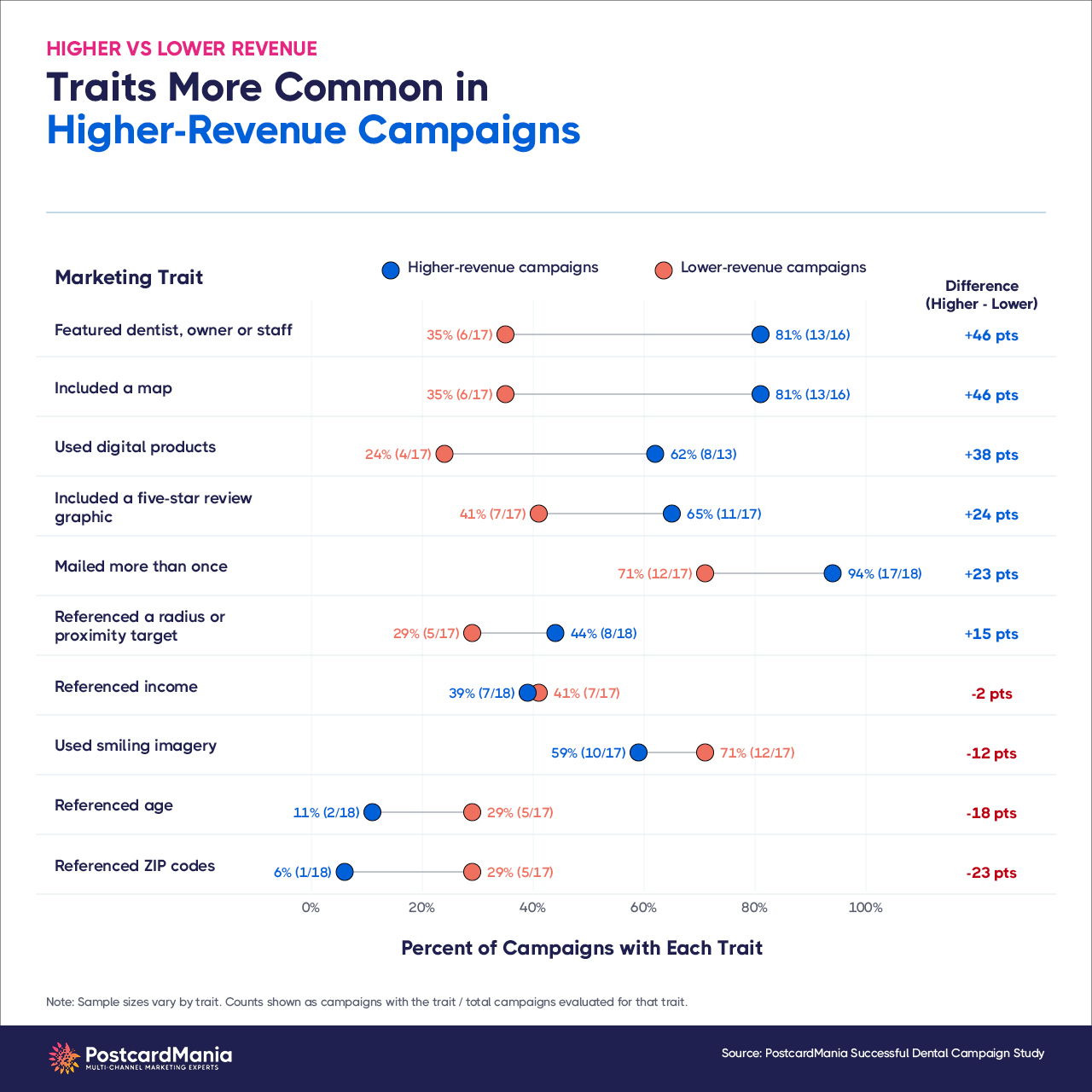
Let’s take a look at each finding in more detail…
Higher-revenue campaigns were much more likely to show the dentist or staff
Among campaigns with an answer recorded for this trait:
- 81% of higher-revenue campaigns featured the dentist, owner, or staff — 13 out of 16.
- Only 35% of lower-revenue campaigns did — 6 out of 17.
That is a 46-percentage-point difference.
This is one of the strongest creative differences in the data. While smiling patient imagery was common across campaigns generally, the highest-revenue campaigns were much more likely to also put a real person from the practice on the postcard.
Possible takeaway: For dentists, trust and familiarity may become especially important when a dental marketing campaign is expected to generate substantial long-term patient value. A professional photo of the dentist or team can help make an unfamiliar practice feel more personal and credible.
Maps were also far more common among the highest-revenue campaigns
The same pattern appeared with maps:
- 81% of higher-revenue campaigns included a map — 13 out of 16.
- Only 35% of lower-revenue campaigns included one — 6 out of 17.
Again, that is a 46-point gap.
Maps may do more than provide directions. They immediately reinforce that the practice is nearby, familiar, and convenient.
Possible takeaway: Dental postcards may perform better when they visually establish proximity rather than merely printing an address. This could be especially useful in suburban markets, areas with several competing practices or campaigns targeting households within a defined radius.
Digital integration appeared more frequently among high-revenue campaigns
Among campaigns with digital-product data:
- 62% of higher-revenue campaigns used digital products — 8 out of 13.
- 24% of lower-revenue campaigns did — 4 out of 17.
That is a difference of approximately 38 percentage points.
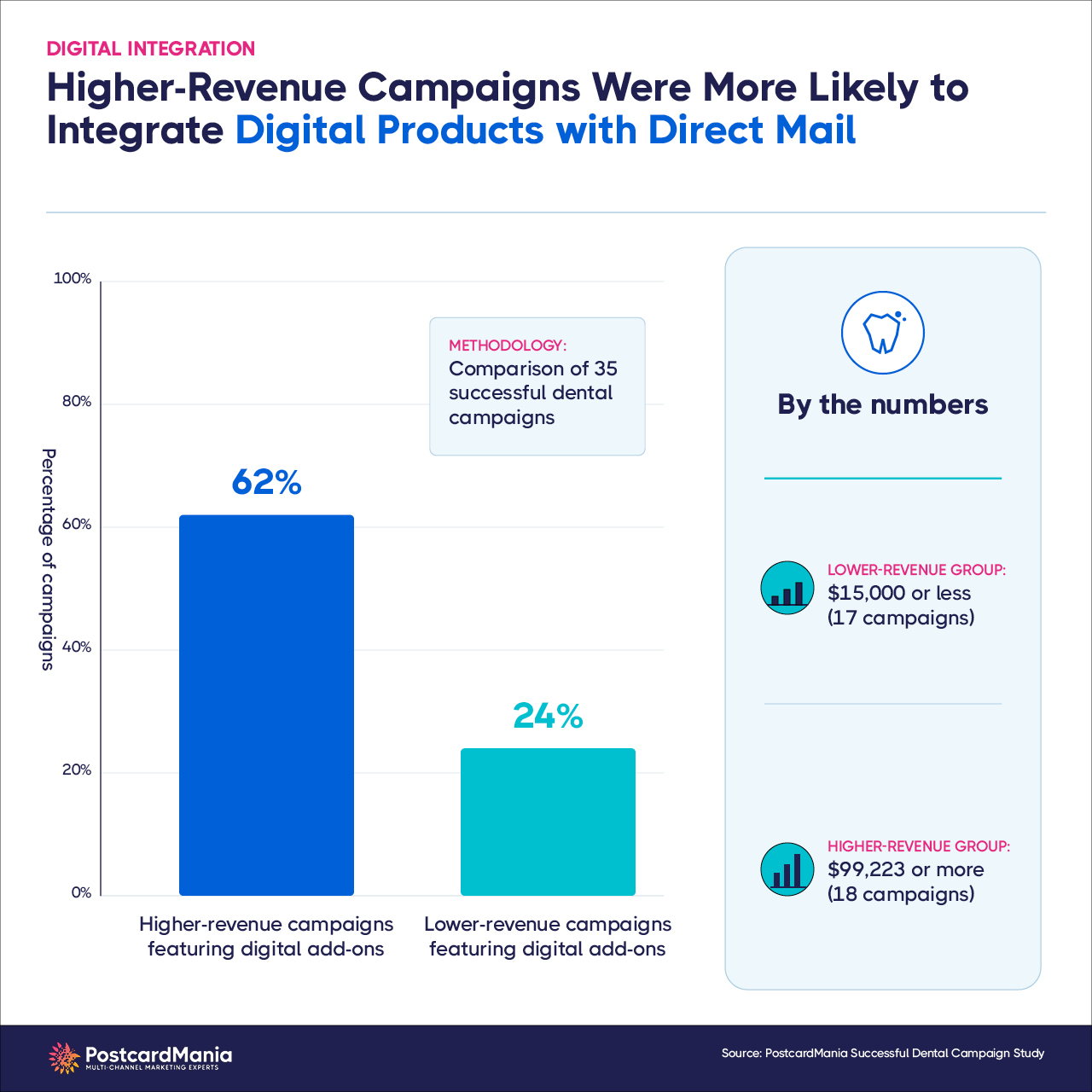
Digital products could include online advertising or other digital follow-up accompanying the direct-mail campaign.
This does not mean direct mail alone was ineffective. Most successful campaigns in the full dataset did not have documented digital integration. However, campaigns that produced the largest revenue totals were much more likely to use multiple channels. It appears that digital marketing for dentists can reinforce direct mail efforts by increasing impressions and brand recognition in a way that’s cost-effective for practices.
Possible takeaway: Dental direct mail can generate results independently, but digital reinforcement may help larger campaigns reach the same prospects more often, improve recognition, and capture people who prefer to respond online.
Higher-revenue campaigns were more likely to mail repeatedly
- 94% of higher-revenue campaigns mailed more than once — 17 out of 18.
- 71% of lower-revenue campaigns mailed more than once — 12 out of 17.
The difference was approximately 24 percentage points.
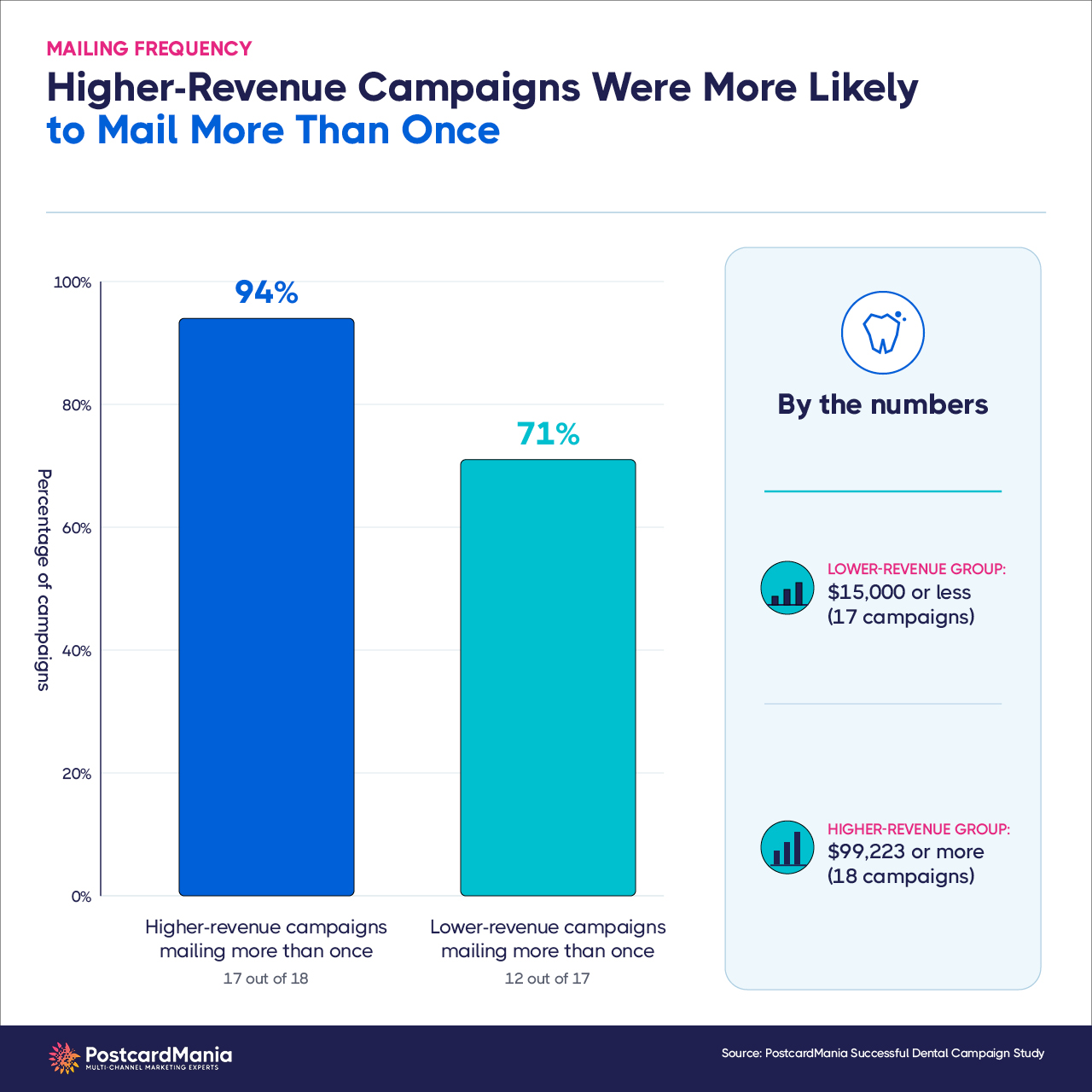
The number of mailings also had a moderately positive relationship with reported revenue. Among the 61 campaigns with both figures available, campaigns with more mailings generally reported more revenue.
The statistical relationship was stronger for mailing count than it was for number of offers, campaign imagery, or several demographic targeting variables.
Possible takeaway: Revenue appears to accumulate through sustained exposure. A single dental mailer may generate an immediate response, but repeated mailings give the practice more opportunities to reach households when a dental need arises or when a patient is finally ready to switch providers.
Social proof was more common in higher-revenue campaigns
- 65% of higher-revenue campaigns included a five-star review graphic — 11 out of 17.
- 41% of lower-revenue campaigns included one — 7 out of 17.
That is a 24-point difference.
Reviews were not essential across the full dataset, but they were noticeably more prevalent among the campaigns generating the most revenue.
Possible takeaway: Reviews may be particularly valuable when the postcard promotes higher-value services or asks patients to switch from an existing dentist. The review helps reduce the perceived risk of contacting a new practice.
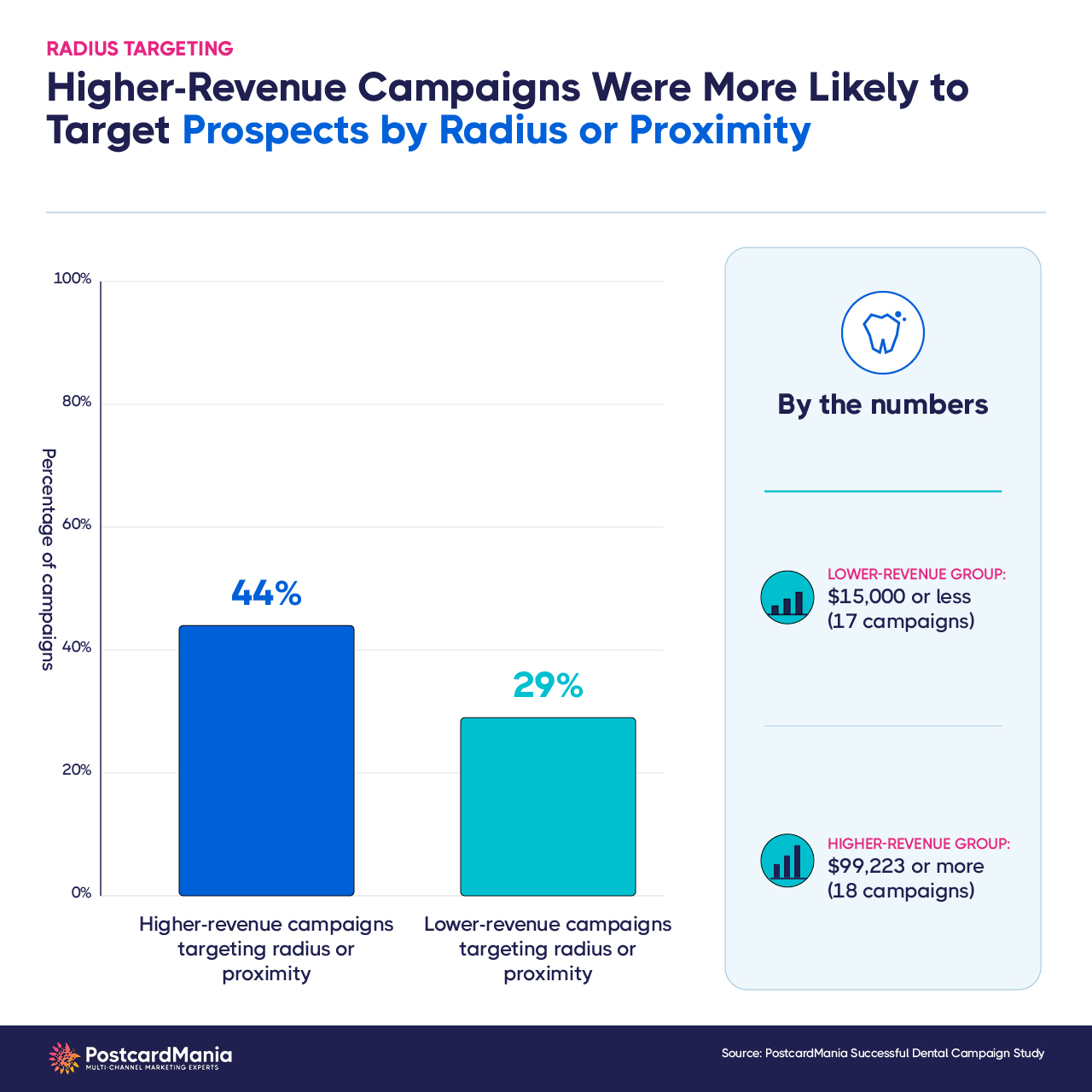
Radius targeting appeared more often among higher-revenue campaigns
Within the additional mailing-list details:
- 44% of higher-revenue campaigns referenced a radius or proximity target — 8 out of 18.
- 29% of lower-revenue campaigns did — 5 out of 17.
This is a smaller difference than the creative findings, but it supports the importance of convenience and local market coverage.
Examples included:
- Households within one, two, five or ten miles
- A radius around the office
- Homes close to a specific practice location
- Larger radiuses for selected high-value households
Possible takeaway: A dental practice may be better served by thoroughly penetrating a practical service area than by spreading its direct-mail campaign across a much wider geography.
Income targeting did not distinguish high- and low-revenue campaigns
Income targeting appeared at nearly identical rates:
- 39% of higher-revenue campaigns referenced income — 7 out of 18.
- 41% of lower-revenue campaigns did — 7 out of 17.
This is an important counterfinding. Income was one of the most common targeting variables overall, but it was not disproportionately present among the campaigns with the highest reported revenue.
That does not mean income targeting is ineffective. It means income alone did not separate the highest-revenue campaigns from the lower-revenue successes in this sample.
Possible takeaway: Income may work best as a qualifying layer rather than the entire targeting strategy. Geography, repeated exposure, service relevance, and trust-building creative may matter just as much—or more.
Age targeting appeared more frequently among lower-revenue campaigns
- 29% of lower-revenue campaigns referenced age — 5 out of 17.
- Only 11% of higher-revenue campaigns did — 2 out of 18.
ZIP-code targeting showed a similar pattern:
- 29% of lower-revenue campaigns referenced ZIP codes — 5 out of 17.
- Only 6% of higher-revenue campaigns did — 1 out of 18.
This should not be interpreted to mean age or ZIP targeting reduces revenue. More likely, these variables were not enough on their own to create the largest campaigns, or the higher-revenue campaigns were described using broader radius and household criteria instead.
Possible takeaway: Dentists should avoid assuming that increasingly narrow demographic filters automatically improve dental marketing performance. Over-filtering can reduce the reachable audience and exclude otherwise strong prospective patients.
Smiling imagery was actually more common in the lower-revenue group
Among campaigns with a documented main image:
- 71% of lower-revenue campaigns used smiling imagery — 12 out of 17.
- 59% of higher-revenue campaigns did — 10 out of 17.
This does not undermine the broader finding that smiling imagery was common among successful campaigns. Rather, it suggests smiling stock photography may be a baseline best practice, not necessarily the factor that separates a good campaign from a very high-revenue one.
The highest-revenue campaigns differentiated themselves more clearly through:
- Dentist or staff photos
- Maps
- Reviews
- Digital integration
- Repeated mailing
Possible takeaway: A smiling patient image helps communicate the desired outcome, but dentists may need additional trust and convenience elements to maximize results.
Campaigns lasting a year or longer generated much higher median revenue
Among campaigns with usable revenue and duration data:
| Campaign duration | Campaigns with revenue data | Median reported revenue |
| One month or less | 9 | $17,152 |
| Two to 11 months | 22 | $43,478 |
| One year or longer | 16 | $99,612 |
>>filename: successful-dental-marketing-examples-proven-campaign-duration_via-postcardmania.jpg
>> alt text: Median reported revenue increased 481% from $17,152 for campaigns lasting one month or less to $99,612 for campaigns lasting a year or longer.
Campaigns lasting at least a year generated a median reported revenue nearly:
- 2.3 times (or 129% better than) that of campaigns lasting two to 11 months
- 5.8 times (or 481% better than) that of campaigns lasting one month or less
This does not necessarily mean each mailing became more efficient over time. Longer campaigns naturally have more opportunities to produce revenue. But that is itself an important dental marketing lesson: judging a direct-mail strategy after one mailing or one month may substantially understate its total value.
Longer campaigns generally involved many more mailings
The median mailing count by duration group was:
- 1 mailing for campaigns lasting one month or less
- 5 mailings for campaigns lasting two to 11 months
- 12 mailings for campaigns lasting one year or longer
The relationship between total mailings and revenue was moderately positive. The relationship between campaign duration and revenue was positive as well.
Possible takeaway: Duration alone is not the whole story. Long campaigns work because the practice continues showing up. A year-long campaign with only one or two mailings is fundamentally different (and less effective) compared to a monthly campaign sustained for a year.
Long-running campaigns were more likely to include maps
Among campaigns with map data:
- 75% of campaigns lasting at least a year included a map — 15 out of 20.
- 54% of campaigns lasting two to 11 months did — 20 out of 37.
- 42% of campaigns lasting one month or less did — 8 out of 19.
The prevalence of maps rose steadily with campaign duration.
Possible takeaway: Long-term campaigns may benefit from repeatedly reinforcing the practice’s local presence. Over time, the map can help the office become mentally associated with the recipient’s neighborhood.
Reviews were much more prevalent in long-running campaigns
- 65% of campaigns lasting at least a year included a five-star review graphic — 13 out of 20.
- 46% of campaigns lasting two to 11 months did — 17 out of 37.
- Only 26% of campaigns lasting one month or less did — 5 out of 19.
This is another clear progression.
Possible takeaway: Long-term dental practice marketing may be less dependent on a single promotional offer and more dependent on building a recognizable, trustworthy local brand. Reviews support that objective.
Digital integration became more common as campaign duration increased
- 56% of campaigns lasting at least a year used digital products — 10 out of 18.
- 29% of campaigns lasting two to 11 months did — 10 out of 35.
- 20% of campaigns lasting one month or less did — 4 out of 20.
Possible takeaway: Dental practices committing to a longer campaign were more likely to adopt an integrated approach. This may reflect more developed dental marketing plans, larger budgets or a deliberate effort to surround prospective patients through several channels.
Long-running campaigns emphasized benefits and scannability
Among campaigns with answers recorded:
- 95% of campaigns lasting at least a year communicated benefits — 19 out of 20.
- 95% used bullet points — 19 out of 20.
By comparison:
- 69% of campaigns lasting two to 11 months communicated benefits — 25 out of 36.
- 86% used bullet points — 31 out of 36.
The gap for bullet points was modest, but the benefit-focused difference was substantial.
Possible takeaway: Sustained campaigns still need strong direct-response fundamentals. Repetition cannot compensate for unclear copy. The postcards repeatedly explained what patients would gain and made the message easy to scan.
Owner or staff photography was more common in sustained campaigns
- 60% of campaigns lasting at least a year featured the dentist, owner, or staff — 12 out of 20.
- 62% of campaigns lasting two to 11 months did — 23 out of 37.
- Only 30% of campaigns lasting one month or less did — 6 out of 20.
Possible takeaway: Short campaigns may lean more heavily on an immediate offer and generic smile imagery. Longer campaigns appear more likely to build recognition around the actual people behind the practice.
The number of offers had almost no relationship with revenue
This was one of the more interesting findings.
Across the 65 campaigns with both usable revenue and offer-count data, the number of offers had essentially no observable relationship with reported revenue.
Additionally:
- 50% of higher-revenue campaigns used three or more offers — 9 out of 18.
- 47% of lower-revenue campaigns did — 8 out of 17.
That difference is negligible.
This suggests that merely adding more offers does not necessarily increase the total revenue a campaign produces.
Possible takeaway: Dentists should prioritize the relevance and strength of dental marketing offers rather than filling every available space with promotions. One or two highly compelling offers may perform as well as three or four mediocre ones.
A better future analysis would categorize the offer types, such as:
- Free consultation
- Discounted exam and X-rays
- Free whitening
- Implant offer
- Emergency visit
- Insurance-related offer
- Percentage or dollar discount
That could reveal whether certain offer combinations correlate with revenue more strongly than the raw number of offers.
The correlation between spending and revenue behind successful campaigns is undeniable
Among the 37 campaigns with both usable spend and revenue figures, higher spending was fairly strongly associated with higher reported revenue.
This is not surprising: practices that purchased more postcards, mailed more frequently, or sustained campaigns for longer had more opportunities to produce revenue.
It does not necessarily indicate that the larger campaigns had a better ROI.
Possible takeaway: Total revenue and campaign efficiency should be evaluated separately. A smaller campaign can generate less total revenue but still produce an excellent ROI, while a much larger campaign can produce more revenue simply because more money was invested.
A more complete profile of the highest-revenue dental marketing campaigns
Compared with the lowest-revenue group, the campaigns generating approximately $99,000 or more were especially likely to:
- Mail repeatedly: 94%
- Use bullet points: 94%
- Include a CTA: 83%
- Communicate patient benefits: 82%
- Feature the dentist or staff: 81%
- Include a map: 81%
- List specific services: 71%
- Include a five-star review: 65%
- Use accompanying digital products: 62%
- Use a smiling person as the main image: 59%
- Use three or more offers: 50%
- Reference radius or proximity targeting: 44%
- Reference household income: 39%
The emerging dental marketing formula is not simply “use more offers” or “target higher-income households.” The largest revenue totals were more strongly associated with a combination of:
Repetition + trust + local convenience + integrated exposure.
What is the best dental marketing strategy? The data reveals it’s a campaign built for the long term
The campaigns in this study shared several clear dental marketing fundamentals.
They gave recipients a reason to respond, made the next step easy to understand, and presented the message in a format that could be absorbed quickly. Most included at least one offer and a clear call to action, while many also used bullet points, patient-focused benefits, smiling imagery, maps, and photos of the dentist or staff.
Deeper campaign comparisons are even more insightful:
They suggest that the strongest results come from practices taking a long-term view of marketing.
Higher-revenue campaigns were more likely to mail repeatedly, include maps and practice photos, use five-star reviews, and combine direct mail with digital products. All of these things communicate to prospective patients: “We’re here for the long-term health of you and your family.”
Longer-running campaigns showed similar patterns. Campaigns lasting at least a year were more likely to use trust-building elements, communicate benefits clearly, and maintain consistent visibility across multiple mailings.
The revenue findings reinforce that point:
Campaigns lasting one month or less generated a median reported revenue of $17,152, compared with $43,478 for campaigns lasting two to 11 months and $99,612 for campaigns running at least a year. Longer campaigns also completed far more mailings, with a median of 12 for campaigns lasting a year or more, compared with one mailing for campaigns lasting a month or less.
Taken together, the data supports an ongoing approach to dental marketing.
The practices generating the most revenue were not treating marketing as a here-and-there fix used only when appointment volume dropped.
They were investing consistently, staying visible in their communities and building familiarity over time.
A single campaign may create an immediate response, but repeated exposure gives a practice more chances to reach people when they are ready to choose a dentist, change providers or move forward with treatment.
For dental practices planning their next campaign, the strongest strategy is to combine proven creative fundamentals with sustained execution. Track your results closely, adjust as needed, and (most importantly) stay consistent.
The findings suggest that marketing becomes more valuable when it is treated as a long-term growth investment rather than a temporary solution.
Wondering how to start with dental marketing?
If you’re ready to put together a campaign for your practice that emulates our most successful campaigns, call 1-800-628-1804 today for a free consultation with one of our highly trained dental marketing experts.
Methodology
To identify the traits shared by successful dental marketing campaigns, PostcardMania reviewed a collection of more than 120 dental campaigns from its campaign-success records. The campaigns span multiple years; where specific campaign dates were recorded, they reach back to 2009, while the broader success database contains records entered through 2026. Exact campaign run dates were not available for every campaign.
For this analysis, a campaign was considered “successful” when PostcardMania’s results department documented a positive result reported by the dental practice, such as responses or calls, new patients acquired, or revenue generated. There was no single minimum revenue or ROI threshold required for inclusion, which allowed the study to look for common traits across many different types and sizes of successful campaigns.
The analysis focused on creative, targeting, and execution choices, including offers, calls to action, imagery, mailing frequency, campaign duration, audience criteria, postcard format, and the use of digital marketing alongside direct mail. Each campaign was evaluated trait by trait. Because some campaign records contained more complete information than others, the number of campaigns included in each calculation varies. Percentages were calculated using only campaigns with usable information for that specific field.
Revenue figures were taken from PostcardMania’s campaign-success records and were reported by the dental practices themselves, rather than independently audited. Revenue comparisons were limited to the campaigns with usable revenue information. The lower-revenue group included campaigns generating $15,000 or less, while the higher-revenue group included campaigns generating $99,223 or more.
The study was designed to identify patterns, not prove causation. A trait appearing frequently does not mean it caused a campaign’s success on its own. Instead, the findings show which marketing practices appeared most consistently across successful campaigns and which characteristics were more prevalent among higher-revenue and longer-running campaigns.