Podcast
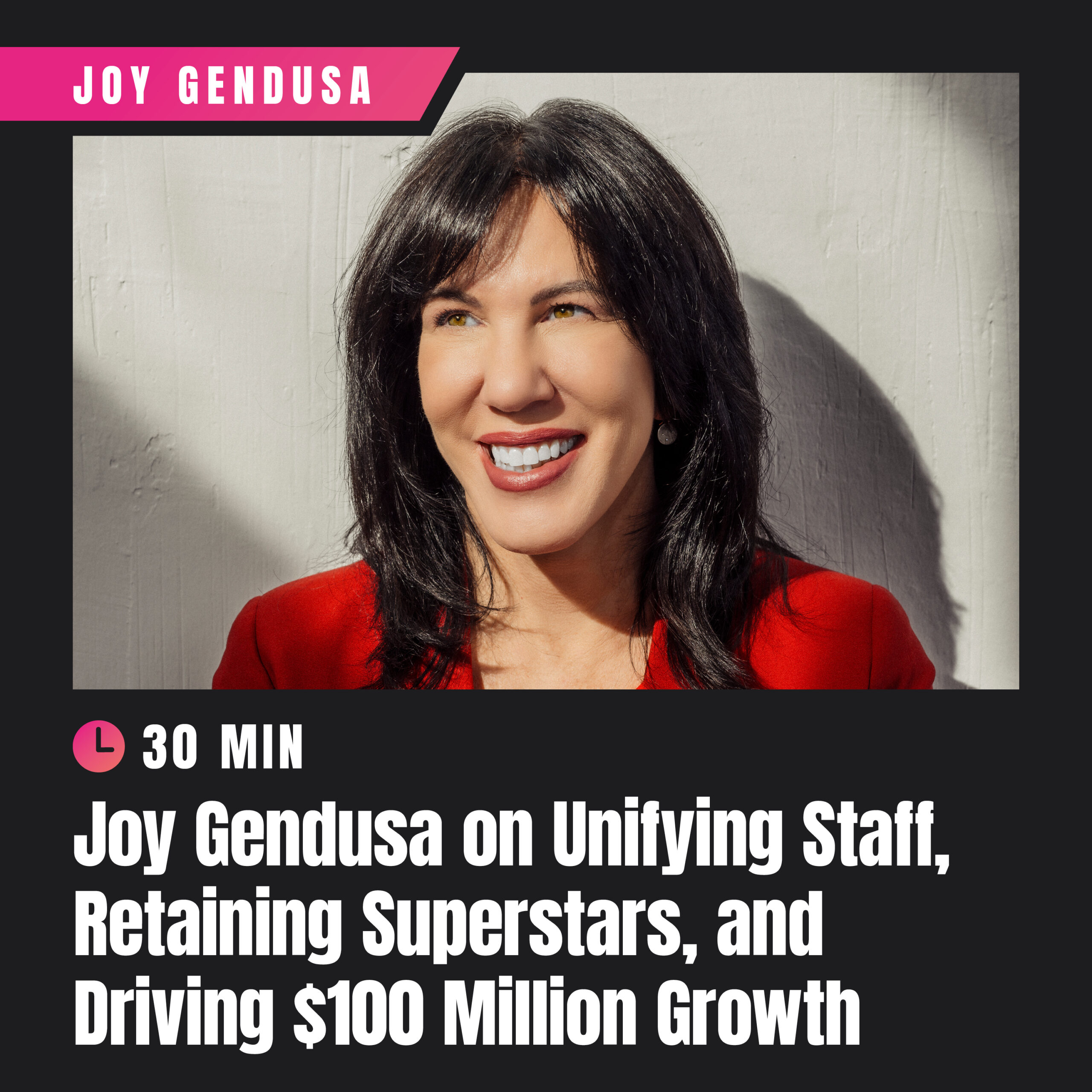
Unifying Staff, Retaining Superstars, and Driving $100 Million Growth
To be a guest on the show, email podcast@postcardmania.com
Listen and watch on your favorite Podcast applications!










Podcast
Episode Transcript
Chris: We're you know, kind of transitioning from culture because one of the most important things there we go. One of the most important things to happen when the business starts to grow is A) the culture gets preserved, but B) the business has to grow. Suddenly you have to stack other products and other services on top of what you've done before, because that's the only way to grow, right?
Chris: So I guess the question for you is, as you start maturing in the business and you reach a certain level of such executive capability that your team is running the business without you, what do you see as your role as business owner and CEO to make sure that it's moving in the right direction and not stepping in where you shouldn't because you're letting the team handle it. How do you decide and make that, you know, live that balance?
Joy: I used to say I'm basically lazy, so if the job's getting done, what do I have to do? Why do why am I gonna work when there's somebody else doing it? I would never I would never describe you as lazy. You're not but anyway keep going. Striving for for laziness.
Joy: I think well, you know Okay, so the question is like how do I know when to step in basically and when I watch the stats. I watch them even when I'm not working. So we statisize everything. I mean, every major statistic has a million sub statistics of how you get that major sure metric. And I that gives me predictability and I can see what's happening. So I've been yeah.
Chris: I imagine over the course of decades that you really get a feel for that, right? You really understand as the numbers start coming through, you know, you've already turned data into information and so you feel what the numbers are looking like and it's kind of reading the numbers and reading the statistics, you get a certain sense of what's happening with the business. You must.
Joy: Yeah, I mean well I mean let's just give them an example o of a statistic. If you take something like revenue, everybody tracks the revenue or the income. You know, 'cause I know we we track gross income. Revenue is you know, what we deliver. So we're I'm really always looking at the dollars coming in. And I know that if delivery slows down, money will slow down. Yeah. So we're watching we we track something called value of services delivered. And every individual person that's on a delivery post has a certain statistic that is pushing towards value of services delivered. Whether it's number of designs completed or and the value of those di designs completed, we're tracking every single solitary thing. Because if a design isn’t completed, the job doesn't go out, right? There's no production.
Chris: Exactly.
Joy: And this is where I say I think I have an innate ability to assimilate information regarding business because I only studied the Hubbard Management System. I don't know anything else. But I was able to go, that makes sense. I'm gonna do that. I'm gonna implement that. Well, you know what's interesting is the the Hubbard Management System is a philosophy and a structure of management, right? Of how to run an organization.
Joy: And it's very thoughtful and well learned, well documented, very well documented.
Chris: I was going to say it's very well formulated. And you, as a youngster in a travel agency answering phones, figured out the formula for closing business. So clearly you're a study and you can study and apply the things that you're learning.
Joy: Yes. I you know, I always thought, I'm the worst student, I'm not interested in education. This is when I was younger. Okay. But I read the Bourne Identity when I was twelve. So when you look at when when my children were twelve, I went, I was actually smarter than your average twelve-year-old. And I didn't realize that. Sure.
Joy: And so I love anything I learned that that I can apply, that I can use, I will use and and I will push it into my organization. And so even though I'm not when I was like not working and letting everybody else run the show, I'm there. I'm a presence and my job is goal maker.
Joy: My job is goal maker. So we have a senior exec planning every January. And I guess he'll be at the next one. And then this is we we've hired Chris as our chief evangelist. We've never hired a C level employee outside of the group. We've always just you know had people rise up and they have really risen to the occasion. but we didn't have anybody with your skill set. And at our last senior exec planning, I literally, literally said exactly every quality about you to my group and said, I need this person. So that's interesting to me and I'm grateful for it.
Chris: I'm grateful for it. Because there's a role that some execs have and s and CEOs have when a company gets to a certain size. they could be a retreater, like they go off into the wilderness and just collect a paycheck. They could be fountain head, what I call a fountain head.
Joy: Figurehead, figurehead, fountain head, an icon. People used to ask me, people used to say to me, what's your job? I was like, I'm an icon. I'm on a letterhead, that's it.
Chris: Where I get fountainhead from is and I don't think it's an MBA or business term. I just I just use it because of the Ann Rand book, The Fountainhead. Yeah.
Chris: Where there is a s there's a single person that creates a vision and that drives forward an ideal of what a business or a thing could be, right?
Chris: And so your role is interesting because in that and even with my role, there's this fountainhead moment of there's this place where there's a place where it's not a hole because there was never anything there. So it’s not a hole because it wasn't created.
Chris: It's just there's this thing that the business doesn't have and could use for its next stage.
Joy: Okay, yes, for its next stage. So let's talk about the next stage and why I what I saw and why. Marketing is changing. It's changing so fast that business owners can't keep up with the change. I mean, and I said, you know, we do what we do very, very well, but we need to take this a step further. We need to be able to not only deliver the type of marketing that small businesses want, but we also need to attract the thirty-year-olds who are buying the boomer businesses.
Chris: Mm-hmm. And it is the great wealth transfer. Yes, the great wealth transfer is occurring.
Joy: And I said, okay, I can I can see what's happening and I didn't read anything necessarily about it. I know we had a newsletter about it, but I that was on Jessica. She came up with or Michelle, I don't know who comes up with the ideas and then I just kind of it says it's by me, it's not. I just have to edit it.
Joy: I just have to read it and make sure it's in my voice. I and it's really them. So but what I noticed is that on TikTok 'cause I scroll eight minutes I lay on a beamer every morning for eight minutes and I scroll TikTok 'cause there's nothing else you can do while laying there. And basically I I always I see a lot of business content because that's what I'm interested in. So it feeds you that business content because you're programmed in their algorithm.
Chris: Exactly.
Joy: And so I'm seeing makers and small businesses and they're all young people and then I'm seeing people buying businesses from boomers. And I'm like, okay That's really interesting to me. And then I see my one of my best friends, Vicky, her son-in-law has a gym, Rift. He has two locations. He's a very industrious young man. and he bought a locksmith company. And I see he and he's showing up on my FYP, my for you page.
Joy: And I'm like Okay. And I had like an aha moment at that point. And I said, Okay, we need to appeal to everyone because we really he is not going to like boom that locksmith business by making TikToks. But he thinks he's going to.
Chris: Right. You know, and it's interesting you say that because the change of marketing is where the twenty year olds and thirty year olds are digital natives. So they've grown up with Facebook, which is now passe and it's too old for them, so now they're on Instagram or TikTok.
Chris: But coming at it from that digital perspective, there's a whole host of characteristics when it comes to that kind of social media and digital marketing, which can seem like it's real marketing but actually doesn't pay off in terms of the bottom line.
Joy: Yeah, I mean you'd have to have you'd have to have a video go like extremely viral and then continue to have more viral videos because the lifespan of a viral video is about ten minutes. Yeah. It's over.
Chris: And so what I what I think is interesting that you that you saw as a vision of it's not just you know the vision of small business changing, but then it's like how does our business adapt and evolve to the changing natures of small business, right?
Chris: And how do we position ourselves correctly into that small business group? And then also now with new products, PCM integrations being one of them, is opens us up to a completely new market space of sales organizations and agencies and B2B mid.
Chris: Mid-market companies and enterprise companies, right? So suddenly there's this whole pocket of revenue that could that we can be attracted to.
Joy: Exactly. And let me just explain what PCM integrations is. PCM stands for Postcard Mania, and integrations is PCM integrations is the part of Postcard Mania where we can integrate with a CRM or any software really, if and have users of that CRM have the ability to mail a postcard in their sales funnel in instead of just sending emails and texts as a triggered occurrence when something happens, let's say you call somebody up on the phone, you get their voicemail. So you leave a voicemail, you send an email, you send a text, you can also send a physical postcard.
Joy: That's just one example of using it. So now we're integrated with Salesforce, HubSpot, Jobber, you may know more than I level go high level. House Call Pro. House Call Pro. We're we're right now integrating with Shopify. And we can also trigger a postcard to anyone that visits a website or almost anyone.
Joy: We can't match every single address, but we can get a decent number of addresses of match back that visitor to a physical address. So if somebody goes to your website and they don't do anything because 95% of the people that go to your website, actually probably 98 or 99% of the people that go to your website are not going to fill out your form. They're gonna go to your website and leave. So how do you they were interested enough to go to your website? Something on your website turned them off, or their kid screamed mom, or whatever happened. Or they're moving on to competitors.
Joy: To competitors, could be. So how can we reactivate that person's interest? Fortunately for small business owners, people don't make rash decisions. Most people don't make rash decisions if it's home services. They're they're gonna do a lot of research. So that works in your favor. I'm a rash decision maker, so if I went to your website, I either bought it or I went to somebody else's website and bought it.
Chris: Yeah, and what and what I love about these new products, by the way, for the personalized direct mail on June 23rd, there will be a webinar just on that.
Chris: The interesting thing about that is that it's taking these new technologies, applying direct mail to these new technologies and creating new market opportunities not only for the business, but creating more touch points for the customer, right? So they can actually use direct mail in different ways than they had before. What that means for the business and you as owner is that there are more products. Right. Suddenly there are more things that we stack on.
Chris: So as you start looking at and without disclosing any strategic intent…
Joy: I love disclosing all strategic intent. I am not a secret keeper. I am not a gatekeeper. I here's the thing about let's just talk about that, the secret intent thing or disclosing.
Joy: There are what, thirty-three, thirty-six million small businesses in in America. I only have a hundred and thirty thousand of them. Right. There is enough business for me, for everyone, for every company like mine. Anyone who wants to go out there and try and compete with me, it ain't as easy as it looks, go for it. Right. That's all. Right? I'll tell you my intent. See if you can keep up. I'm a little snotty about it.
Chris: So for the next stage, you know, there's next stage of kind of building not only kind of what I call the shield wall around SMB market, the small business market. Right? We've got a shield wall, we've got a moat.
Joy: Shield wall? I don't know what that means. That just means we're protecting and defending it, right? We we we have this That's our market. Stay the hell away.
Chris: Exactly. We have this I want everybody to help them. Well well fair enough. Everybody can help them but we do it really well. We do do it really well. We really, really know how to do this.
Joy: One thing I want to say and maybe if you're watching this podcast, maybe you already are a customer of postcard manias, but we have like real receptionists that answer the phone.
Joy: Real people. We we use AI for to help ourselves be more efficient, but we don't use it on you, the customer. We I marketing is emotional because people are spending money on it and it and it's painful to spend that money and not get a good result.
Joy: And they've already been burned by other companies and other people. The only way you're not going to get burned by a marketing company is to understand how marketing works and learn marketing. Because then you can make decisions about out the money that you're spending with information with knowledge.
Chris: Well and also with a confidence. So oftentimes a small business owner lacks the belief that marketing will work.
Joy: Because they don't understand.
Chris: Because they don't understand it. And so you what you don't understand you usually fear. And so you're like, okay, I'm not I'm not gonna do that. So I'm not gonna invest that time and invest the belief that it can work for me. And so I was on a podcast earlier where this guy's client used us to promote and she said, my gosh, it worked for me And she kind of always thought it worked for other people, but not for her.
Chris: Her name is Judy and I Yes, well Judy had this transformational moment emotionally when she realized marketing could work for me. Not just other businesses, right? I know you work with a hundred and thirty thousand but now it works for me.
Joy: And Judy was listening to an educator. She she was part of a coaching group of some sort. That's right. She's part of a coaching group.
Chris: Right. So she learned marketing. So she learned it, right?
Joy: See, I listened to the podcast.
Chris: There we go. So so one of the things that we talk about is that we want to help educate small businesses so that if we can help a small business hire one more person and we scale that over ten, hundred, a thousand, hundred thousand, my goals a million.
Chris: Help a million small businesses hire one more person, we can change the face of the American economy.
Joy: You also have to explain that. Why does that change the face of the American economy? You have to think about the money that those customers are spending at that small business. And then that small business owner is paying the employees, more employees, and they then go out and spend their money at another small business. And that is how it works. It's not just like some small business owner getting rich. It's all the it's everyone in the business.
Chris: It's everyone in the business. It's everyone spending their money somewhere else and creating more and more in that area. Absolutely, because I shop at small businesses. We all do. We drive by them all the time.
Joy: I prefer them. I prefer them. I so prefer them. And I'm a small business.
Chris: Right. Exactly.
Joy: Even though I don't seem like it. I am. I am a woman owned, independently owned. I don't have any partners. I am a small business. There is no PE behind me.
Chris: A hundred percent. But I actually I think that that When we talk about that authentic brand culture, I think that that comes through. I think it comes through that you can say, look, Amos, we're all actually in this together. It's just we've learned a lot. We've learned so much about what works and what doesn't work. And the mission is how do we help you learn what we've learned so that you can apply the learning so that your business can grow too.
Joy: 100%. Chris is gonna do a ton of webinars and you should listen to every single one of them. He is so smart. I am so lucky that you decided to become to work here.
Joy: You know, I was probably the main person carrying the flag of education at Postcard Mania. And I have, you know, we have our course room here called Postcard Mania University, PCMU. It's a little, it's a course room that holds about 20 students, but basically we have the tools to teach everybody, but I need more pushed for everybody here to learn and everybody out there to learn. Like here in Postcard Mania and the small business owners.
Joy: Education is key, key, key, key, key. And I don't mean formal education necessarily. I just mean reading, understanding, learning something so you can apply it to your business and to your life.
Chris: It's applied education. And so one one of the things that happens is that you've been in business for 27 years. A lot of small businesses can't wait 27 years to learn some of these lessons. So we try to help fast track with the education that we provide. Like Joy said, it's every other week. So go to postcardmania.com/ webinars to find the webinar stack that you need. And and a question that I would have as as we start wrapping up is you are a small business, you've grown this business. The business grew you…
Joy: a hundred percent. I mean, goodness gracious, who the heck would I have been if without right this whole journey that I call It's amazing.
Chris: But also too, you've created the opportunity for other people's journeys too. For someone like Melissa who's been here for so long.
Joy: My mama. We call each other Mama.
Chris: Her journey would be and her life would be completely different without being a part of this journey. So as a lot of people admire you as they should. I do.
Joy: Thank you.
Chris: Of course, of course. So, who in business do you admire?
Joy: Lots of people. I I have friends that I admire that are business people. I have like close friends that I've talked to about business. I have this one friend, actually, he's he is re he sold his business years and years and years ago. His name is Mike Kaplan. Mikey, I hope he watches this. I'll have to send it to him. I admire this guy so much. He's so freaking smart. He is now helping us with our sales coaching unit. He wrote a book called I'll get it, Mikey. It's Secrets of a master closer. Nice. It's on Amazon. It is a genius sales book. I love this sales book.
Joy: He breaks it down into eight steps.
Joy: It's genius. He is so smart. He is so smart. And he's funny as heck. And he is a great, great friend. So I fully, fully admire him. He sold his business years and years. And he had him he had a he had like a marketing company, but it was different. I mean he it was different than what we do totally because it was a long time ago that he sold it already. so he's someone I admire greatly. I I mainly admire people that I get to talk to for real real. Okay. You know, and it it's not like I no no icons necessarily because I could you know, I could read a book like I loved the book Good to Great. Right. It was a great great book. Excellent. It was an excellent book. So of course I admire every one of those CEOs that that that that are talked about there. I admire my husband. My husband is a great.
Joy: He's so much more conservative than I am. So much more conservative. And I need that balance. Yeah. Because like my husband says that if I was in charge of the money it would be gone. And it wouldn't be because I buy myself presents. It's because I would donate it to every charity that asks.
Chris: Of course, of course.
Joy: I don't I'm not money motivated, so I'm…I mean, obviously I need money to live a life of you know, whatever, but I'm more motivated by helping people. I'm I'm such an empath.
Chris: Well and also the way I was phrasing it is the greater good. The greater good. I'm much more motivated by the greater good.
Joy: Yeah. you know I think that really only can happen when you have had success and you're no longer struggling right to make ends meet and your children are f turned out okay and you know, all those things that you're concerned with as a younger person.
Chris: Well it's kind of like Maslov's hierarchy of needs, right? As soon as you reach a certain level of being able to have some modicum of success and and stability with those areas and the question is, what can you do more as a person for the greater good, right? How c what kind of impact and legacy can you have beyond just, you know, the car you drive or the house you live in, it's what can I do that impacts other people in a positive way.
Joy: Totally. And I and I and I have a low tolerance for people who just spend their money on toys and things because there's so many organiz good organizations out there that are really working towards the greater good that can use our help.
Joy: You know, so we're we we have a good give back program here at we do which we pick an organization every single month that we give back to at postcard media and we make it possible for our staff to contribute to that. either small financially or with their labor and we allow them to do it on work time too.
Joy: To go you know, we've done wheel meals on wheels, we've done…What is the one where you build the houses habitat?
Chris: Habitat for humanity.
Joy: Habitat for humanity. And all kinds of other ones that are one off charities.
Chris: Yeah, but I you know, and I think that that's part of the mission too, where if we're helping small businesses grow through our services and we help the community growth the way we can. Yeah. Right? Because it all it all builds on each other. And and you know, if you have a strong community, you have strong businesses, you have strong businesses, you have strong communities.
Chris: Right. So that's kind of where I see this aligning really well with basic with the great Mission. Yeah. So I'll ask you one last question. What would you like to ask me?
Joy: What would I like to ask you? How do you like working here so far?
Chris: That's a layup. That's an easy question. I adore it. I'm so happy. I adore it. Well, well, here's and here's why I adore it. there's I'm a very purpose I've I've become a purpose driven person.
Joy: You are. You're very unusual.
Chris: Well thank you. You are in a good way. You are too. and so I feel like in the organization there's a a channel and an avenue for my purpose. Mm-hmm. Right.
Joy: And so tell us what your purpose is.
Chris: My purpose truly is to help Businesses get to the place where they can hire that one more person.
Joy: I love that that is your personal purpose.
Chris: It a hundred percent.
Joy: That is that is this man's personal purpose. I hired a man who has that personal purpose. I am the luckiest CEO around. Because you can't give someone a purpose. It has to be their own. You can have them join yours. You know, like I've brought people on board with my purpose, and my purpose is, well, you know, we say it at staff meetings. We have a wonderful purpose. I'm not gonna say it here.
Joy: Anyway, we have a wonderful purpose, and we you know, and and we say it as a mantra at staff meeting. And basically, that is my way of bringing everybody into my purpose and feeling it. You know, and I ask them to say it loud and proud.
Chris: Which is wonderful. And I do at home when I watch it virtually, of course I do.
Joy: So I I feel like that you came to me already with that purpose is kismet, really.
Chris: It absolutely is. And and I think that as as as we start growing the business even more and small businesses are going to be challenged in brand new ways there will never be a n a lack of need to help them in a real practical way.
Joy: Right.
Chris: Because in in that way you can make every you can make the lives of your community so much stronger if we're able to fulfill on the purpose. All right, to the greater good. Woo! That's perfect. Thank you so much for watching.
Joy: That was fun. Thanks, Chris.