Podcast
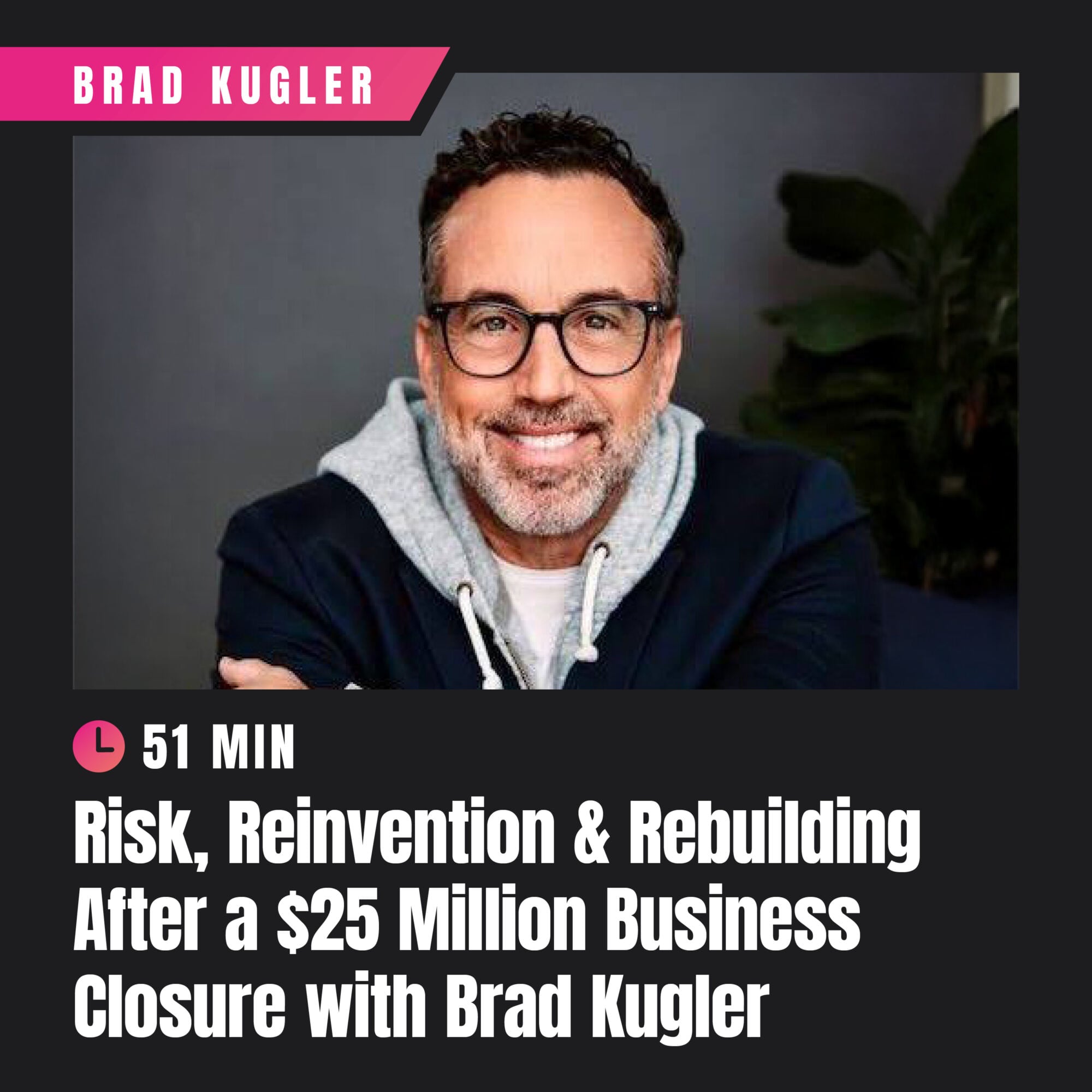
Risk, Reinvention & Rebuilding After a $25 Million Business Closure with Brad Kugler
To be a guest on the show, email podcast@postcardmania.com
See more of us on Google
Listen and watch on your favorite Podcast applications!










Podcast
Episode Transcript
Here’s the transcription below of today’s episode, a conversation between host Chris Foster and Brad Kugler, founder of Direct Mail 2.0, about growing his family’s packaged media distribution business from $2 million to $25 million and then watching streaming end it, the twenty-seven business books he worked through before starting over in software, and why he now thinks his own risk aversion is the ceiling on how big he has ever built.
Note: This transcription has been formatted from the original episode transcript for readability.
Transcript
Chris: Well, all right — Brad Kugler, welcome in to the Everywhere Small Business Podcast.
Brad: Thank you, Chris. Always a pleasure to talk to you.
Chris: Always. Tell us a little about yourself and your business.
Brad: So, myself — I grew up in Chicago, I lived in Los Angeles, went to San Diego State near where you live, as my alma mater, and I’ve been living here in Clearwater, Florida since the early nineties.
Prior to doing what we’re going to talk about, I had a family business with my father and brothers where we did wholesale distribution of packaged media for twenty-some years. CDs, DVDs, video games, VHS even. And it got disrupted. I don’t know if there’s anybody still using VHS or DVDs — I heard there’s a resurgence, but I don’t know if it’s enough to restart the business, let’s put it that way.
But now I run a company called Direct Mail 2.0, which is very closely related to what PostcardMania and Everywhere Small Business are. I can get into that germination story. I have about eighteen full-time employees, and we develop software to help printers and people who do direct mail get a better result.
Chris: Fantastic. I’m curious about your origin story with your own family business, with your dad — so you started as a small business, and a small family business. Now, I think vinyl records are making a comeback. I don’t think DVDs and VHS cassette tapes are going to make the same comeback that vinyl did.
Brad: No, unfortunately not. Although there is some growing interest in VHS.
I came out from LA — I had a marketing job for a few years and then I came out here. My dad needed help in this growing video distribution business. In fact, at the time it was the first Gulf War, and there was a bit of a recession that kind of pushed on the numbers.
The business launched in the proliferation of video stores, which — for the younger audience — video stores were the thing from the mid-eighties until probably the mid-nineties and even later. It was an activity to go to a video store and choose a video for the weekend. I’m sure you did it as a kid, and it was a thing you did. And this particular company that my father had bought was putting together opening inventories for people that wanted to open video stores.
And the business was actually on the downturn, because of the twenty-four-hour news cycle of CNN at the time talking about the Gulf War — people weren’t going to video stores as much. And he decided to go into insurance. He said, Brad, you can come in here, you can be a hero and save this thing, or you can see what you can do with it, but I’m going on to greener pastures.
And I took the challenge and went in there in ’91, and ended up growing it from two million to twenty-five million at its peak in 2012.
Chris: Congratulations, that’s fantastic. How did you learn how to do that? Because you hadn’t owned a business before. You might have seen your dad own a business, and you studied marketing and went to school. When you took that mantle of ownership and leadership on, did you have a plan, or did you learn as you went?
Brad: I learned as I went. Even in the marketing business I very quickly rose from a junior marketer to a manager of a division within a few months, and I was doing that job for about four years.
And then when I came to the video distribution business, I started in accounts receivable. I had done some accounting in college, and my dad had me cold calling collections from past due customers. It’s getting in the trench.
And I knew the business was actually on the downturn. I would have daily discussions, I’d sit in on meetings with my father — at that point there were like twenty or thirty employees — and for about six months to a year I just listened. And then my dad said, listen, I’ve got something, I’m going to go do it. Are you ready to take the helm? And I was gung-ho. I just figured I knew enough in the six months I was there.
And I felt that there was really no lose. If the business failed, it was already failing before I got there, in all honesty. So it was sort of like I had a net. Nobody’s going to blame me.
Chris: Mentally that’s really an interesting place to go into it, because it almost frees you up. There’s less pressure, because you knew it was on the downturn and you’re like, I’ve got nothing to lose, I’ve got all my ideas, let’s see how we can go. Which is different from, this is a really successful business, Brad, don’t mess it up.
Brad: It really did put me in the frame of mind where — not that failure wasn’t an option, but it didn’t matter if I failed. Because it was always a pre-existing option, especially with my father who turned the business over to me.
My father and I, we quickly brought in my two younger brothers. Now we’re all in our early twenties, mid-twenties at this point, and we’re like, all right, let’s go for it.
The economy changed, and I don’t want to pat myself on the back, but as the first Gulf War ended and the economy turned around, the business started growing, and then I was sort of on a roll. We stayed on a roll pretty much consistently until probably about 2009 or 2010. So a really good long run.
A lot of confidence — whether false or deserved, I’m not sure. But like I said, we grew the business ten X in those ten or fifteen years. And it supported my whole family. We were obviously paying out my father for years while he tried other entrepreneurial adventures, and my brothers and I all had kids at that point, growing up and starting to go to college. So it was a very stable long run, until we hit the early twenty-tens when the streaming markets took hold and began to erode it, and we tried a lot of different things.
Chris: That story with your brothers — it’s a family business, you’re all huddled up, you’re growing, super excited. What did you learn about yourself as the business was growing?
Brad: I would never do business with — no, I’m kidding.
In a time of plenty, everybody gets along. Everything is easy. When things start turning and the light at the end of the tunnel is an oncoming train — and that’s known, because of format changes — now everybody’s got an opinion, and they’re convinced that the other is doing wrong and they themselves are doing right.
It did become quite friction-based. We had taken on lines of credit at our peak that the banks were calling. Revenue was eroding at thirty percent a year. We had fifty-five staff at our peak. And now is when it gets uncomfortable.
My dad had come back and left the business a couple of times, and we ended up deciding to buy him out, so we had the expense of the note to him that he needed to live on. My parents — I mean, I’m almost sixty now, but at the time my father was only eighteen years older than me, so he was in his late fifties, early sixties. He wasn’t basking in a life of retirement. He needed that buyout income. So we had pressure from banks, pressure from my parents, pressure from employees. It was difficult.
And I’ll tell you, I learned a lot more on the way down than up, because there’s something called your necessity level. You have to make it go right. You have dozens of families and people relying on you. How do you navigate this thing? That was difficult. It was stressful. Lots of sleepless nights, arguments.
Honestly, my brother and I — the last remaining brother — decided to split the business in half. We each took a portion of debt, we each took a portion of sales, because we couldn’t agree on the direction to go. And it strained our relationship for years. But to make a long story short, we did get through it.
The business did end up failing, and it was due to format change. I’m not saying that wasn’t my fault — as a CEO, everything is my fault. But we did our best to navigate other options, which is a story in itself. And in the end, the business was stage four cancer, with debt and revenue declining by thirty, forty percent a year. There was no successful off-ramp or pivot at that point.
Chris: That makes a lot of sense to me. It’s interesting that small businesses are oftentimes family businesses, and there’s an intertwining of the family and the business itself. I can see when things are going great, everyone’s getting along; things go poorly, things start to fracture.
How did you cope with that stress of the downturn? And did you see the downturn coming, or did it look like an avalanche?
Brad: We knew about the coming streaming technology. My father had gone to an entertainment technology conference in New York City with BMG, CBS Records, all the big names at the time. They predicted a streaming version of entertainment being five to ten years off — in the early nineties. And he came back and said, doom and gloom, the sky’s falling. I said, there’s no way it’s going to change that quick. But we knew at that point.
And the first signs of it were when the internet hit in the late nineties. There were signs that there was an effort to digitize entertainment. And by the time Netflix with their mail-in orders started biting into the network and the video stores started going out of business — which was our bread and butter — it was known. There was a change in 2008, 2009.
And by 2012, when streaming started, we attempted to get into streaming and put a lot of money into it. It was just way out of our league of ability to capitalize and compete against the large content holders.
I learned my first tenet of business in those terms: you either have to own the channel or own the content. The people who own the channel it’s distributed on — Verizon, Cox Cable — or you own the content itself, the studios that own the content, the television stations, ESPN. Now you’re a kingmaker. You’re in a position to get the capital you need, or to control the outcome, because you own one or the other. And I realized we didn’t own either. We owned no channel and we owned no content.
Chris: And also, you’re a small business. You’re not Verizon, you’re not a studio, you’re not Blockbuster — you were serving those folks. So there’s a ceiling to how you could expand your product set. When did you make the decision to fold the business?
Brad: We started branching out into other areas. Rather than staying in packaged media, or even attempting streaming, we were doing distribution liquidation.
So, for example, Disney would release a new Disney movie and put fifteen million copies into the retail channels for the release, but they’d only sell twelve million. So the three million that would come back need to go somewhere. Companies like Disney would destroy most of them. But in some cases the retailer was able to take possession of the unsold merchandise, and they would end up in liquidations to small businesses like us. All right, Best Buy, I’ll take that truckload of your VHS or DVDs and I’ll give you twenty cents on the dollar.
Our business moved into that neighborhood for years and it was really successful. We experienced a big growth spurt from 2008 to 2012 in the liquidation business. And then we started expanding that to non-media — toys, clothing. It was a pivot, but it was a pivot with an inherent business model problem.
It’s not scalable. When you’re making a product, say a book or a hat, you just produce as many as you can sell. Now, if you acquire a liquidation of a soap dispenser that you got for ten cents on the dollar and you sold it for thirty cents on the dollar, people run at you and say, I want more. Where are you getting more? You’re out.
So the supply chain wasn’t scalable, because you couldn’t recreate those supply channels for the same product. You’re in thousands of different products and it turns over every month, every couple of months.
Chris: And once again you had put yourself and your family business in a situation where you didn’t control it — just like you talked about earlier, not controlling the channel. You didn’t own the product.
Brad: Violated my own rule. And it ingrained it even more: not only did I not own the channel or the content, but even switching to liquidations, I can’t reproduce or scale. It was whatever I got out of somebody’s on-the-way-to-the-garbage-can, literally.
Chris: That’s really interesting, because then that sets up some lessons for the next chapter. The software business you’re running right now is a complete in-control situation, where you control the release of the product, you control the features, you control how it gets marketed and advertised. So you’ve taken those lessons of, I didn’t control any of this stuff, to, I’m going to control everything.
Brad: Much better. And it focused on something where — my business was disrupted due to technology changes. Not that software can’t be disrupted, which it is being disrupted now with AI, but the fact is you can change your software pretty quickly and continue to sell it. You own that content, you own that technology. Your cost of goods is essentially just the labor it costs to produce it or market it. Whereas if you’re selling packaged media or a widget, you have to buy that widget.
There are so many different business models out there, and I spent a lot of time during these transitions studying them. As I put the tombstone on my wholesale distribution business in 2016, 2017, I re-educated myself. I went and looked for the list of all the MBA books that people were studying in universities all over the country, and I read like twenty-seven books — or I listened. I did audiobooks over a period of like eight or nine months.
What is it that I never learned in college, and the mechanics of a business, if I’m going to start over? Listen, selling widgets is great, but if nobody wants your widget anymore, you’re back to zero.
So I sort of started checking boxes of what I want. I wanted recurring revenue. I wanted to be a disruptor instead of a disruptee. I wanted something where I controlled the distribution channel or the content. And these were things I learned over my twenty-some-year business career just through hard knocks. I don’t remember anybody teaching me this — not that it’s not out there, but I never learned it.
Chris: I don’t think you can teach it. I think small business owners have to learn from their own experience. It’s lived experience, it’s watched experience, it’s books. You can get an MBA, but the MBA isn’t going to teach you how to handle the situation you’re in. It’s more for theory and generalities that you hope to apply to your own business model situation.
When you listened to all those books, how did it help you reframe the next chapter of your life? You mentioned you wanted the control, you wanted the recurring revenue — but how did it get you to think differently about yourself in the world of business?
Brad: I never got a college degree — I left college early. And I had to evolve as a CEO and entrepreneur. What I knew was a very specific industry and a very specific business model: merchant arbitrage. Buying something low and selling it for more. Millions and millions of businesses are built on arbitrage, the difference between the purchase price and the sale price.
So going to something like software — I knew I had a dexterity for technology. I put our CDs and DVDs online before most people. I was one of the top sellers on Amazon Auctions, or zShops, which is now Marketplace, and got the privilege to meet Jeff Bezos a couple of times as the number one seller. So I understood using technology to improve your business.
I knew I wanted to be in the technology business. So reading technology books, reading management and scaling books — or listening to them, I should say — it helped me evolve as a CEO and an entrepreneur, so I can have conversations with investors, with seasoned business people, and not sound like some garage sale vendor somewhere. Which is really what my experience was at the time. I could talk the numbers, I could read a financial statement, but my business vocabulary was limited to more simple businesses. I think that helped me communicate and talk to the right people.
Chris: That makes sense, because it’s almost like you saw yourself as a higher level of professional — CEO, entrepreneur — and you felt comfortable having those quote unquote higher-level discussions.
Brad: Absolutely. And I know that it’s important. Your ability to communicate is part and parcel to your ability to do business. If you aren’t communicating at the level your peers expect from someone they’re going to do business with, then you’ve sort of isolated yourself to some degree. That’s not saying you cannot be successful. It’s just something that makes it easier.
Chris: And so now, as the CEO of a software company, you are tasked with growing features, understanding how the technology is moving in the next six, nine, twelve months. You’ve got software challenges you have to solve today. How are you as CEO balancing your future-proofing responsibilities and the management of the day-to-day team?
Brad: That’s a great point. I like to put CEOs into certain categories. We all have the same responsibility — the buck stops with us, and you must grow the business and you must make money. But there are different types of CEOs that tend to be better skilled at one area over another.
You’ve got CEOs that are amazing at sales. They can sell their way out of any problem. You’ve got operational and finance CEOs that can work a spreadsheet and know exactly where they can make tweaks and changes to increase the output or the profit. You have people-picking CEOs that know how to pick exactly the right person to scale and fill an organization, who are amazing at those relationships.
I would call myself a product and technical CEO, where I concentrate on delivering a product to market that people will buy. I have some technology savvy, so I concentrate on product development. Of our software company, I would say most of my time is spent in the developing, perfecting and architecting of products and bringing them to market within our software suite.
Chris: Got it. And that being the case, how do you decide to delegate the other responsibilities of the business, from an organizational structure? Do you have a COO? Do you have different managers? How does that play out?
Brad: That’s another one that takes time. I notice what my weakness is. Although my staff tell me I would be an amazing salesperson, maybe I just don’t like the fact of sales. So I need a chief revenue officer or a senior VP of sales who is absolutely skilled at sales, to complement where I feel I’m a little weaker. If it’s something I feel I cannot jump in and do myself better than anyone else, then I need the right person for that.
In terms of operations, I have an operations guy who will dig into the details and minutiae — specifically in our business, digital marketing campaign execution, setup and optimization. Not that I can’t do it, but some of the detail things are not for me.
I have a fractional CFO. I don’t think I need a full-time person, mainly due to the size of the business, and because I do have some dexterity in terms of financial statements and spreadsheets and can look at numbers and judge what’s happening pretty quickly. So it’s complementing anything I feel I’m weak at and getting the right person for that.
Chris: I like that. As a small business owner now, you don’t have any family members working for you, do you?
Brad: None. Once you remove that — if there’s anything that can ruin a relationship quickest, it’s money issues between two people.
Chris: Of course. Now, with your business as you’re growing, what is your hiring theory? Do you hire ahead of the revenue that’s coming, or do you get the revenue and then hire and catch up?
Brad: This is one thing where I may be shooting wrong, but I hire when I’m in catch-up. This is something I’ve wrestled with. I wait for the need and then hire.
Chris: So you’re N minus one. The N minus one idea is that you operate in a scarcity model, instead of N plus one where you’re hiring ahead of the revenue coming through.
Brad: Absolutely. And I’m beginning to shift, after some thirty-five years in business, to thinking that maybe that’s wrong. Maybe that’s preventing me from scaling. One of the key things about being entrepreneurial is, if you always assume that you’re right, what can you learn?
So this is one thing I struggle with. And right now we lost a couple of salespeople and I hired an N plus one, for the first time in a long time. Nervous. Because it doesn’t fit my balance sheet nirvana. I’ve got an extra guy, who obviously is new, so he’s just a big expense line item at this point.
Chris: That puts you in a situation where, A, you want to make it work really well, but B, it’s almost like you’re betting on yourself and investing in your future self when you do that.
Brad: Yes. And this is another evolution I’m trying to be at, at this point. If I had to pick one thing — why has Mr. Brad Kugler never built anything bigger than twenty-five million? I did it once, and I spent fifteen, twenty years getting there. I’ve never exceeded or recreated that. And listen, I spend a lot of time introspecting.
It’s my risk-averseness, as demonstrated in my N minus one hiring scheme. I’ve never been willing to take a risk that would either propel me forward or put a nail in the coffin. I don’t bet that big. So looking back, I think my risk aversion is why I’ve never built a fifty or hundred million dollar business.
Chris: Do you think that risk aversion comes from the original folding up of your family business? Or was that a lesson your dad taught you through his entrepreneurial journey?
Brad: It’s interesting you bring him up, because he was the opposite. He was very risk positive, even when there wasn’t reason to be risk positive. And he would make big bets, wild bets. And it didn’t work out for him, to be honest with you. I’ve seen this coming for more than a decade and a half. I believe that has tamped down my risk tolerance rather than taking the lid off of it.
Chris: Of course it has. Because you learn as a child, and you learn growing up — these lessons are not only lived experience for you, but watched experience when you see other people.
So as you start adjusting and changing and evolving, like everybody does — are you becoming a little more risk positive, and are you seeing value in that?
Brad: I am being more risk positive, because of a few things. My personal financial security is getting stronger. I don’t have to support three children anymore. I’m not saying I want to wipe out my nest egg over a big bet, but I also know that my entrepreneurial career is closer to the end than the beginning. So if I’m going to do something amazing — and for me, amazing is a fifty or hundred million dollar company — I’m going to have to take a bigger risk. When I’m thirty years old, well, I’ve got thirty-five, forty years to achieve it. Now I’m down to probably under a decade.
Chris: Which is an interesting way to think of it, because you could say, you know what, I’m going to play it super safe for the next ten years so nothing happens — yet at the same time you’ve got this agenda driving you to build something big, so you have to take bigger swings.
Brad: Exactly. Now, let’s qualify some of that. The bigger swing — I can go up to bat and try to hit the grand slam, or I’ve been hitting singles all my life and maybe I’m going to try for a triple. Let’s keep this in perspective on the size of the risk. There’s a better chance of hitting a triple than a grand slam, or even a home run. So I’d be happy for a triple at this point.
Chris: So you’ve changed a bit of the way you’ve done things. You’ve hired a salesperson before the revenue came.
Brad: I’m spending more money on marketing. I’m investing more in the business. I’m taking a chance with different product types and categories, with different markets. So I’m going outside my comfort zone, but not to the degree of — to me there are levels of risk. Yes, I’m increasing my risk tolerance by twenty or thirty percent. Am I going double or triple? Not there yet.
Chris: But you’re still putting yourself in a place of discomfort.
Brad: Yes, I am. Because if one of these bets, which is larger, goes wrong — again, I’m held accountable to myself and others. They come to work every day with their own mortgages and car payments and kids, and I have responsibility to them as well.
Chris: That’s an interesting place to be as a business owner, to figure out risk and to mitigate, and to lean in. There’s no right or wrong answer.
What I also think is fascinating is that so often the shape of a business is reflected by the personality of the owner. And the trajectory, promise and potential of a business is reflected in the personality of the owner. Someone like Jeff Bezos took a ton of risk and went at it crazy, and of course the rewards were fantastic for him.
So as you start understanding yourself more as this later-stage entrepreneur, how do you think the business reflects that in the way it goes to market?
Brad: I think there’s also a benefit for a CEO to be predictable and conservative to some degree. I’ve worked with other entrepreneurs — whether for them or with them — who are much less risk averse, and the day to day has a lot of employee turnover. I’m not saying this, but sometimes these people can be manic, or change priorities on a dime, and there’s confusion within the business.
I see how that reflects in other people. I’ve seen how it reflected on me when I’ve worked in those situations. It’s destabilizing and not fun. I don’t like to do to others what I don’t like to have done to me. So there’s that. And when you are swinging for the fences, there is a level of intensity that makes for some chaos, let’s put it that way.
Chris: Sure. There’s of course this balance between energy, and you want to be disruptive in the market but you don’t want to be disruptive to your team. What is the personality of the team? Is the team more aggressive? Is it more risk averse? Does it follow your lead? Do you have a blend?
Brad: I would say it mostly follows my lead. The culture and intensity and work ethic is really kind of set at the top. I’m not saying it’s cookie cutter all the way down — people have their own personalities and their own quirks. But it does seem to follow that of the leadership, and even the middle managers.
So our team is, I’d say, relatively calm. We don’t have anything that’s outrageous. And this is where I go, well, sometimes I think I need to mix it up a little. I need to get in there and crack the whip, or I need to push harder. I’m not saying I don’t push at all, but what if I just pushed a little harder? What would happen? These are the things I think about.
Chris: Have you been pushing harder?
Brad: I have been, especially because we’re experiencing a little revenue pressure. People have spoken about the SaaSpocalypse — we’re a SaaS product for marketing — and I believe that is real in terms of attitudes. And this brings us to current technology.
We’ve all heard of the seven or eight companies that are bringing in more money than God right now — Anthropic and OpenAI and NVIDIA and all these guys. And those billions and billions of dollars are coming from somewhere. The business just didn’t make this money overnight. People are paying these companies billions of dollars a month. Well, that’s coming out of some other budget.
And the first thing that’s being disrupted is some of the software, because whether it’s true or not, people believe, I can make my own CRM. Which I reply to: go ahead and try. Just because they say you can do it, going and doing it is another thing.
I’ve tried little things, and some are really easy to build, like websites and small standalone apps. But integration, enterprise apps — try building that with your Claude Cowork. It’s not as easy as you think.
Chris: We did a webinar on AI for SMBs and we talked about the AI maturity curve — and if you’re listening, go to postcardmania.com/webinars, you can check it out.
You start off with curious. After curious you move to experiment. After experiment you move to operate. After operate you move to integrated. After integrated you move to AI first. And the most important thing is not to skip steps — to move up as you go, and stop at the point that’s right for your business. If you’re an eight-person HVAC company, you’re not going to be AI first. That’s ridiculous, that’s inappropriate. But maybe you’re AI experiment, or AI operate, with some part of your business. Maybe it’s the lead intake, the follow-up. Maybe that’s where AI can help you.
And to your idea of where that money is coming from and what market sectors are changing — the SaaSpocalypse. What do you see now, after going through the DVD-pocalypse or the VHS-pocalypse? Are you seeing this again? Are you worried that this trend is repeating itself in your own business life?
Brad: No, I’m really not. I think there are bumps in the road. At this point already — we’re putting a date on this — but as of Friday, or was it Thursday, there was a big collaboration between Anthropic and Salesforce. And Salesforce some months ago had a huge drop in their stock price due to the SaaSpocalypse. It’s rebounding a bit now, as people realize you’re not going to replace something like Salesforce within your own company in two weeks. Salesforce, or any CRM, is years and years of established code and infrastructure that is not easily replaced, even with AI.
So when these doom and gloom warnings hit the markets hard, people clam up with their spending, or they don’t know what to do next so they wait. And I think that’s beginning to thaw a little and be like, this isn’t happening tomorrow.
Chris: It’s a little bit typical that uncertainty makes people not spend.
Brad: Right. And there’s an instant reaction, and then there’s a more thought-through reaction that happens months later.
Chris: So if you’re a small business owner or an entrepreneur listening to you, what are two or three pearls you would drop to that young entrepreneur, now that you reflect back on the various journeys you’ve had? Because this is your second or third chapter that you’re writing in your own book, which is still evolving. So what would you say if someone is twenty-eight years old and getting started and says, Brad, got any advice for me?
Brad: Absolutely. I’ve been asked this before, and this is what I say.
Imagine going back to the 1990s and you’re hitting the job market in your mid-twenties. If you don’t know Microsoft Office tools — Word, email, Outlook, Excel — what are your odds of getting a job? Pretty slim back in the mid-nineties.
Today I would give the same advice to someone who is not using a Claude Cowork or Claude Code in their daily lives. If you are not a personal AI user and have been able to use it to simplify or become more efficient in your daily tasks, then you are that guy who didn’t know Microsoft Office in the mid-nineties. You are at risk. So that would be my first advice.
Second of all, I would try the vibe coding. Build something. Build something yourself.
You had mentioned the stages of AI adoption. We are at AI first. Everything of ours is being done or redone with AI principles first. Every piece of code is being re-looked at and rebuilt AI principles first. Our product managers are now required to deliver clickable prototypes to the engineering department that you actually can see, touch and use in some eighty percent functional sense, to then be integrated into our software platform.
Where did I get this? I read an article that Meta was forcing their product managers either to adapt and build clickable prototypes to deliver to engineering, with a whole primary resources document — or resign. And this may have been some part of my lessening of risk aversion. I said the same thing to my guys: you’re going to have to learn how to do this. Get Claude Code and start learning how to deliver clickable prototypes.
So you must evolve if you’re coming into the business world, and you must evolve with AI.
Chris: That’s pretty definitive. So, clearly you’re leaning into AI, clearly AI is a big part of how you see technology. Do you see it also impacting other marketplaces and other small business spaces?
Brad: Ultimately everything. And when I say everything, I’m even talking the plumbers and the ditch diggers and the landscapers — but that may be ten or fifteen years out, with the advent of robotics and mobility AI. But I don’t think in ten or fifteen years there’ll be any part of our lives that have not been revolutionized by AI.
On an immediate basis, knowledge work — writing documents, preparing spreadsheets, PowerPoints, generative AI — that’s immediate. It’s here. It’s happening. And if you haven’t figured it out yet, then again, you’re at risk. So this journey will take a while, a decade or two to complete, and everything will change.
But I’m not a doom-and-gloomer that says eighty percent will be without a job in two years. I’m not of that thing. But I’ll tell you, things like small home businesses, home services, dry cleaners, gutter installation — these businesses that were looked at as boring and non-sexy businesses are probably the most weatherproof to AI out there.
Chris: They are. They’re the ones that are going to not only survive but also succeed and excel. If you’re a pressure washing business, you can’t do that with AI. If you’re an HVAC or roofing or landscaping business, you can’t do that.
Brad: But let me warn you: there will be massive consolidation. So if you’re a little solopreneur with your pressure washing business, there will be the Walmart of pressure washing. There will be the Target of window installation. So be prepared for massive roll-ups. Entrepreneurs are not dumb. They will follow the money, and they will find these businesses and scoop them up and roll them up into massive national and regional businesses.
Chris: That makes sense. And then the question is, do you shop local, regional — and how do you manage that? But that’s an interesting thing for all small business owners to be aware of as they manage their own family businesses.
Brad: So if you’re not a hyperscaler, then look for your best deal, or find a few others you can join with.
Chris: So we’ll wrap this up a little bit. Do you have any questions for me?
Brad: No, I feel I know you pretty well. We’ve known each other for a few years. In full disclosure.
Chris: We have. What I am so intrigued by is your own personal and professional journey as an entrepreneur — seeing that not only are there different types of CEOs, but there are stages of CEOs. There’s a newer CEO, there’s one who’s been seasoned but maybe in a new environment, seasoned maybe in the same company, kind of looking at that final arc. Maybe there’s a handoff, maybe there’s the legacy — how you actually leave, what your handoff plan is.
Do you have a handoff plan? Do you see someone else in the business coming in? Do you see an outside CEO coming in if you decided to part? Have you planned that far ahead?
Brad: I’ve thought about it. At this point, I’m going to be sixty, and it would be nice to exit the business clean. One of the things that drives me is that I do enjoy helping others with the experience and wisdom I’ve gained over my career. So I am happy to continue on with the business in a more secondary role — advisory or consultant — or help other businesses for that matter.
But I would say that my future of being a fifty-, sixty-hour-a-week full-time CEO in the trenches — I’m definitely seeing the end of that type of situation within the next five years probably. I would like to do something that helps others, where I can use the knowledge I’ve gained in some role.
Chris: Are you then thinking about preparing your team for that transition?
Brad: I have been since day one, because I knew that my exit would most likely not include me after very long. So I’m working with my team, and I’ve been grooming them for probably a year or two now. My family members are all employed elsewhere and they would not be an option. They have their own career choices.
Chris: Excellent. Good for you.
Brad: Thank you very much, Chris. Always a pleasure. I’m sure we’ll do it again soon.
Chris: Anytime. Thanks for being here. I appreciate you.