Podcast Episode 6
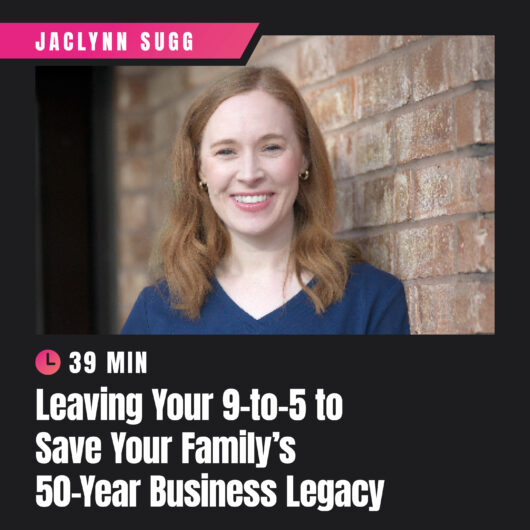
Leaving Your 9-to-5 to Save Your Family’s 50-Year Business Legacy with Jaclynn Sugg
To be a guest on the show, email podcast@postcardmania.com
Listen and watch on your favorite podcast applications.




Episode Overview
Host Chris Foster talks with Jaclynn Sugg, who stepped in to run her family’s dental practice, Wheatland Dental Care, after her father’s death, about consistency, leadership alignment, and building a culture of open, honest communication.
Podcast
Episode Transcript
Here’s the transcription below of today’s episode, a conversation between host Chris Foster and Jaclynn Sugg, who stepped in to run her family’s dental practice, Wheatland Dental Care, after her father’s death, about consistency, leadership alignment, and building a culture of open, honest communication.
Note: This transcription has been formatted from the original episode transcript for readability.
Transcript
Chris: Well, all right, Jaclynn Sugg, welcome in to the Everywhere Small Business Podcast.
Jaclynn: Thanks so much for having me. I’m excited.
Chris: Glad to have you here. So tell us a little bit about yourself and your business.
Jaclynn: Yeah, so I’m Jaclynn, I’m 35. My dad started this dental practice, Wheatland Dental Care, in 1972. He had it for fifty years. He started it when he was thirty-two, and when I was thirty-two, he passed away. I had come on board a little less than a year before he passed to help my family with the business. My mom’s a hygienist, my dad was a dentist, and both of my parents were having health issues, so I left my job temporarily to help with our family business. My boss at my other job was really encouraging about just stepping aside to help my family. Originally I said, “I need like a week off work to come help my family, maybe two weeks. I’ll get the business together and then I’ll be back at work.” And I was leaving in a really peak busy season for our work. I think my boss knew I was a little naive. Five years later, I’m still here. But I actually really love it, so it’s worked out well.
Chris: That is incredible. That’s such an interesting transition to put yourself into. I’m sorry about your father passing. And then, coming into the business, I’m sure there was a legacy you knew about growing up in the business, right? It was your dad’s business, you grew up there. What was that impression, stepping in and assuming the mantle of leadership, versus the stories you heard growing up?
Jaclynn: Yeah, a lot of what I heard growing up, and it wasn’t just hearing stories, it really is the epitome of a family business. Some of my earliest childhood memories are working here. I remember being eight years old on Christmas break, alphabetizing charts. I wasn’t a great reader, but my parents said, “Well, you know the alphabet, you can alphabetize charts even if you can’t read them.” I’ve heard a lot of stories from patients who tell me how great my dad was and how he helped them, but I’ve also just been around to see it in action, to see my dad up here late at night helping patients, and getting here early in the morning to see someone who’s in pain, an emergency. So whenever I came back as an adult, after about a ten-year break where I worked and went to college, a lot of things were just the same. There’s a lot of consistency, patients who really loved coming here, a handful of very loyal team members. We have a team now of about thirty people, and it’s a mix of people on their third day of work and people on their thirtieth year of work. It’s been really neat to get to continue what my dad built. So many people loved him, and not many people say they love their dentist, but I talked to one patient who said, “Every time I come to the dentist I feel so loved.” And that’s our goal, that you come here and feel loved, not embarrassed or overwhelmed or stressed, but that every patient leaves and says, “Man, every time I go to Wheatland Dental, I feel so loved.” So it’s fun to get to carry that on.
Chris: That’s wonderful, what a great legacy to carry on. Did you go to business school, any training at all?
Jaclynn: I did. I majored in finance for my bachelor’s. Then I was working for a nonprofit mentoring college students, and I went to graduate school for organizational leadership. I had about one class left of graduate school when I came to work here. So in many ways I felt like the Lord was preparing me for this, I had some good skills, and at the same time I came in obviously overwhelmed with a ton to learn. So it was a mix of being prepared and also a little behind the eight ball.
Chris: Yeah, it’s interesting, because people go get an MBA, or an organizational development master’s, or a finance degree, but that’s very different from actually living and working in a business.
Jaclynn: Yes, yeah. I’ve read so many business books, and a lot of business, social science, and psychology books as part of my graduate degree, and I love reading books, but there’s nothing like living it. I’d read so many books, and it’s easy to think, “Wow, that’s a really cool story,” but when you’re reading it, there’s an end to the story. When you’re in the story, you don’t know how it’s going to end. Since then I’ve gone back and read some of those same books, and you hear them so differently once you know what it feels like to be stressed about making payroll, or what it feels like when an employee betrays you. It’s one thing to read it, and a totally different thing to live it. There’s a quote I love, and I’ve thought about it a thousand times in the last several years: “The business works on you more than you work on it.” It’s so true. Running a business exposes your insufficiencies, exposes where you’re coming up short, and it really has the potential to make you a much better person. I feel like I have a lot more integrity now than I did several years ago. Not that I wasn’t a person of integrity, but there’s a heightened level of having to keep my word, of doing exactly what I say I’m going to do. If I make a promise to twenty-five employees, I have to keep it. So yeah, I really believe the business works on you more than you work on it.
Chris: That’s interesting, because one of the things I wanted to ask is, you’ve been running a business for five-plus years now. How have you grown as the business has grown?
Jaclynn: I think one of the biggest things is consistency. Being consistent, being steady, doing the same thing every day, the same boring thing every day, has always been challenging for me, and I think that’s something I’ve grown in a lot. My dad passed in August of 2022, which was really hard, a lot of grief. He was ill, but at the same time it was still a surprise, I really thought he was going to get better and come back to work, and that didn’t happen. About a little over a year after he passed, after a year of trying to run a business in an industry I wasn’t extremely familiar with, I remember reviewing our financials and being so overwhelmed, feeling really embarrassed and ashamed, because I looked at it and thought, “My dad worked for fifty years to build this business, and I might be the reason we lose it.” It was not going well at all, and it was so overwhelming, thinking about having to tell friends and family, “I have a bachelor’s, I have a master’s, and I can’t do it.” I was sitting in my car, so overwhelmed, crying, and did what many people do when they’re overwhelmed: scrolling Instagram to escape.
Chris: I was going to say, there are so many answers to that. It’s the bar, it’s the meal, it’s the bottle of bourbon, it’s the beer.
Jaclynn: Right, that’s where we all go to escape reality, scroll your phone. So I was sitting in my car crying and scrolling, right after I’d broken down on the phone with a consultant, and I read something on Instagram that said people who run a hundred miles believe they can do anything. I used to love to run, and I’d stopped around the time my dad passed. At first I thought, “That’s insane, who in their right mind.” I’d done a marathon, but running a hundred miles felt insane. But I kept thinking about it, and I thought, “What would it feel like to believe I can do this?” So I did some research, found a coach, and on January 1st I started training for a hundred-mile race. The first mile I went out to run, I couldn’t even run one mile, I had to stop and walk. My definition of success that year wasn’t going to be how fast I could run or how many miles, it was just going to be consistency: work out five times a week, that’s it. In October I ran a hundred miles and finished the race. What I really learned was that consistency pays off. January 1st I couldn’t run one mile, and on October twentieth I ran a hundred miles. I think that’s translated so much into the business. Running a business exposes your weaknesses and shortcomings, and it exposed how inconsistent I was before. I really learned the power of consistency, that if you do the same boring thing every day for a year, you will make a lot of progress.
Chris: That’s incredible. You know what’s interesting, Jaclynn, is that a business can expose your weaknesses, but it can also reveal your strengths, things about yourself you might not have known. I love that parallel between training for a hundred miles and applying that to your business life. How do you think you’ve grown, now that the business has evolved, you’ve got thirty employees, three days of experience to thirty years, a lot of people to manage, the economics and finance to run, and you were at our growth summit so we talked about marketing too. As you build these skill sets around running a business, I’m thinking you’ve also grown personally.
Jaclynn: For sure, yeah. It’s funny you mention that. One of the things I’ve come to realize is that some of our strengths can be so innate that you don’t see them as a strength, you think, “Doesn’t everybody think like this?” For me, I’m a great visionary, I can have twenty ideas by 9am. I love problem solving, I can come up with creative solutions, I’m a very abstract, big-picture thinker. From everything I’ve read, and it’s affirming to read so many business books and articles because they confirm things about yourself, people who are great abstract thinkers, visionaries, creative people, great with marketing, tend to be terrible at operations, at managing people, at everything over on that side. There’s a great book called Rocket Fuel, and the structure we’ve come to over the last twelve to eighteen months is: I’m responsible for the planning, six months out, a year out, for problem solving, ideas, creative solutions, the big picture, managing the work culture here. And then we have an office manager who knows dentistry very well, she’s been in dentistry twenty years, and she manages the day-to-day, the operations, holds people accountable. We got this format from Rocket Fuel. We were working with a business coach, and he told me, “Jaclynn, these are your strengths.” I was surprised, because I thought, “It doesn’t, I don’t understand people who don’t have this many creative ideas and solutions. What are you thinking about if you’re not thinking about what I’m thinking about?” But yes, it certainly exposes your strengths as well, and if you get the right people to work with, it’s a lot easier to say, “These are your strengths, you take this responsibility; these are my strengths,” and work can be way more fun.
Chris: Right, because you’re doing the things you’re really good at.
Jaclynn: Yeah, and things you enjoy, and I look forward to coming to work because I get to do the things I’m really good at. It still baffles me, the office manager we have, we work together really well, and we’re totally yin and yang, the opposite. She’s so excited when she has one idea, and I’m like, “One idea? I had twenty ideas by nine AM today.”
Chris: Sure, folks who balance each other out. It’s not uncommon to hear from business owners that they need that key person to help operate or run or do something they can’t do, whether it’s the creative side or the operational side. As you get older and develop your skills, you end up moving into the place you like the most, so you develop the greatest skill in that area.
Jaclynn: Yeah, and I think it’s easy to undermine yourself and assume everyone thinks like this, but to have outsiders say, “No, you’re really good at this, and not everybody is,” can be very affirming and encouraging.
Chris: Very validating. So as you think about what’s next for Wheatland Dental, how do you communicate with your staff and bring them on board, get them excited, evangelize the things you’re thinking about?
Jaclynn: That’s a great question, I should write that down. One of the things is we have a lead team of six people, and we have a ninety-minute meeting every Tuesday morning, and my top priority is that the six of us are completely aligned. The way I’d describe it is like a piece of stone, our goal is that there’s not even a hairline fracture. Not that we don’t have conflict, but when we have conflict we work it out quickly and stay completely aligned with each other. Whenever we’re making decisions and trying to get the other twenty-four people on board, my number-one priority is that the six leads are all on board first. There have been some big changes we made just yesterday, but the first priority is always, are we all in agreement? We’ve also had situations where someone says, “I don’t agree with you, but for the sake of the team I can be on board with this,” for the greater good.
Chris: Yeah, alignment’s so key. I think that creates the structural integrity within an organization. If you’ve got twenty-plus people hearing mixed messages from leadership, that can be very discouraging. But if all the leadership is aligned, the team can say, “Okay, I guess this is what we’re doing, and we’re all moving with it.” How did you learn that idea? That’s a pretty powerful concept, making sure there’s alignment in your leadership team.
Jaclynn: There’s a fantastic book called Traction, I think it’s the same author as Rocket Fuel, they’re related. Traction is essentially a business framework to run your business on. It gives you instruction on how to run meetings, solve problems, build an accountability chart. It’s similar, I talked to Joy about this, to the Hubbard management system, it gives your business structure. I was telling a couple of coworkers today, they were asking how the office came to run the way it does, and I said I have a friend who’s an attorney who recommended it, a friend who owns a publishing company who recommended it, a guy who owns a real estate company who recommended it. I kept hearing about this book from people in totally different industries, and they were all saying, “I’ve read so many business books, if you just read one, read Traction.” So I got a lot of it from Traction, this idea of getting people running in the same direction.
Chris: That’s excellent. For you as a business leader and owner, knowing you don’t have all the answers, knowing there are gaps in your own knowledge of how to run a business, seeking out those resources, and figuring out the ones you trust, because there’s a lot out there, but to find that one nugget, like Traction, that the entire organization can rally around, that’s very powerful.
Jaclynn: Yeah, for sure. One of the things it walks you through is helping a company develop its core values. I know PostcardMania has the Code of a Maniac, which I love, someone gave me a poster of it and I just loved it. So for us, we really thought about what our core values were going to be, what’s going to make us different from any other dental office, and what we want to see in all of our team members. One of our core values, and I know this sounds basic, is open and honest. Sometimes when I talk to people about this in interviews, they’ll say, “I’m not a liar, I tell the truth.” What I talk to them about is it’s not about not lying, it’s about being open and honest. So what we ask is: have you ever been slightly passive-aggressive with somebody because you were frustrated with them? That’s not open and honest, if you’re frustrated, I need you to say you’re frustrated. Have you ever been slightly manipulative to get what you wanted? That’s not open and honest either, I need you to be open and honest. Has there ever been a situation at work where you didn’t trust somebody because of something they did? I need you to tell them. We have a clear format for how we work out conflict at our office. What I tell them is, we’re all coming from different families, different cultures, we were all taught to work out conflict differently. At Wheatland Dental, this is how we work out conflict: you go to the person, you don’t text them, you look them in the eye, you start with a question, not an accusation. We give them three points for how to work out conflict. Being open and honest means not being passive-aggressive or manipulative, and if you don’t trust someone, say it. I’ve had team members come to me and say, “Jaclynn, you said this was going to happen and it didn’t happen.” Then I have to own it and say, “I’m so sorry, I didn’t keep my word,” or, “I thought this was going to help and it didn’t.” Being open and honest is also a lot about apologizing, which as a leader you get a lot of practice at.
Chris: Sure. Well, some leaders don’t. It sounds like you’re the right kind of leader, because we’re all human, we all make mistakes. I think one of the challenges is that when you’re put in a place of leadership, it can feel a little lonely, because all the eyes are looking at you to make certain decisions.
Jaclynn: Yeah, it can. A huge thing that’s helped me is developing our leadership team. We started that in December of 2024, so it’s been about eighteen months, and it does not look the same now as it did when we started. We have six people on the team, and three of them have changed out, some have left the business and some have just left the leadership team but are still with the business. Having a leadership team I feel like I can be really open and honest with makes all the difference in the world. I don’t feel like I’m carrying the weight of the business on my shoulders, I feel like the six of us are carrying the weight of it together. It makes all the difference, and I enjoy my work so much more.
Chris: That’s wonderful. And my hunch is the rest of them feel the same way, that they’re all responsible for the business, not just you.
Jaclynn: Yeah, a few months ago we were having issues getting paid by insurance companies, which is a huge deal for us, and I was so stressed about making payroll, on the verge of tears. We had our lead meeting, and I was just really open and honest, “Guys, this is why I’m stressed, and this is what we can do about it.” They were awesome, they said, “Hey, we got it, we’re going to make it through this. We’ve been in business fifty-four years, and we’re going to be in business next week too.” Just to have other people rally around you like that. When I was in graduate school, we did a really fantastic program, and our professors would always say, “Leaders need to need.” You need to ask for help, you need friends, you need relationships. I think about that and it’s so true, leadership can be isolating, but it can also be isolating because leaders have a tendency not to let other people in.
Chris: Right, because it’s almost like it can be lonely by choice. But if you choose not to be lonely, and you choose to reach out, to have friends, mentors, connectors, that leadership team, and be open and honest with them, you find you’re actually not alone, you’re surrounded by friends.
Jaclynn: Yeah. I told a coworker a few months ago, she was asking why we didn’t do something, and I said, “Well, this software is four hundred dollars a month, and this is however much, and that’s why I made this choice.” She said, “Thanks so much for telling me, most business owners don’t tell you how much things cost.” It was just being really open about finances, like this is how much it costs, and money’s tight for everybody. That’s been a big thing I’ve learned and grown in. It takes courage to be vulnerable with your team, because you don’t know when you share things with them whether they’re going to freak out and think, “The business isn’t stable, I’m going to go find another job.” And then you find out who’s really going to stick with you.
Chris: Yeah, no, that’s true. I think that sense of being vulnerable, what I find in life and in business, is that if you’re vulnerable it’s actually a strength, because it takes the courage of commitment from your team and the courage of yourself and the business to express that vulnerability.
Jaclynn: Yeah.
Chris: That’s cool. So right before we started, we were talking about mentors and people you admire. You have a wonderful story about this, why don’t you tell us?
Jaclynn: Yeah, so a common question is: who’s your business mentor, who do you model yourself after, who inspires you? I touched on this briefly, but the reason I ended up here was because both of my parents were ill, and I left a job I loved basically overnight, in our peak busy season, but my boss was so wonderful. He told me, “Jaclynn, turn out the lights in your office, go home, help your family, and your job will be here for you when you’re ready to come back.” So I came into the dental office, and even though my family had had it for years, I hadn’t been involved in so long, I had to go around and learn employees’ names and introduce myself, “Hi, I’m Jaclynn, my family owns the business, and I’m here to be your new boss.” It was really awkward. It was such a weird situation, being put in charge of something where basically everybody else knows the industry better than you. At the time I was thirty-one, and except for one or two people, I was the youngest person on staff, which felt a little intimidating, working with people in their sixties and holding them accountable for their job. It’s weird in so many ways. But one of my favorite movies is Home Alone, with Kevin McCallister, and this scene from the first movie kept playing in my mind: he’s just found out that Marv and Harry are going to rob his neighborhood, he gets home from the grocery store, shuts the door behind him, leans up against it, this eight-year-old little boy, and says, “This is my home, and I have to defend it.” I had that scene play through my mind over and over: I know I don’t know what I’m doing, I know I’m basically the youngest person here, but this is my family business, and I have to defend it. So yes, Kevin McCallister is my inspiration.
Chris: Sure, go, let’s go. You know what I love about that, Jaclynn, is that it’s very honest and open, just like you said you are. We find inspiration everywhere, in different places, a piece of music, or some innocuous thing a stranger does. The fact that you were able to glean that out and say, “This is what it reminds me of, because it’s a family practice, I’m part of the family, the fact that I haven’t run it before doesn’t actually matter, because it’s still a family business, and I can learn how to do this, I can do this, I can get through my frustration, my uncertainty, my doubts, my fears,” pushing past those personal blocks and instead saying, “I’m going to be somebody new, somebody different, and I can do this for the business.” It’s almost as if the business became bigger than you, or bigger than your family, something you had to carry on that was its own thing.
Jaclynn: Yeah, exactly. It’s definitely helpful when you’ve seen the movie a hundred times, I might be able to quote every line.
Chris: That’s fantastic, that’s hilarious. So as we wrap up, this has been a wonderful conversation, thank you for being so open and honest with us. What’s next for Wheatland Dental that you can share? What are you most excited about for the next couple of years?
Jaclynn: Yeah, I’ve loved this, thanks. That’s a great question. Honestly, speaking of open and honest, a lot of what we want to do, one of our uniques as a dental office, is that we don’t do any referrals, you can come here as a two-year-old and literally stay your whole life and get everything done here. I think one of the things we want to grow in is just the basics of dentistry. I was telling Sareth, our office manager, this morning, when I read about really great companies, they do one thing. They don’t do two or five or six things, they do one thing. We were having a discussion this morning about drilling down more on providing the best clinical care and the best customer service, and outsourcing everything else, because we’re not a marketing company, we’re not an insurance company, and just having even more focus on the dental side. There are so many things that can be so distracting, insurance, marketing, HR, this, that, and one of the things I’m working on currently is what we can outsource so we can put more time, energy, and focus into doing great dentistry.
Chris: What you do best, that makes a lot of sense. There are lots of resources for businesses to do that, insurance, marketing, other types of services, so you’re only doing what you do best, and even your mind and attention as a leader isn’t broken up and fragmented into other areas of thought.
Jaclynn: And I think it’s just, all these little things creep in so slowly. You’re concerned about the dental insurance over here, concerned about the marketing, concerned about the accounting and the HR, and then we were talking, and I said, “How much have we talked about dentistry? How much have we talked about patients?” You just realize we need to outsource, simplify, get rid of it, and do one thing better than anybody in Dallas.
Chris: I love it, that’s fantastic, that’s a great direction. Well, thank you for being a part of the Everywhere Small Business Podcast, it was such a delight having you on.
Jaclynn: Thank you so much, I loved it, it was great. I can’t wait to listen to more episodes.
Chris: Great, have a wonderful day. Bye bye.