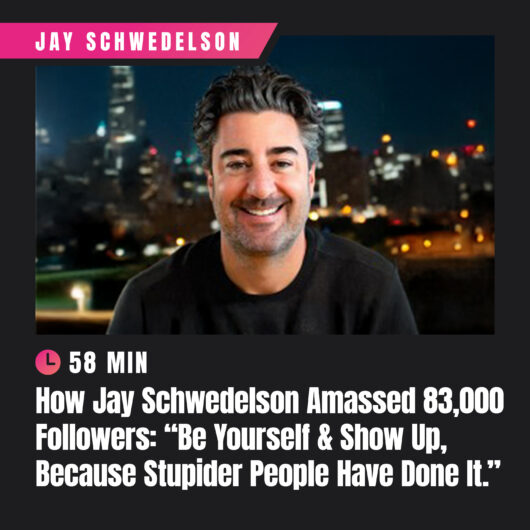
Podcast Episode 12
How Jay Schwedelson Amassed 83,000 Followers: “Be Yourself & Show Up, Because Stupider People Have Done It.”
To be a guest on the show, email podcast@postcardmania.com
Listen and watch on your favorite podcast applications.




Episode Overview
Host Chris Foster talks with Jay Schwedelson, founder of Outcome Media and author of Stupider People Have Done It, about growing up inside his parents’ garage-run direct mail business, letting COVID push him into finally marketing as himself, and why consistency beats being the smartest person in the room.
Podcast
Episode Transcript
Here’s the transcription below of today’s episode, a conversation between host Chris Foster and Jay Schwedelson, founder of Outcome Media and author of Stupider People Have Done It, about growing up inside his parents’ garage-run direct mail business, letting COVID push him into finally marketing as himself, and why consistency beats being the smartest person in the room.
Note: This transcription has been formatted from the original episode transcript for readability.
Transcript
Chris: Well, all right — Jay Schwedelson, welcome into the Everywhere Small Business Podcast.
Jay: I’m loving what you’re putting out there. I’ve listened to a bunch of episodes. You guys are crushing it. Honored to be here.
Chris: We’re so excited to have you. Tell us a bit about yourself and then we’ll jump in.
Jay: Oh wow, that’s a loaded question. So I have two businesses. I have an agency I’ve run forever called Outcome Media, and we work with small, medium and large businesses running a lot of what I call demand generation programs — direct mail, email, social media, you name it. I’ve been doing that a real long time: business to business, consumer, nonprofit.
And then the other piece is a media business, where we put on some of the world’s largest virtual events. Direct mail events, email marketing events, AI events, events about events. So I live in this world of media and agency. I really don’t know what I do for a living, but whatever, it’s all good.
Chris: It sounds like you have a lot of fun doing it for a living. So I want to ask you about that origin story of running your own agency. Did you start off that way, or were you in corporate America and then transitioned to an agency when you realized that was really the juice?
Jay: That’s a great question. What happened was — and I’m going to try to make this not boring — I was in college, back in the early nineties, and the internet was just getting going. I was enamored with the idea that you could advertise on the internet, and back then you couldn’t advertise on the internet. So I started an internet advertising company while I was in college called WebConnect, and it did okay.
Coming out of college, my folks had a direct mail business, and I grew up around direct mail. The business started out in my garage when I was five years old — they started it in like 1979. So when I had this internet advertising business, it was doing okay, but my folks really wanted to get out of the direct mail business they were in. They said, do you want to do something with this direct mail business? And I said, well, maybe I can mush it all into something.
Email was also just starting to come about. So I took my internet advertising business, I jumped into the world of email, I took what was left of this direct mail business, and I said, this is really the format for an agency that could serve clients. I mushed it all together, and that was the foundation of how I went down this agency path. We got to about a hundred or so people doing all this crazy stuff.
And then the media business — I had no plan to ever be in a media business, putting on events, all this stuff. But candidly, when COVID hit, that was a very, very difficult time for businesses in general, and especially for mine. The world of having an agency was tough. I didn’t want to fire people, I didn’t want to furlough people, but all the marketing budgets were getting cut left and right. And I was like, what can I do to get more business? This is a problem.
I wasn’t really on social media. I think I had 400 LinkedIn connections at the time. I had no other presence anywhere. I said, I’ve got to start being out there — which I don’t like doing. I’m not really an out-there type of guy in my personal life. But I didn’t want to go out of business. So I started posting on LinkedIn a lot. And then I said to my wife one day, I think I need to put on a virtual conference, because maybe I’ll meet a lot of people and maybe I won’t go out of business. I said, I’m going to try to make it different and fun.
So I said, screw it, and I launched a virtual conference about email marketing, because why not? And that did way better than I expected. Fast forward, we’ve got this media business, we’ve got this agency business, and I’m now on social media way too much. That’s my origin story.
Chris: I love it. So I’m going to wind the clock back a little. Your folks were entrepreneurs.
Jay: Yes. And that story is crazy. My mom was a school teacher. My dad worked for a magazine subscription company — this is back in like ’78, ’79 — and the company he worked for went out of business. But he was thinking, this magazine business, they constantly need data in order to fulfill and send their magazines out.
He said, I think there’s a play here to organize data — which sounds so ridiculous now, because it’s so easy to get access to data. He said, I think I could start a business around databases for direct mail fulfillment, and I’m going to do this. And they had no money. The house I grew up in cost forty-five thousand dollars. He had to borrow money from everybody in my family to buy a computer, a TRS-80. And they bought this computer and he said to my mom, listen — you’re not making a lot of money as a school teacher, and I’m going to have to hire somebody that costs more than you to help me. Why don’t you just quit your job and let’s do this together? And they said, okay.
And they gave up our garage. They would literally take the Yellow Pages and type it into the computer and make these lists, then try to sell them to companies that wanted to do direct mail campaigns. Every day I thought it was normal not to have a garage. And every day at dinner we were putting Cheshire labels onto different envelopes, putting out these mailings, all this stuff. From the time I was five until whatever, I thought this was normal — literally kitchen table type stuff.
But the reason it was so valuable to me was what I learned about direct mail, which is what I love: you could spend a dollar a mailpiece, right, between postage, printing, whatever, maybe less. And then you could make two dollars if you do it right. And there’s this whole idea of, wow, spend a dollar, make two dollars, and then you scale that up and you test. So I love the idea of marketing. I love the idea of this laboratory. That’s where it all came from for me. I grew up around just try it, and that’s been my ethos.
Chris: I think that’s a family mantra. You said earlier, COVID hit, tough for business, go virtual. And what I love about small businesses, Jay, is that it’s invariably a family business. So you talked to your wife and said, heck, why not? Let’s do a virtual conference. But that was modeled to you as a youngster, because your dad was like, hey honey, quit your job, why not, we’re going to give this a shot.
To me that’s — I call it luck, but really it was the fortitude and the resilience and the energy and the imagination of your parents. You were born into a modeled entrepreneurial mindset of, look, we can try something. If it doesn’t work, that’s all right. Growing up, that was your normal.
Jay: It was my normal, and I will tell you there was also a lot of stress there. You said the word fortitude, and I think everybody listening is likely involved with a small business or is a small business owner, and there is a fortitude — because when you’re a small business owner, you don’t just wake up and get a check every week and go, all right, I worked this week, I got my check. You’re trying to make whatever payroll you have, you’re trying to pay your bills.
And every small business is a family business. That doesn’t mean your family’s working in the business necessarily, but that business is feeding your family. That business is everything. Your entire family is invested in the outcome of this thing. That makes it both hard and amazing. And that is what I grew up around.
If you fast forward, what’s interesting is we grew this media business, and ultimately I ended up selling that first conference I built, Guru Conference. I sold it to Constant Contact, and you know these guys. Constant Contact bought that conference, and they also bought a website I have called subjectline.com. We had a bunch of different companies reaching out saying, hey, we want to buy this event you put together. And we said no, no, no — Constant Contact’s cool, because they help like a half a million small businesses. And I want to be a part of things that help small businesses, because being a small business owner is amazing, but brutal. It’s so not easy.
Chris: It’s so not easy. Every conversation I’ve had so far in this podcast, Jay, has had a moment of Test with a capital T. It’s a test of the business, it’s a test of the character of the business owner. There hasn’t been a single one where they haven’t had to burn the ships and go from there. You mentioned this fortitude, this resilience, this mental ability to move forward. Of course it’s not easy. It’s really tough.
But you mentioned your dad was like, hey honey, I don’t want to hire somebody, could you please jump on board? And so now we’re all in it — the whole family’s in. Jay, we’re going to put some Cheshire labels on at dinner. Here’s the casserole, here are the labels, let’s do it. We’re all in this together. And when you graduated from college you were like, hey Pop, I’m pretty interested, why don’t we mush all this stuff together?
But you had a choice. You’re in your early twenties, Jay, and you had to hire somebody. What was that first hire like? Because suddenly the business extends beyond just you and your family. Who was that hire, and what was that overture like?
Jay: It was terrible. I would say the first bunch of hires I made were all horrendous. It’s a weird thing — as a small business owner you’re almost always selling. You’re always selling something. I couldn’t even help myself back then. No matter what, if I was out to dinner with friends, I would be selling my idea for whatever it was I was doing.
So when I was interviewing people initially, I would be selling them on why they should come work for me. And they’d be like, okay, great, I’m excited — we’d get somebody so excited. And then they would come on board and I’d think, oh my God, I didn’t even find out if this person was a doofus or not. And I kept doing this over and over again. It took me a while to realize, wait a minute, there are certain times where you’re not always just trying to sell, you’re trying to do this other thing.
In almost everything I’ve done in my career, and any business I’ve done — and I think small business owners will appreciate this — when I look back at the first version of a conference I did, or something I sent off to a client, I cringe. It is so horribly bad when I look at the first version of whatever, that I’m like, I can’t believe we even made it, because it was so bad.
But then I started to realize: listen, the first time you work out, it’s really bad. The first time you put out a podcast, it might be really bad. The first time you do anything is really bad. In order for it to be really good, you have to have really bad. So I was bad at interviewing, I was bad at hiring, I was bad at being a boss, I was bad at everything. But here we are.
Chris: Here you are — you learned through it. Some people learn through their mistakes. Some people get a second chance to make the same mistake twice, or three or four times. And I think that’s a beautiful idea, Jay — Jay 1.0, Jay 2.0, and now you’re Jay 75.2, whatever that is. The evolution of you, and your evolution parallels a business evolution.
Jay: Well, it’s true. And the other thing that happened very early on — I actually just recently wrote a book called Stupider People Have Done It. That’s the name of the book.
Chris: I do want to touch on that later, because it’s awesome, and I have it on my Kindle.
Jay: Amazing. All right, I’ll get to that later. So where were we? I took us off course.
Chris: No, you’re great. What I was wondering was, there seems to be this thing where you personally, Jay, are a different man than you were fifteen, twenty years ago, and that parallel path of growth happens with your business too. It’s different when someone chooses a career — yeah, they grow in their career, maybe they develop skills, maybe they get to manage, maybe they get to director, maybe they get to VP, maybe they get these different levels and titles at different companies as they mature and grow. But as a small business owner, the business grows with you and you grow with the business. If you don’t grow, the business does not grow.
Jay: That’s right. And when I look back and say — because I guess people do this — I’m twenty-eight years into this wild career, and I ask, okay, what do I wish I knew earlier? What do I wish I did differently? There’s really one North Star related to all that. Because you’re right, I did change a lot. COVID really hit me hard.
Every small business owner at some point probably has to deal with this, unfortunately: when your back is against the wall and you’re like, I might go out of business. When your back’s against the wall like that is really when you’re like, well, I’m going to try just about anything to make a success of this thing. COVID did that for me.
And what happened during COVID, which frankly I wish I knew twenty years ago, was number one, be comfortable being uncomfortable — everybody says that — but actually, be myself. Up until COVID, I was playing everybody else’s game. I was talking a certain way, dressing a certain way, writing emails a certain way, presenting a certain way. I wanted to make sure I was doing it like everybody does in whatever industry I’m in. I don’t want to be too different.
Then when COVID hit, I started putting on this virtual event and posting on social media. I first started out very green screen and rigid and all this stuff, and nobody cared. And then I put out a post about something extremely random, and it was just me, the way I normally talk — and it did incredibly well. I thought, maybe I should do more of that.
What I started to realize — and this is perfect in this world of AI — is that the more you can lean into the humanity of who you are, the better. Everybody is interesting. Literally everybody. Share a little bit behind the scenes. The irony is, if you look at today, what is the top-performing content on Instagram, on LinkedIn, on TikTok, on Reddit, on any social media platform, no matter what market you’re marketing to? It is human content.
And human content is lo-fi content. Behind-the-scenes videos. You manufacture something — take somebody into your plant, show a video of how it’s manufactured. You own a bakery — take them through the steps of how you get your flour delivered. If you’re selling a services business, do a walk-and-talk and say, hey, I’m going to meet with this new client, I’m going to do their tax work, and this is why it’s a big deal.
The humanity of it all, the lo-fi content where you’re actually showing who you are — the engagement is exponentially higher than any other type of stuff you could put out there. But it’s also the stuff that makes you the most uncomfortable, because you’re like, well, I don’t want to do that. I don’t like me on camera. I sound funny when I talk. I’m an introvert. I don’t know enough. Or people won’t find that interesting, that’s so boring, everybody knows that. None of that is true. And the sooner you realize that, and the sooner you can insert the humanity of it all, that’s when — for me — my businesses really went to another level. If I had known that ten years ago, that would have been a really great thing. But it’s something we need now more than ever.
Chris: We do. I love the Oscar Wilde quote — just be yourself, everyone else is already taken. And a business is the same thing. When we talk to businesses about positioning, which is a marketing term for how are you different than the other guys — how are you different and better than the other guys — the idea is that you’re different because you’re you. Every business has the personality of their owners.
And for you, I love that you went there, because it was one of my planned questions. You do have a playful personal style. Just so everybody knows — your Guru event is about email marketing, and everybody knows email involves a term called spam, the bad emails. So Jay had a spam eating contest. They’re eating Spam, like Spam out of a can. It’s awesome. The cans were CAN-SPAM compliant. Look, I’m opening up a can of Spam. It’s fun. And I think that’s actually you. I think you’re a comfortable, playful guy who is getting more comfortable being yourself. And I think it’s fascinating, Jay, that it took the crisis of COVID for you to reveal that.
Jay: Yeah. It’s frustrating for me that that is what happened. But look, the timing of it is great, because I do believe we’re in this age now where being a human is the secret sauce to success. I don’t care what business you’re in. If you own a pizza parlor and you’re new to some local market, how are you going to get people to show up to your pizza parlor? You’re going to hire a local influencer who’s going to drive people that are interested in pizza to your place — because we are interested in what humans have to say.
And for myself, you’re absolutely right. I think people get scared. I put on events about all sorts of different topics. You mentioned our email marketing event, the one Constant Contact now runs — that’s amazing. But to make those events work, everyone’s like, well, virtual conferences, why would anybody — that’s a weird thing to be involved with, those are dead, I don’t want to attend one of those. And that’s valid.
So we try to say, well, what can we do to insert humanity and look at it differently? For example, at any of our virtual events that now get thirty, forty thousand people, we don’t allow any on demand. Which is wild. If you’re not there, you’re not a part of it. Well, you can’t do that. Why not? This is how you actually get people to show up — because they’re going to miss out on something.
And beyond that, we try to insert fun things that have nothing to do with any of the topics we’re talking about. At our last event — which was an event, believe it or not, about events — we had a live cannonball guy, a guy shot out of a cannon, and he had to land on the thing. We were all staring, and for about five seconds he didn’t get up. I thought he was dead. I’m like, I’m going to jail, I don’t know what’s going to happen. And then he stood up, and I’m like, thank God.
Chris: Oh my God. Oh my God, my insurance is not going to crush me. That’s hilarious.
Jay: A hundred percent. And we try to do this stuff. We’ll do a dance contest — we had Lance Bass from NSYNC judge a dance contest. We had Flavor Flav do an air guitar contest with us. We try to do things to make it different. But that’s any business. If you think in this world that you’re just going to make the best of something — I’m going to be the best real estate agent, I’m going to make the best pizza, I’m going to make the best iPhone case — and that just by being the best is enough, it’s not. Some of the best products and services in the world go out of business because they’re not going to market with this human feel around it.
Chris: Yeah, I love that. And also, what you do now impacts your business three, six, nine months from now. So if you’re a small business and you have aspirations for growth — brother, I’m here to tell you hope is not a strategy. I hope my business grows. I hope we do well next year. No, that’s not going to do it. You’ve got to actually act.
I think it’s amazing that you almost went out of business during COVID, and so often it’s that moment in a business’s life where you’re like, you know what, the greatest thing I have is myself, I’m just going to be myself. So in the course of doing this now, Jay — you’ve been running agencies with hundreds of employees, and now you’ve got an events business — from a marketing perspective, what have you learned as the thing where you realize, this is my North Star in marketing, and if I ever forget this, I’m doomed?
Jay: It’s a great question. First of all, I learned — and this is not me being self-deprecating — I’m not the smartest dude on the planet. I didn’t crush it in school. I had to take statistics three times in college just to get through it. And I know I’m not the smartest dude. So I said, well, how am I going to win if I’m not the smartest dude?
What I’ve learned is that the secret to all things is consistency. And when I say consistency, I don’t mean I wake up at the same time every day. I believe that by being consistent in your business, you could beat out ninety-five percent of anybody else on the planet. By consistency, I mean never stop doing stuff. We put out a podcast, I put out newsletters, we post on social media, I post on social media — and all of that is something we never stop doing.
As much as it’s crazy annoying, a lot of times I’m like, what’s the attribution, are we even making any business on this? But we don’t stop. We don’t stop posting. We don’t stop getting the word out. We don’t stop emailing. We don’t do something for six months or one year and quit. We never, ever, ever stop.
Because the businesses that fail, in my view, are the ones that say, okay, we’re going to post on social once a week about blah blah blah — and they do that for like three months, they don’t see a lot of traction, and they’re like, all right, this isn’t worth it anymore. Or we’re going to do a podcast, and they do like twenty episodes and go, this is not working for us. That is where failure happens. I don’t mean you should do the exact same thing — you could tweak it, make it better, whatever. But consistency will beat out smartness every day of the week, and I think that’s where most small businesses actually fall apart.
Chris: Right, it’s the give-up. So I talked to this brilliant woman, Stephanie Betters. She’s the CEO of Left Main REI — super niche of niche, a software company that focuses on real estate investors. She’s awesome, but brother, she started as a cardiovascular thoracic nurse practitioner. Hardcore.
And then she started to flip houses on the side as a side hustle with her husband while she was raising kids. And she was like, I need to make this easier, I need to make this more effective. So she started to make software for it. But what she said was that there were a thousand reasons why she couldn’t do it — a thousand constraints. I can’t do this because I’ve got to pick my kids up, I’ve got three kids, we’ve got to get dinner on the table, I’ve got to do this.
And she said at any one of those points, the easiest thing in the world would have been to stop. The easiest thing. But she didn’t. She personally persevered and went through it, and now she’s got almost twenty employees. Your parents showed you that it was possible if you just start working and putting one foot in front of the other. So that consistency thing can’t be understated. And in some ways, Jay, it seems not just like a practice — like every day you’re doing it — but almost like a mindset.
Jay: That’s right. First of all, it’s a very annoying mindset. And it probably comes from a place of fear. It’s why — listen, I’m in therapy, I’m very open about this. None of this is easy stuff, because it’s not easy. But you just have to keep pushing. I’ve done so many things that have absolutely failed over and over again. So many different things I’ve tried and failed. You just keep trying and you don’t stop.
And I will say — this is not a commercial for PostcardMania, but I’m going to say something about postcards in general. I think it’s another shining example of consistency. There’s a saying that ninety-five percent of your market, whatever you’re selling, is not in market for it in that moment. Only five percent is. So what you need to be doing is to be in front of those people, those companies, whoever may be buying your stuff, on an ongoing basis. So that when they are in market — that one moment they are in market — they’re thinking about you.
And the thing I love about postcards, going back to my direct mail world, is that when you get that postcard from a brand and it sits there on your desk and you put it off to the side, and maybe you’re getting another one a month later or six days later, and constantly you’re getting this postcard over and over again — at some point you’re in market and you’re like, you know what, who should I use? Wait a minute. That company does a great job, and they’re always in front of me. I’m going to call them. That consistency is how you win.
Chris: And that’s actually how Joy Gendusa, CEO and founder of PostcardMania, grew the business. She relentlessly marketed, and every week postcards go out promoting our business. And you know what she found? The more I mail, the more revenue I get. And the more I mail, the more revenue I get. Over twenty years, as the marketing spend increased for PostcardMania, the revenue increased. The graph speaks for itself, Jay.
Jay: Yeah. And the critical thing for small business owners, which I think is what messes them up, is they try to look at it as, I spent this much on this marketing thing, how much money did I make? They make it very transactional, like there should be a straight line. And of course you want to be measuring things, that’s very, very important. But there is an enormous amount of revenue being generated in what you can call dark social, or dark marketing, where you will never be able to find the attribution as to why that company decided to use you, or why that person decided to buy from you.
It is the adding up of all the things you have been doing, and the consistency — like you said, the PostcardMania story, the consistency of that marketing is how you will win. If you’re just trying to line up dollar spent to dollar earned, you will give up on so many marketing activities, and that is where it’s going to dry up.
Chris: That’s a great point. In fact, I talked to a guy, a wonderful man, Andrew Clegg. He runs a soft wash and pressure washing business in Georgia. Brother, he’s twenty-one years old and he’s going to maybe hit a half a million dollars in top line this year. He’s four years in — he started this business when he was seventeen.
And he said, well, I heard about you because a friend of mine that I trust has a landscaping business in Alabama and he used you. And because I heard about you from him, then I went online and then I was able to get in. So it was like you said — it’s the accumulation of visibility and presence in customers. Because you actually don’t know truly. Yes, you need to have that attribution, but you don’t know where this next lead, this next opportunity, is going to come from. And just the simple act of marketing consistently helps build that out.
So I love that, because you answered one of my questions about what you’ve seen as some of the success. And I also think it’s interesting you say, gosh, I’m not the smartest guy, but I might be the hardest working guy. And if I can outwork and out-consistent — I don’t think that’s a verb, but I just made it a verb — if you out-consistent other folks, you’re going to get ahead.
So now I do want to go to the book you wrote. You said the book is Stupider People Have Done It. Folks, you can buy it on Amazon. It is a USA Today bestseller, and I will tell you I bought it, put it on my Kindle — of course — and proceeds go to supporting a cancer charity, which I think is brilliant. So give us a recap. Why did you write it, and what message and lesson did you want to drop into the readers?
Jay: Well, first of all, it’s ridiculous that I wrote a book. Like I said, I’m borderline illiterate, but here we are. I got approached about writing a book about marketing tactics and stuff, and I said okay — but first I said, I shouldn’t be writing a book. So my first premise was that I’ll only do this if I can donate all my proceeds to this organization, the V Foundation for Cancer Research. Which I’m proud to say, because of the book, we’ve donated over $130,000 so far. And they said, great.
And then I started writing the book, and it was about all this regular stuff — put this in your subject line, post on social media on this day. And I was like, this is horrendous. I hated it. I was ten chapters in and I’m like, this is the worst book I’ve ever read.
Chris: This is the dumbest book ever.
Jay: So I went back to the publisher and said, I just need to write the book that I would read. They said, okay, fine.
Then I took a step back and thought, well, what is this all about? And early on in my career, when I was really trying to get started, I was at my office — this is exactly what happened — and I had my hands on my head. I couldn’t make the sales, I couldn’t do anything. I thought, I’m not built for having a business. And my grandfather — I didn’t know he was showing up to my office — but he showed up, and he walked into where I was sitting and he goes, Jay, what’s wrong with you?
And I said, I don’t know. I can’t do this. I’m incompetent. I don’t know what I’m doing. And then he put his arm around me and he said, this is going to hurt. I said, okay. And he said, stupider people than you have been able to do it.
And I was like, wait a minute. There is somebody out there that’s stupider than I am, and they were able to do it. For some reason — it shouldn’t have been — it was the most motivating thing anybody could ever say.
And then the other thing he said to me, which is not in the book: back then we all had phones on our desk. I had a gray phone on my desk. And he said, you know, that thing’s not just going to ring by itself. You’ve got to pick it up and do something with it. He was basically kicking me in the butt and saying, call people, try to get business, get off your butt.
So that was kind of the ethos of the book. I wrote it really just trying to share life lessons, motivation stuff, little marketing tactics. I’ve also found in my career there’s no one thing you’re going to do that’s going to make everything work, so I try to share little secrets I know about marketing to actually move the dial forward — and also nonsense. I share as many ridiculous things about my life as I can. I’m glad the book was well received. I’m shocked and happy. It’s almost like a pop-up book, that’s how stupid it is. But listen, I appreciate the fact you checked it out.
Chris: I’ve got it on my Kindle, I’m reading it, and I’ve read a piece of it, which I love. And first of all, I really appreciate you sharing that story. One of the reasons we wanted to start a podcast here at PostcardMania was so that small business owners could share their stories and other folks could learn and listen from them. Because for me a small business is a family business, a family business is a people business, and everybody is interesting.
You mentioned that before — everybody’s interesting. And I think what’s awesome is that you had a cinematic hero’s journey mentor moment. Your grandfather is Yoda. Your grandfather is Gandalf. And he says, Jay, stupider people have done it, and you’re like, whoa. That is such a beautiful moment.
So I think that — you talk to people all the time. Are you now realizing that when you talk to people, CMOs, directors of marketing, VPs, people who maybe have MBAs, you think, they might be smarter than me — but you know what? They’re not me. They’re them. Are you really leaning into this? I don’t mind sounding like a goofball — I like Taylor Swift, but I’m not a huge Swiftie — it’s kind of like the Taylor era. It’s like the Jay era. Looking from afar, it seems like you’re really flourishing and just leaning into being Jay.
Jay: Yeah, and I think that’s — I think every small business owner needs to do that. If you believe in this world that we’re in today that you’re going to have a small business and be the owner of it, and you’re like, well, I don’t really like being out front, that’s not what I’m comfortable doing — I think you’re going to have a hard time. Because when we all spend our hard-earned money, whether that’s on a consumer product or a service or a business service or whatever, we want to know the human behind it if it’s a small business.
There’s a reason we’re buying from a small business: because we like their backstory. We like the interaction we have when we go there. We feel connected to that owner. You’re not buying from a small business because they’re the slickest, the coolest, whatever. That’s just not the reason. You go and buy from Nike or Apple or Amazon because yeah, they have the game, the system. But if it’s a small business you’re going to interact with, it’s the human element.
So for me, I’m like, okay, this works for me, I’m comfortable being me. I may not do this in my personal life — I can’t post on Facebook, it’s like nails on a chalkboard. But it’s also that I realized you can’t take me from me. I’ve lost a lot of big clients over the years, and when you lose a big client it hurts really, really bad — financially, ego, the whole thing. And I said, I want something nobody can take from me. I want some sort of megaphone that I can get business from that nobody can ever take from me. And if I make myself the megaphone, then you can’t take me from me.
That’s what I’ve tried to do, and I lean into that, and it’s helped my business quite a bit. I don’t have salespeople anymore. We got rid of all of our salespeople, because now my business is that I can just go out there, talk, post, whatever, and then people hit me up and they’re like, what the heck do you do for a living? That’s really our go-to-market. It’s not that sophisticated.
Chris: That’s awesome. I think that leaning into yourself, being yourself, promoting yourself and being proud of who you are as your business — I love that. That’s a big softball-size pearl you just dropped right in.
So tell me, Jay, your connection with Constant Contact is such an interesting — I’m not going to call it a dichotomy, but it’s a shift. Here’s Jay being Jay, and suddenly Constant Contact, one of the largest small business support brands in the country if not internationally, says hey, we want you to be a part of this team. What was that conversation like? Was it, yeah, you’re just going to get me and I’m folding into something larger? Was there a different conversation? How did that work?
Jay: Yeah, so you’re right, Constant Contact’s a beast. They’re over half a million customers worldwide. If people aren’t familiar with it, they sell — I don’t know how they do it so inexpensively — but they have this tool where you can send out your email marketing, your SMS messages, your social media, all for like, I don’t know, less than fifty bucks a month or whatever it is. It’s wild.
So what happened was, with my media business we put on all these conferences, we have all these websites, all this stuff that we do. And coming out of our email marketing event this past year, Guru Conference, where we had thirty thousand people at it, the team at Constant Contact reached out. They said, you know what, we love what you’re doing for small businesses with your email event. We also love what you’re doing with your website, subjectline.com, which is a free resource for small businesses to improve their email marketing. We’d like to acquire those businesses. And you’re a champion of small business — we’d love for you to help us get the word out to the world about how small businesses should be doing marketing.
The reason it was a fit for me is that they care about small businesses. This is not just that they sell a tool and small businesses use them. Their thing is so wildly affordable, and all they care about is small businesses. They’re not trying to be everything for everybody. So I said, you know what, this is a great fit for me. We sold them those assets.
And then I have a handful of brand ambassador relationships in different buckets. Do I do it because it’s good for me as a business? Absolutely. But I only want to talk about brands that I believe in, and I fully believe in what Constant Contact’s doing. Because when you’re focused on small businesses, what you’re really focusing on is families. Families that are trying to put food on their table, put out the best products and services possible. That’s what they care about, so that’s why I care about it. It’s been a great relationship.
And I don’t think it’s dissimilar to what PostcardMania cares about. You guys are really trying to create something where — listen, you’re a business, you want to make profits, but you want to make it accessible that small businesses can do direct mail and not burn all their budget, and find success. So you and Constant Contact are very similar in your ethos, and that’s why I partnered up with them.
Chris: That’s wonderful. Just as a reminder, you’re spot on — our mission is to help one million small businesses grow through education, marketing and technology. And the genesis behind that, Jay, is that if a small business can market to the place where they grow, they can hire one more person. And if we can duplicate that across a thousand, ten thousand, a hundred thousand, a million businesses, where they hire one, two, three more people simply because of their marketing activities and their growth — Jay, we can actually help create an upward spiral for the American economy.
Look, we’re getting no help from the top. Nothing’s coming from Washington, gang. It’s not happening, we know that. So for us as communities — small businesses are what, ninety-nine percent of all businesses? Fifty percent of employed Americans are employed by small businesses. One out of every two neighbors you’ve got. Small businesses are the lifeblood of the American economy, and they are the structure and the strength of a community, period. If we can help do that, we strengthen communities across the country, economically and culturally. It’s an upward spiral.
I just talked to this fantastic woman, Jessica Aubin. She started as a speech pathologist at a school — solopreneur, her own self, she hangs her shingle. She gets a client, she gets a couple folks, and she’s like, oh my gosh, I’m actually getting more work, I need to hire somebody. And then, oh my gosh, to get more work I need to hire somebody. And suddenly she’s in this strange transition from being a speech pathologist, Jay, to being a business owner.
She goes through all the challenges, all the face plants, as she calls them. But if you face plant, at least the one thing you can do — like Rocky Balboa says — is get up after you face plant. And Jay, she is the epitome of the upward spiral. She invested in marketing, grew her business, and she’s got about twenty people now that she employs. She’s created employment for twenty people. And guess what? She’s hiring.
This other guy, Brian’s Lawn Maintenance — he’s hiring. And in fact, Jay, what I love is he’s hiring an apprentice. He’s hiring an apprentice-level person. That’s exactly what we want small businesses to do — create opportunities for other people to be a part of this great American story.
Jay: Totally. Wow. That is such a great focus and goal. And I also saw this past month there were more small businesses created in the United States than any other month, I think, ever. This is a magical time to take that leap, to do that thing.
I’ll tell you the other thing for small business owners out there, if people are thinking about starting a small business: I believe fully that regret is worse than failure. I have a lot of runway left in my career, but I’m twenty-eight years in. And what I don’t want to have happen, when time runs out, is to say, you know, I wish I would have done this, I never gave that a shot. If you’re out there thinking about that small business, this is a magical time to do it. Because I think the entire world, in terms of how we’re looking at buying products, we want to buy from small businesses. We want to help that small business owner get their shot. So it feels like the right time to take a leap.
Chris: A hundred percent, and there are more resources than ever. It is easier than ever now to start your own small business. It’s never easy — look, it’s never easy — but the tailwinds in your favor are that you can get a website set up. You can work with folks like Constant Contact to start email marketing. You can work with folks like PostcardMania to start an ongoing marketing program. You can get a CRM system to manage your contacts. You can do this relatively inexpensively. You can promote on TikTok and Instagram.
And what I love about TikTok in particular is that it’s the democratization of marketing. In the past you had to spend a bunch of media budget to get stuff out there, but you can do this now. So to your point about the time being right — yes. The resources are right, that’s there. That final crucial ingredient, though, is the space between your ears. Do you believe?
Jay: Oh my God, tell me about it. Listen, the space between your ears is hard. And I don’t think people talk about — I know everyone talks about mental health, but maybe because dudes don’t talk about it that much, guys don’t talk about it that much — I’ve gotten very woo-woo in like the last year. And I like sharing that I’m woo-woo, because I think anybody out there who just seems like they have it all together, they don’t. Everybody has stress. Everybody has sleepless nights.
I wake up every day now and I need to do meditation. I need to go on walks, I need to read all sorts of crazy stuff, because it is hard, it is stressful. Anybody that pretends like it’s not is full of garbage. So don’t think that because you feel nervous, have anxiety, feel imposter syndrome, that you’re not on the right track. That’s called being a human.
Chris: A hundred percent. I love that. All right, you’ve been awesome and you’ve been dropping some of these softball-size pearls, which are fantastic. So give us another one — you might have already said it, and if it’s a repeat, it’s worth it.
I’m a twenty-seven-year-old and I’ve got a lawn care business that I’m just kind of getting into. I’m trying to hit that next level of revenue. I’m struggling, I’m scraping by at about $325k. I want to get to $750k, but my real goal is to get to $1.2 million and I want to hire a crew. So Jay, I’m working hard at it — what do you think I should be doing that I’m not doing now?
Jay: Okay, so: micro-boosting. This is the one tactic I think small business owners are sleeping on. I’m talking about something that will cost you less than probably $30 a week.
Chris: You said micro-boosting?
Jay: Micro-boosting. So what I mean by that is, let’s say you have that landscape business and you’re like, how do I grow my area? I post on social media, I’m not getting any traction. Let’s use Instagram for example.
If you go on Instagram and you post — today I’m doing fertilizer here, which is great for tomato plants, and if you’re interested in this you’ve got to let me know because this is the hottest trend, whatever. Great. You make that video, you put it on Instagram, you get three people to look at it, you get one like, and it’s your mom, and the whole thing is not going well.
But what you should be doing — the way Instagram works, which people don’t realize — is if you boost that post, which means you put ad dollars behind it, you could literally put $15 behind a post. That’s all you need to put. And then use targeting: I want to target people in this zip code, maybe this income, homeowners, whatever. You do that type of targeting. And if you just spend $15 to boost a post, you will get exponential circulation, because Instagram wants more people spending dollars on advertising, and they overdeliver massively when you boost a post like that.
So any post that you put out, literally carve out $30 a week. If you micro-boost those posts, you will see an enormous amount of activity. And then every single person who likes your post, DM them saying, hey, you checked it out, what do you think about this? And that works not only on Instagram — that works on LinkedIn, that works on TikTok, that works on YouTube. Literally spending $15 to boost anything you’re doing on any platform will change your business for relatively no money.
Chris: Boom. That’s a volleyball-size pearl. Beautiful. That’s fantastic, I love it, thank you so much.
All right, so Jay, I’m calling it your era of flourishing. I just am — whether you like that or not, you can wear it or you can toss it. So what’s next for your era of flourishing? What are you looking forward to for the back half of the year and into 2027?
Jay: Yeah, so listen, we’ve got to be doing AI stuff. If you’re not doing AI stuff, then you’re not really doing anything in this life. So we’re leaning in heavily into how to leverage AI to be more productive, to do all things for my business. We’re launching a new event in December — it’s going to be an AI-focused marketing event, but really for small businesses.
In general, you want to be putting out as much content as possible to help small business owners win. So we’re starting weekly webinars and just more garbage that we’re putting out there for everyone to consume. So more is basically the answer.
Chris: I love it. Well, that was fantastic. Final question for you, Jay — do you have a question for me and PostcardMania?
Jay: Yeah, I do have a question for you. What is the future of direct mail? What’s the future of this podcast? What are you guys focused on over there?
Chris: Great question. That was a three-part question, so I’ll give you the three-part answer.
The future of direct mail is integrating a lot of different kinds of data to do direct mail for a lot of different places in what they would call the customer funnel, or the customer journey. Direct mail is great for acquisition. So at PostcardMania we have direct mail plus a program called Everywhere Small Business, where we integrate Instagram, Meta, Google, CTV and YouTube along with direct mail. It’s this multi-touch program, which is fantastic, and that’s great for acquiring new customers.
But what’s awesome is all the small automated programs that are triggered automatically based on data. One of them is called Website to Mailbox, where we can mail to website visitors who don’t buy or convert or fill out a form — which is ninety-eight percent of people who visit a website. Only two percent actually do it, so ninety-eight percent walk away. And studies show seventy to eighty percent of those folks never return unless they’re retargeted. Retargeting digitally is challenging — it can be very expensive and it gets overlooked. So we do direct mail retargeting, which is amazing for small businesses, from e-commerce to retail to services.
We also have a thing called New to Town. If you’re marketing to new movers and new homeowners, we have an automated program that markets to these folks every day automatically. We have what’s called a radius mailing, or the in-the-neighborhood mailing — so if you’re an HVAC company and you finish a job, you can immediately mail to 150 homes around the job you just did and say, hey, we just worked for your neighbor at such and such.
And the other product we have is called automated smart touch mailings, which taps into your CRM system — whether it’s HubSpot or Salesforce or HighLevel or whatever CRM you have. You can automate thank you cards, you can automate lead nurturing cards, you can automate retention cards. All of that is automated. So what’s next for direct mail is a beautiful place where it’s as easy to send direct mail as it is to send email. We’re actually connecting with Constant Contact, figuring out how that goes, because they work so well together.
The second piece is that what we’re trying to do at PostcardMania is truly educate small businesses so that — Jay, it’s that stuff between the ears we talked about. It’s the belief that marketing can work for them. And if they believe that marketing can work for them, more importantly, if a small business owner believes that they can grow — there’s a lot they can’t control in the world. They can’t control the price of gasoline. They can’t control interest rates. They can’t control the stock market. But what they can control is what they do every day, and they can control how they mentally think about the growth of their business and invest in that growth.
So if we can say, look, believe that you will grow if you invest in marketing consistently, just like you talked about — and it’s not an expense, Jay, it’s an investment. It’s like food. I guarantee you that if I said, hey Jay, I want you to eat one bowl of rice every week, you’d be like, that stinks, Foster, I’ll feel terrible. But if you eat three healthy meals every single day, your body feels good. The same is true with a business — balanced meals every day, balanced marketing every day.
And if they get to the place of believing that, then they will figure out, oh my gosh, because I did this, six, nine months from now I’m doing better. And fifteen months from now I’m in a place where I can hire somebody. That’s the goal — to get these businesses to grow so they can expand that community.
And to your last question about the podcast: that’s why we’re doing it. We’ve got conversations with owners, leaders and marketers from the world of small business, so that they can share their stories and hopefully inspire other small businesses to look in the mirror and say, I can do this. I’ve got help, I’ve got resources, I can learn. There’s a ton of stuff out there. If I put my mind to it, I can do this too. I can. I will. Again, it’s not easy, but it’s doable. Because as you said — stupider people have done it.
Jay: Love it. There it is. Boom. Love it.
Chris: I think what you’re doing is fantastic. We’re really excited to keep in touch with you, Jay. Best of luck to you and your team, go small business, and thank you so much again — and blessings to your family.
Jay: Appreciate it. Honored to be here. Thank you.
Chris: All righty, have a great day.