Podcast
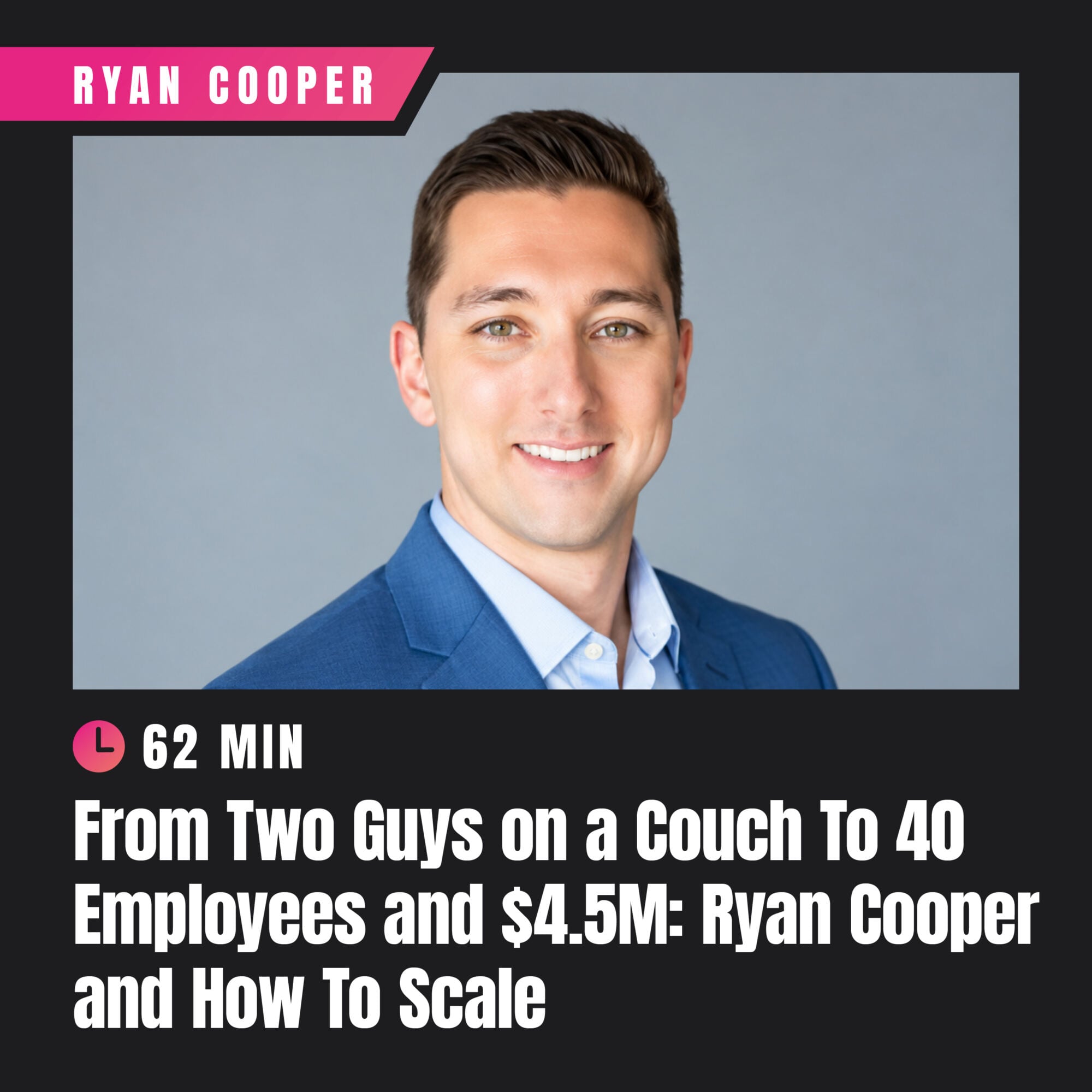
From Two Guys on a Couch To 40 Employees and $4.5M: Ryan Cooper and How To Scale
To be a guest on the show, email podcast@postcardmania.com
Listen and watch on your favorite Podcast applications!










Podcast
Episode Transcript
Host Chris Foster talks with Ryan Cooper, co-founder and chief revenue officer of Set to Close, about growing the company from two founders on a couch to 40 employees and $4.5 million in four years. Ryan shares how documented processes, the right people, and a strong company culture helped them scale.
Note: The supplied episode transcript has been formatted for readability; its spoken wording has not been fact checked.
Transcript
Ryan: Mantra here internally is like you're not first or last, reverting back to some Ricky Bobbyisms from uh Talladega nights. But that was kind of our mindset is that we wanted to be, you know, one of the fastest movers, but you know, obviously making sure we're doing things with quality. But we wanted to put in the extra work, extra time to really hypercharge the business. And I think that was one of the differential factors where you know Jordan and I don't have a typical schedule when it comes to this. We worked, you know, typically every day of the week together talking about how we're thinking about growing the business, how we're looking at different areas to analyze and really identifying areas of opportunity. So I'd say that's probably the first factor. And number two is having, you know, the best team in the game.
Chris: Welcome in to the Everywhere Small Business Podcast, where we have authentic real conversations with owners, leaders, and marketers from the world of small business. Look, there's a lot that small business owners can't control. But what they can control is how they manage their growth. And one way to grow, well, is by learning from other owners who are on their own journeys. I'm your host Chris Foster, and each episode is packed with conversations and true stories, the origins, the successes, the mistakes, the lessons learned, the big challenges, the great decisions, and advice that you can use in managing your own business growth. Brought to you by Postcard Mania, we're on a mission to help one million small businesses grow through education, marketing, and technology. And in these stories, we're going to shed light on what the world of small business is really like, hearing from the folks doing the work, and passing on the lessons you can use to grow your own business. And in this episode, we're going to be speaking with Ryan Cooper from Set to Close. Set to Close is what they call a revenue operations company. Well, what does that mean? That means they use softwares like HubSpot to help businesses close more leads and make more money. So, he and his business partner started on a couch, and now it's four years, 40 employees, and four and a half million dollars. Amazing growth. This guy has a growth mindset and has a relentless pursuit on scaling his business so that they can hire more people and impact more folks. His is a remarkable story of how you can scale intentionally. You're gonna love this dude. Welcome in to the Everywhere Small Business Podcast. Hey folks, it's Chris, and before we get started, here is something to think about. When prospects ask AI, you know, the artificial intelligence search about the services you offer, will your business be recommended or are they going to find your competition? Well, something new is coming to Postcard Mania, and that will help you make sure you're not only found on Google, but recommended by major AI platforms like ChatGPT, Claude, and Gemini. It's so great. And it's available right now. Check it out at postcardmania.comslash AI. Well, all right. Well, Ryan Cooper, welcome into the Everywhere Small Business Podcast.
Ryan: Thank you so much for having me. It's a pleasure to be here.
Chris: Oh, terrific. So tell us a little bit about yourself and your business.
Ryan: Amazing. Well, my name's Ryan Cooper. I'm our chief revenue officer here at Set to Close. Um, and Set to Close is a revenue operations organization that is based here in Canada. And uh we are focused on um helping organizations scale their revenue operations across people, processes, and technology.
Chris: Fantastic. That's a that's a very clear statement. People, process, and technology. So I have to ask you, have you always been in the technology space?
Ryan: Um I've been in the technology space for a little while, but actually started the career my career in in sales, actually. Um my business partner and I, um, how we actually got into building set to close um was actually from a sales capacity where we used to um have an organization uh that was based on outbound um SDRs and meeting setting for organizations. And so um through that, we were able to really uncover that hey, booking meetings was not the challenge uh when it came to getting organizations' opportunities. It was what happened after that initial meeting booking. What happened if they weren't able to show up, if there was, you know, maybe next steps that needed to be followed up on. A lot of that because uh their systems that they had in play were not protecting them. Um it was allowing for revenue leakage uh from their business. They're paying, you know, exorbitant amount for leads and obviously driving towards getting MQLs in the business and SQLs in the business. Um, but you know, post that we weren't able to see that revenue convert. And so um that is how um set to close is born uh as we're kind of going through this transition, understanding really what is the true gap in the market and what are the true problems that organizations are facing out there. And so it allowed us to take a deeper dive and really take a step back, understand, you know, from a sales perspective, where were we seeing the gaps and where were the common areas where revenue was slipping out through the cracks in the business? And so we birthed the idea of set to close in building an organization that could help organizations protect them from themselves and enable their people to have less friction in their day-to-day operations, allowing the organizations that we're working with to have standardized process so they understand the levers in their business about how to make things go faster and also to identify where things are maybe falling off and where there's room for optimization and most importantly, how to have metrics and a system that you can trust so then you can build amazing adoption academies to continue scaling that team and doubling down on those revenue efficiencies and opportunities for growth that have been uncovered by our systems.
Chris: Wow, that's a significant explanation and detail of what you guys do. I I think that um what I found so uh well, you know, if you're not in the space, it can be bewildering. But if you're in the space, you really understand what you're doing. And also, too, if you're a business that needs that kind of solution or that, you know, experiences what you so eloquently and painfully call revenue leakage, right? I mean, that's such a painful phrase, Ryan. Right? Um, that it's very specific and kind of niche. Are you did you find that when you went and started to explore your solutions with your business partner, that were you worried that it was too niche and that it was too um small of a market? Or did you think, oh man, there are thousands of businesses who have this problem?
Ryan: Yeah, I think uh the way we we like to approach this is kind of understanding that, you know, there is a lot of you know jargon maybe around this and being a new kind of I won't say almost industry, but a service, where revenue operations has, you know, in our minds always been something that has been happening for many years, but it'd been given a different name. And so what people are most familiar with was sales enablement, marketing enablement, success enablement. How do we take these terms that people understand these concepts and how's that kind of rolled into the umbrella of revenue operations, what touches on all three of those aspects? So we're able to look at it at the lens of all of the revenue-driving departments in the organization, and really how do we um be able to simplify that down and be able to eat the elephant one bite at a time, uh customers being able to digest that a little bit more because definitely it can sound overwhelming, but truly it's how do we dial into those different areas of opportunity and be able to prevent that revenue leakage, not just in sales, but you know, marketing that supports that, customer success, customer experience teams, um, really where we see that revenue is that closed loop uh between all three of those areas of business.
Chris: Yeah, that makes sense to me. Um so if I'm an HVAC company, for example, and someone comes to my website and fills out a form, says, Hey, I'm curious about, you know, redoing my whole HVAC heating system, and then that lead comes in. If that lead doesn't actually turn into a bid or a quote that then leads to a final deal of a $20,000 HVAC heating install, that's actually the revenue leak, right? I mean, that's the moment that revenue can leak away because there's so many of these little stages that happen. And a business owner might not be aware of these different stages that happen uh on the customer side or even on their own side, right? From their own marketing team or their salesperson, if their person is calling quickly enough when the lead comes in, if the quota is being followed up with, if you know, when someone comes to their house and they tool around and they leave and they say, Well, I'll think about it with my wife, and then they don't hear from the business at all, that's a revenue leak, right? So I it's where I think is interesting is the is that these types of situations happen all the time for every business, especially for home services businesses. Um, and when you when you started and talking with your business partner, uh tell describe for me, were you working at the time? Were you guys working in a different business? Did you guys decide to say, hey, we're gonna dream up this thing in a napkin or a whiteboard and you know on the sofa and we're gonna draw it all out? How did that actually come about?
Ryan: Yeah, that uh that came about um as uh we were kind of transitioning from our past business that uh we'd had around uh outsourced SDR teams. And so um we had transitioned uh away from that business. It was kind of um the the owner at the time was uh making some direction changes in in a way that we felt, hey, we feel a calling towards something different. And so it was actually at the beginning of COVID uh that all this happened. And so uh Jordan and I were able to um get together and able to really focus on this opportunity that we had been seeing in the market and being able to kind of fulfill uh a dream that we have to be able to serve and support organizations when it comes to these challenges because a lot of times, you know, being a business owner or being business owners ourselves, building a business can be daunting, right? There's so many different areas of a business to grow, you know, obviously revenues, what's paying the bills and keeping the lights on, but you know, that's a very high-level aspect and look at it. And we want to be able to take that guesswork out of uh out of growing businesses for organizations and be able to give them the clear picture about what's happening and how that system is performing for them and what changes they need to make. Oftentimes we would find, you know, working with a lot of the customers you had in the previous business, that, you know, they knew that, hey, I need leads and you know, I want to convert deals, but the how that was happening was, you know, very inconsistent uh across different team members. You have some, you know, obviously sales team members who are going to operate in a way that they know to be successful. Um, and everybody has their own different style. But at the end of the day, that's not a process that can be tracked, the organization that can engage, you know, what is the scalability of this? Right now, it's trapped around people or founder-led sales. And so we wanted to be able to be able to bridge that gap where we're able to then say, how do we take it away from being a business that's focused around a person, but it can be focused around the system? So even if people in the team are shifting roles, maybe going up into leadership roles, maybe transitioning to other opportunities in their life, the business would not suffer in that regard because we have the standardized process for somebody new to come in and be able to follow, track that, how they're performing. The onboarding and adoption academies to be able to get them up to speed quickly and understanding the system so we can decrease that time for onboarding and then giving them the appropriate metrics and ports to be able to say, this is how the team member is performing, this is how our organization as a whole is performing when it comes to revenue. And these are some areas of opportunity across people, process, and technology, where we can look at making some optimizations to making our business run faster, set sales velocity to increase, deal size going up, things like that that just are a little bit more challenging when you don't have the appropriate business structure in place to be able to actually gauge how your business is performing and why it's performing that way.
Chris: Yeah, the why it's performing, I think is a is a really missing, is a big missing piece for a lot of small businesses. And let's say you run a landscaping business and you got uh, or like I said, a lawn care or pool construction or dental practice, uh, and you've got the sales reps that are making these calls, but the sales reps don't they don't track, they don't actually prop follow a process, they just do it their way. Like I'm Hank, I've been here for five years, I know exactly how to sell and talk. Um and I was talking to another woman, and she was interesting. She said that she was asking a sales organization, she said, okay, so what does this actually look like? And they said, Oh, well, we've got a sequence. And she says, Great, what does a sequence look like? Well, it's a it's the stuff that we do. And she's like, Okay, that's awesome, but what actually do you do? Like, does anyone write it down? Like, is is there any process in place? And so I think it's hard for businesses to figure out um, you know, how to create a process if the people in there are already doing a good job. Like if a person like has a way of doing things and they've got their post-it notes or their Excel sheets or maybe even a CRM system. Um but the challenge that businesses face is that there's no what they call kind of that role duplication. There's no ability for them to say, okay, if this person steps away, can we still function in the same way? So imagine that what you're doing is you're saying, I can come in and I've got these tools, right? I've got a process, I've got a system in place so that you can put in anyone that comes in here, and it doesn't have to be your superstar, but anybody can come in here and and figure out how to actually work this process so that becomes a moment where a company can quote unquote scale, because then they can actually hire three people to do the role of what one person was doing and get more sales out. So I think that's a pretty interesting way that you can really go into a business and kind of transform it and help take it to a next level of revenue.
Ryan: Yeah, I think that uh a lot of times to your point, there's great tribal knowledge of these organizations and um, you know, obviously going through that sometimes, especially, you know, getting to discovery and meeting with some of the salespeople who, you know, their process, it works for them. They've been doing this for you know 20 years. They know how to be successful. And we're not, you know, a lot of times it comes in and I think it's a perception thing where an organization brings in some consultants and saying, hey, we're gonna try and improve how things are done here, it's gonna totally change their process. I think that the different aspect and the perception flip that we like to have and approach the organization and do a little bit of reframing. It's not to say, hey, we're gonna change how they do sales or their process necessarily, but how do we enable them? How can we learn what their process is and maybe modernize and and take off a few of those, you know, manual steps, the friction points that, hey, they're great at doing them, but is it a way that we can give them time back? I think for us, it's always been around how can we increase the selling hour of any individual rep on a team and give them back time to do what they really are the best at doing, which is selling and spending less time on the admin, the administration, the updating inside of the systems where we can really support that. To your point around sequences, how do we ensure that we have some great sequences in place to support them with, you know, maybe some of those closing follow-up emails that need to happen to ensure that deal comes across the line for those customers who are maybe not ready just yet? They need to have some initial conversations. How do we continue that follow up so that doesn't drop off and we continue educating them through that process? And so different ways that, you know, obviously great salespeople, they do that, you know, manually, but is there a way for us to take that and help automate a part of that process to help them be able to scale that activity and be able to help more people reach out to more people in that in that fashion?
Chris: Yeah, I know that that makes a lot of sense to me. Um, so you've been you started this venture in COVID, so you're about six years in. Um, how many people do you have on your team now?
Ryan: Yeah, we're at about 43 people here in the organization and growing quite quickly. So yeah, it's been uh an amazing ride, and we experience a lot of the same things that you know a lot of the businesses that we work with. We've gone through those ourselves, you know, uh organization that grew quickly. Um, you know, we have doubled our doubled our growth um every year since our existence. And so uh we have been you know consciously focused on not only how do we just you know be able to drive more sales, but how do we create the operations to scale the people so we can ensure that consistency as we continue growing. So um, as you mentioned early on, you know, are all these businesses the same? A lot of the businesses have their own specific nuance and they have, you know, their industry expertise that they have, but a lot of the problems and challenges they faces face are shared across many companies, across many industries. When you really get down into the process and what is actually going to help move the needle for them, a lot of that starts to line up and become quite common across all the industries and companies that we support.
Chris: Sure. So 40 people is really dramatic growth and change. So it just started with you and your business partner at COVID, just two guys. Um, and then you started to hire more folks. When did you see that there was a tipping point in your business where I mean to go from even two to eight is significant, but suddenly eight to twenty is over double. Now you're even more than that. I mean, you're 20 times the size you were when you first started. Isn't that crazy? Right?
Ryan: Pretty crazy metric to think about and look back on is like you know, that growth you just focused, you know, head down. And you know, sometimes it's really helpful to take that perspective back and to step back and from two to forty people in six years is is just amazing.
Chris: Where were moments, Ryan, where you found that there was you kind of reached that threshold or that breakthrough point where you you hired a bunch of people and suddenly they could drive more revenue, which meant that you could hire another group of people, which meant they could drive more revenue. When did that actually happen?
Ryan: Yeah, I think it came down to the equation for us of looking at, you know, at what point did our business need to add additional sales team members to continue growing that, different operational staff, marketers on our team. Um, and so it really came back to us looking at our model, our data points internally, saying, hey, this is how we're forecasting, modeling things out with our you know, current team, current conversion, you know, our lead flow. This is where we can you know accurately forecast our business is going to grow. And by able by having those kind of standardized process metrics in place, we've been able to map that growth and hire tactically and strategically to not overhire, but also not to be understaffed when it comes into those swing times where we know definitely are a little bit busier in the year than other points.
Chris: So you actually used your own method that you coach other businesses on on your business.
Ryan: Yeah, correct. We try to prove everything here internally on ourselves, whether it's you know things we're doing with our people, process technology that we're trying and testing that on the set to close team here internally before producing that for any type of customer, as we want to be able to vet all the solutions that we're gonna be walking them through as we're you know, the experts in in this space. We don't want to be communicating anything that is not coming from an actual place of expertise and things that we have, you know, tried, tested, and been able to walk through and can guide our customers and clients tactfully on you know the best scenarios, best you know, strategies around some of the opportunities for innovation they have.
Chris: You know, that's interesting. There are a couple of businesses. I would say that postcard Mania does this too. I mean, when Joy Jendusa founded the business, she used postcards to market herself as a postcard marketing company. And then the more postcards that she used every week to market, the more business she got. And she's like, postcards really work in marketing business because we're doing it ourselves. So now we're mailing 250,000 postcards a week. I mean, we were mailing a lot, we're mailing a lot, right? But it worked for us and it worked for Joy over the last 20 plus years. The more you mail, the more customers we got, and our revenue just increased. And so there's another business that I'm familiar with, it's called Cardone Ventures. I'm not sure if you know about them, but with Cardone Ventures, they um they say, well, we just followed what we did as we grew and scroll and scaled to various breakpoints, right? And so I think that's really beautiful that you're using your own methods to grow your business, and that way you can go to a client and say, Look, we do the same thing, and we've grown from two to twenty to forty people in six years, and here's how we've done it.
Ryan: Um it's actually four four years. Um, this is where just in year, this is year four uh for us that we're rolling.
Chris: Year four. So not even starting a COVID in 2020, but year four. 40 people in four years. That's incredible. Um what was kind of like the what did you think you did that was the biggest factor in this successful growth?
Ryan: I think one of the biggest factors um was definitely gonna be the approach and that entrepreneurial mindset. My business partner Jordan um he has been you know prior you know primarily mentor you know becoming business partners um and and growing together and obviously became a great friend I think having the right person to go and drive a business with was kind of one of the biggest catalysts for this and somebody that him and I share share a vision towards how we want to you know leave an impact on the world how we want to you know create jobs for people here at our organization and really being able to facilitate how we could you know have an impact on the world and we know that you know time is is kind of the enemy of all of that. And so um you know we we uh you know phrasingly bullishly kind of had a funny little um you know mantra here internally is like you're not first you're last reverting back to some Ricky Bobbyisms from uh Talla Day Good nights but that was kind of our mindset is that we wanted to be you know one of the fastest movers but you know obviously making sure we're doing things with quality but we wanted to put in the extra work extra time to really hypercharge the business and I think that was one of the differential factors where you know Jordan and I don't have a typical schedule when it comes to this we worked you know typically every day of the week together talking about how we're thinking about growing the business how we're looking at different areas to analyze and really identifying areas of opportunity. So I'd say that's probably the first factor. And number two is having you know the best team in the game. We would be nowhere without the people in our organization and this amazing group of folks who are helping us create this value for uh people in these business segments that we support and just I think having those right key individuals especially when you're starting out and you're going from you're like you said two to eight, two to ten people, those first hires that you make are so critical because they're really the people that not only are going to be able to help you drive the business forward, but they're also going to be there to set the culture. And so I think having those two components of having you know a great partner to dive into a business with having an even better team to support you to move that forward and have real ownership of how they grow the business as well with us and having a strong culture where we have a culture of innovation and collaboration here was pretty flat at our organization where you know we really seek the now the best guidance next steps from them and really try to enable our team to be catalyst and drive that business forward outside of George and myself.
Chris: So I wanted to ask you about that and you just started to lean towards that culture where um it's for lack of a better phrase it's almost like a culture of empowerment where you're letting your team feel that they own the business and the success is on them and they don't look to you to make all the decisions.
Ryan: Yeah I think that um Jordan and I know that uh we have some great ideas and we're incredibly hard workers. We're definitely not the smartest people in the in the world and um especially even in the space and we really want to rely and and we want to bring in people that we knew were smarter than us, better than us at a lot of stuff um when it comes to revenue operations and adding those tactical components to our business where we were able to you know have those true conversations about ourselves and saying you know what are we good at what are we not good at and where are we going to need that help and what are those people that are going to be able to help drive this forward and not only are they able to do things technically but what type of people are they? And so I think something that we really focus on is, you know, obviously the technical skills and ability to do the role are are important. But for us, we are so focused on culture and role fit and making sure that you know even if they can do the technological components if they're not the right fit for the culture of our team and the rest of the organization the key people they're gonna be meeting with are not finding that fit it's not going to be a successful in you know implementation of them into the business. And so really making sure that as we continue to grow that we are keeping that collaborative innovative structure where we're seeking feedback from our team having them help in building that culture with us drive that forward that's been really that key critical component for us to be able to kind of take that to the next level and ensure that you know as we are growing the business that we're able to maintain that culture.
Chris: That's that's really interesting.
Ryan: So who does the hiring do you hire or now have you brought somebody on board that actually does the hiring so my business partner Jordan is um has a background in recruitment he he's done strategic uh placements for a number of years prior to him and I ever working together um and so through that experience uh we've been very fortunate to be able to lean on his expertise around some of the recruitment aspects the tools that he used um from getting to understand uh you know people are like from some different assessments and things like that um and then as well uh when it comes to recruiting he's you know getting us a lot of those talent he has a team underneath him that uh help support and find those candidates uh as we drive those forward and then you know having like I mentioned a pretty much a flap structure uh when it comes to interviews and role fits where he's doing a lot of the vetting his team is you know bringing the the best people forward but there's a very collaborative um review and interview process where we get to look at it from all aspects obviously the technical components but also like I mentioned a heavy heavy focus on personality culture role fit what are they looking to do in their career um I think a big thing for us is not only just thinking hey you know set to a set to close is definitely going to be a place where people are working but what are their dreams? What do people care about? You know, what do they want to do with their career and is this a place that can facilitate that growth for them and really do justice to their you know their career and their development and making sure that it's not just a fit for us, but it's a fit for the people that are coming to our business. So we can make sure that as they're coming in we can build those role development plans that are going to allow them to align with what their goals are. So we're mutually engaged in finding you know success and an outcome together that is going to be a win-win for all parties.
Chris: That's great are you hiring right now?
Ryan: We are hiring we are definitely hiring right now it is a is a constant thing that we are looking at um across you know uh all of our operational roles sales teams marketings um we are continuing to grow and um as you mentioned you know we are going through we do go through quite a few interviews but we're very selective about how we choose our candidates mentioning you know just they have to hit all those criteria sure um make sure that they're getting that sign off from all the members of our team well right we will be right back and I told you you would love him and when we return Ryan's going to talk about the importance of culture lean into more about how they hire and how they manage to go from 13 to 30 people in three months and why they decided to choose a B Corporation structure moving forward.
Chris: We'll be right back stay tuned hey it's Chris imagine your business showing up everywhere your ideal prospects are without having to manage multiple platforms. With Postcard Mania's everywhere small business you reach targeted local prospects build trust and generate more qualified leads with one coordinated campaign. It includes direct mail and coordinated ads on Facebook, Instagram Google, connected TV, and more you can now claim one thousand free postcards when you visit Postcardmania dot com slash one thousand podcast. That's postcardmania dot com slash one thousand podcast got it? Okay back to the show. So Ryan uh you and Set to close have grown your business to forty people in four years which is remarkable. It's four years forty people four plus million it's astonishing it's a great story. Um and instead of um you know sometimes it's maybe this steady growth where it's like you know every six months nine months 12 months you're tacking people on was it that or were there moments where there was kind of like this hockey strick of growth and and a trajectory where you're like oh my gosh we are really flying we have to put more coal into the fire right we have to invest more in this business because if we do if we do that now we're really going to grow did you have a moment like that?
Ryan: Yeah definitely we had a a big moment um at the beginning at the end of 2024 where we had created uh the first ever DIY onboard academy for the HubSpot ecosystem and so through that so let's unpack that a little bit a DIY academy for HubSpot people so what does that actually mean? Yeah so the DIY Academy was essentially a uh program that we created um through one of our uh Arc tools and our great partner Superd and so we had built an onboarding academy for HubSpot as that the only way to be onboarded previously was through uh some guided up uh guided onboarding uh from HubSpot themselves and HubSpot has an amazing uh solutions partner ecosystem but there was you know maybe a smaller implementation around onboarding and um a lot of the smaller momma pop businesses businesses that you know under a million dollars they couldn't afford a a massive you know um implementation you know even five ten thousand dollars is is a huge chunk of money to a small growing business and so we want to be able to help those business owners like ourselves when we first started out and how do we get as much knowledge as fast as we can and do it in a way that's not gated by anybody that is you know saying hey you have to wait till the next session to learn more. And so we wanted to take the uh the cuffs off and be able to give people ungated unlimited information around how to become a user with HubSpot and so that was our kind of birth of this DIY academy where we created a top to bottom onboard academy that went through each of the uh objects inside of HubSpot uh obviously the the sales marketing objects things like that um and folks on how to use those tools but also what are all the names and nomenclature within this program what do each of these features do how is this going to apply to my business and so what we did is created an academy with over 200 lessons and and walkthroughs essentially of how to use HubSpot from our expertise our perspective what we were training our customers on to really help them get sticky with HubSpot. And so that allowed us to create a huge wave and a catalyst for business owners who didn't know there was another option for this and to allow them an easier launch point to getting started with HubSpot in a faster way and really allowing those entrepreneurs like Jordan and myself when we started this business to say, how much can we do on our own? How much can we learn first and foremost before we want to go look at maybe getting some support for implementation or taking that next step with building our business but how can we give back and give people a way to get started with the platform that we know has so much power but maybe they couldn't afford the implementation at the time or the onboarding cost that was typically in front of them.
Chris: God I like that so it's a real focus on education because one of the challenges that small business owners have is they're trying to run a business and then aspects of running the business like managing a CRM system like HubSpot or in our case you know running a marketing campaign gosh Ryan they don't know how to do that right they know how to you know make have a field sales rep go and sell an HVAC system and implement that HVAC system but social media or marketing or direct mail well they shouldn't know about it right because that's that's that's a kind of a learned skill that you do when you do it. So I love that focus on education and then when you guys did that what did how did that impact your business?
Ryan: Yeah that uh that was the the kind of catalyst for the hockey stick uh that we're talking about for revenue growth and and serving customers um it allowed us to provide onboarding uh to about 800 HubSpot customers um in about a uh in about an eight to 12 month span uh post-launching that program where uh we've been able to really accelerate people's ability to get onto the platform find value um and be able to get a ton of great feedback on that uh on that program that we can continually optimize and grow for you know future users of of that program. Great so how did the business actually grow then so when you started that so the business uh absolutely took off uh as we started that obviously we had a a name in the ecosystem and uh we're doing some pretty amazing things but this really allowed us to stand out and become kind of a host household name about you know really where we kind of saw a gap in the market of like how do we start a business and grow with them you know rather than having to say hey I need to buy all the tools today and I'm gonna have things that I don't know how to use I'm not ready to implement how do we start small and grow with them and that was really our our thought behind that and so we had you know as I mentioned close to 800 customers there um a little bit more than that um find that this was the right fit for them and uh we've been able to get a ton of great feedback from them on just the impact it's had to their business how easy it's for them to get started um and really find value in HubSpot quickly before jumping into more technical deeper things that they'd like to build in the ecosystem.
Chris: That's great. And in terms of your staff you said you had to grow your staff folks.
Ryan: Yeah obviously with that that many customers um and people that you know obviously going through the the DIY onboarding once they'd completed that that's the stepping stone to you know taking the next step with their business. So uh that obviously created a a wave of new customers for us that we could continue to grow and support uh with their goals with HubSpot and gave us a really great place to develop that trust. So with that happening we obviously needed to grow our operations team quite quickly and uh we went from about 30 or sorry 13 staff members to about 30 uh in about three months and uh three months you doubled staff yep yep and it was a huge undertaking obviously uh for us to bring on that many staff members and uh for us to bolster up things on our sales side as well as on our operations department and our team was able to carry that weight for a considerable amount of months while those two new team members ramped and onboarded. Obviously they're not plug and play immediately at the gate everybody needs to go through onboarding and get to the organization that they're working with but it was a real testament to our operational staff for supporting and serving these customers at a very high level and um providing some amazing services and allowed them to really pave the way for those new team members that were joining us to really um understand what we do, be able to serve the clients the way that we were looking for and be able to kind of continue that culture and growth that we had been working towards so what did that how did you change Ryan when you looked around the room 13 is really different than 30.
Chris: Now are you guys remote or are you in the office or a blend or hybrid? How does that work?
Ryan: We uh as I mentioned we started in COVID so there was not an opportunity to build an office when we first started this business. So we actually started our business being 100% remote and um we have continued that till today so uh we have a 100% remote organization uh coast to coast across Canada um and a uh team in over in the Philippines and a couple other areas around the world uh that we engage for with support um but it has been honestly one of the you know most exciting and challenging things to do obviously not having that in-person office culture which I think a lot of us are accustomed to pre pre-COVID and be able to get that face-to-face time and it really put forward a new challenge about how do we build a culture and uh and a company in this remote world that we were uncertain if it would ever go back to an in-office uh you know state um and with the success that we've seen in and growing it uh for the first few years being a remote business we made that decision to continue growing it this way and um you know we have some amazing people and just allows us to when we choose to get together and have company events that we can actually focus on just being people rather than you know focusing on just getting together for work.
Chris: That's awesome. That's amazing especially bringing 30 people you know you know going from 13 to 30 in three months and handling that in a remote capacity that is a a skill that clearly you guys have learned to kind of create in terms of managing this new organization. So that's wonderful.
Ryan: Yeah thank you I mean it just comes back to what we talked about earlier just having the uh the people the processes and the systems in place to really be able to translate that to new hires and team members that'd be growing with our organization because without having that documentation without having you know that playbook essentially for how to support and be a great team member here at Set to Close, it would have made that a much more challenging adventure for sure.
Chris: That's brilliant. I love it that you're hiring I think that in today's economy one of the things that we love seeing our businesses that are thriving from a revenue side and that have an opportunity and a and the chance to hire, to create employment, right? Because there's a lot of you know woe and you know if you listen to prognosticators or people on the street you'd think that nobody has a job. But that's not true. There are businesses that are doing well that are succeeding and that are creating the opportunity to hire which of course we love because it stimulates the economy and strengthens communities and that's marvelous. So congratulations to you and Jordan and the team there for putting yourselves in a position to hire. Was there a time when you were growing and you had these dreams and aspirations and you were hardworking but there was there a moment where you didn't think you'd quite make it or was it always kind of this really positive upward spiral that has just been a rocket ship over the last four years?
Ryan: Yeah I mean um anybody who has has started a business and grown a business knows that there's definitely some times where you know things don't always look as uh as easy uh as you want them to be and definitely some of those challenges along the way um where you know really have to take a look and you know think about your strategy and understand like is this the best decision? Is it going to work out for us here set to close we are uh a hundred percent bootstrap business so uh we didn't have any investors to to fall back on and it was you know Jordan and myself driving this business forward and um we've built our uh a cash based business moving forward so it's been you know definitely critical that we are have a focus on revenue while we're working on growing operations and uh definitely some of those early months in in our career um as we were starting out and building a book building a book of business um definitely a couple sleepless nights in there that uh you know leave you up and and and wondering about what the what the future's gonna hold but um you know having faith and um I think that's a big thing for us here as well and um you know having a higher power that uh that we align to and um being able to to lean on that faith and that relationship that we have um to be able to you know get us through some of those hard times and you know having some of that trust and faith that it's gonna work out and um just keep doing the little things and trust the process and it'll all work out.
Chris: Yeah you know it is a it is a hard thing to do but it's a constant story that I've heard now from business owners that it's one foot in front of the other just focus on the work and I I think um you mentioned earlier that you talk with Jordan about every day about the business which makes sense because you and the business are one there's really no separation and that's that's totally appropriate. How do you balance your time between managing the business as it is now but also thinking about what the business needs to be six, nine, eighteen, twenty four months from now? How does that actually work?
Ryan: Do you schedule time for future thinking or does it just come organically and come in and out yeah I think it's probably a combination of both um as you know mentioned like we're always thinking about the business. We definitely have you know structured meetings where we're we're talking about our our planning and what our goals are what our roadmap looks like what our strategic vision is and we you know do that with our SLT team and obviously bring in um lots of members from uh the operating uh side of our business the the sales side of our business to have you know feedback weighing in on that but um you know I think having structured meetings being able to work through getting feedback from your team and taking that feedback and having time to to deeply think about that um you know a lot of times um it's not when you're focusing on a problem that the solution comes to you it's it's often when when you're doing something else that that that aha moment happens um I think back to the story of how Velcro was created and um uh story on that and how it was a scientist trying to figure this out how do I develop you know a new way to uh have things be attached for people that are going to space and it wasn't him when he was sitting in his office thinking about how that was going to happen you know where that idea came for it came to him it came to him when he was out walking his dog and the thistles that he was walking his dog in the little burrs from those plants start attaching to his pants and he's like what the heck's going on here but it was like the Yahum was like oh maybe this can work. And so it was taking the mind away from just being focused on the problem and doing something else that you love where all the work that you've been doing previously came together when your brain was kind of calm in that flow state and that's you know where I kind of find for myself personally a lot of the ideas come where it could be you know after hours uh you know making dinner or you know being outside in nature on a weekend that's typically where sometimes you know the aha moments come for me and I know for my business partner um is we're able to step away from the business, the noise Quiets down and those connections come together.
Chris: Right. I think that that's also a common thing that happens. Either the best ideas are in the shower, the best ideas are when I'm taking a walk, right? There's I think that's a common thing that happens in business. Um, you know, as you start to hire now, clearly there's an emphasis on sales and operations, sales to bring in the business, operational folks to support your customers coming through because it's a high, I have to imagine, because each customer has a unique situation, whether you're working with a B2B customer or an HVAC business or consumer customer, whatever that is, no two businesses are alike. Even though they might have similar problems, they're they're not alike. So I have to imagine that your support has to be completely customized to that individual, which means a person, which means that you the more you have sales, the more you have an operations. Is that how you see it? Are you like front loading a bunch of sales? Or you know, I'm just curious how you're planning your organization so to hire um new people. Out of the 40 people, for example, how many are sales?
Ryan: Yeah, um, for out of our sales team right now, we have six members uh of the team that are on our sales side and the revenue side there on the front end. Um, but we run a uh a bit of a retention strategy where we're enabling our ops teams to be able to also support in that. So everybody at our organization is involved in revenue. Uh, and that allows us to strategically, you know, obviously on the front end, we're building pipe for new sales coming in, but also on the back end, you know, how are we going to be able to educate and guide our customers on some other areas of opportunity that as we're working with them, come up, some needs that they have, and be able to continually forecast that roadmap of, you know, really how do we get them to that end state, that solution vision they've communicated and making sure we have plans that are built up towards that. So we're able to uh be able to plan our business to be it because of how we're planning our revenue coming in, but also how we're nurturing and taking care of our customers to then be able to manage that revenue on the backside. So we're not just saying, hey, we're working on a ton of acquisition, but how do we retain great people, great customers, and continue growing with them until we get them to their solution vision?
Chris: Right. I like that because that way it actually that makes more sense to me how you can do some projection of growth and scale and projection of hire. So uh may I ask what your revenue is and what your revenue per employee is? Is this something you can share?
Ryan: Um I'd be able to share the uh the revenue. Um, you know, on pace to do about uh four and a half million this year.
Chris: Wow, that's fantastic. Congratulations. That's thank you. You know, some people work their entire lives to get a four million dollar business, and you guys have done it in four years. That's fantastic. Um so at this stage now, are you looking to have more hyper growth to get to that eight to ten million in revenue in the next couple of years? Or are you are you are you comfortable where you are? It doesn't seem like you're you're ever going to be comfortable.
Ryan: Yeah, no, I I mean uh maybe the easy answer to say, hey, we're we're happy where we're at, but no. Um we are we're entrepreneurs and we want to keep growing this. I think you know, the the feedback direction from our team as well is that you know, we have a lot more work to do. And there's a lot more people, a lot more businesses to help out there. And so uh we want to continue growing this uh as large as we can uh to support those, you know, as many customers as we can and to employ as many people as we can moving forward. So uh I don't see us stopping. Uh we definitely have some projections for uh the next few years about how we're intending to grow, definitely crossing that $10 million threshold um and continuing onwards from there.
Chris: That's very exciting. Um so what are the things that the because you've only been at it for four years, what a dramatic four years it's been. I'm sure it's been an eye-blink, yet at the same time the longest four years of your life. I'm sure it's it's it's a strange thing. Um But Ryan, how has this business experience changed you personally and professionally? Like what is what has it done to you?
Ryan: Yeah, I think that's a great question. Um, I think personally it has helped me truly mature um from going from being a salesperson to understanding what it takes to grow a business and being able to handle, you know, some of the swings and uh different strategies and really the responsibility of you know, not only just you know, Jordan and myself, but all the people that we have on our team. And uh, you know, it's not just about us uh as owners, but you know, what about the other people on our organization that we employ? They count on us every single day. And so I think understanding and growing that perspective uh in my career through growing this business has been, you know, something that's definitely helped me mature, become more comfortable um in this space, and and really feel like we've, you know, personally I found a niche where uh we can excel. And, you know, that's you know, come through a combination of experience and working with discipline customers, a ton of education. We try to drink from a fire hose when it comes to uh content around revenue operations, things with technology that we're working on, um strategies and changes in the market that are happening uh out there. Um so I think that has been one of the things that personally I felt is that maturity and just how I operate as an individual, as a you know, a salesperson, as a revenue leader in the business, as an owner of a business, um, as a leader of people. I think it's really helped to really shape and mature myself and how I can you know be one of the best leaders for my team moving forward.
Chris: Isn't that interesting that you you you cultivate a sense of leadership as you get a little bit older, you become a little bit more mature because thrust into a role of leadership suddenly means you're responsible for other people. Um, and that um, you know, you you understand that and the decisions you make have impact on other people's lives. Um, in terms of the structure of your culture, you had mentioned it before, it really seems like you're people focused. You've mentioned a lot about caring for the people and about caring for the culture. Talk to me about that and and how that is kind of baked into the organization and the way you see yourselves.
Ryan: Yeah, I think that uh that like the people, we'd be we'd be nothing with our people at the end of the day. Um they're the they're the ones who truly drive the business forward every single day. And um, you know, so thankful for them. And I think uh as a big part of that, we try to you know incorporate uh you know their feedback into how we're you know looking at problems, making sure that we're aligned on um how this decision is. It doesn't mean that, hey, because we're you know leaders of the business, that we're always right. We want to make sure that we're constantly focusing on what do they need, how do we best support them? That's really been, I think, the lens at which we kind of look and approach our people is how can we best support you? What do you need to be able to get past the blocker that you have? And how can we attack this problem together? I think that's something that's you know, I wouldn't say maybe unique to organization. I'm sure there's other organizations out there that do this. Um, but when we have uh have an issue or a solution that needs to be solved um or developed, uh we typically like to get together. And we have uh probably our one of our biggest values here is called Never Walk Alone. Um took that from the the Liverpool.
Chris: I was just I was just gonna say, you must watch EPL and you're a Liverpool fan, you never walk alone.
Ryan: So my business partner Jordan is a is a massive, massive Liverpool fan. And um, so when we're starting the business, it just it resonated so much with us about you know that mantra and that that culture of that, you know, even though we're we're building something, we're never alone, especially with our team around us. And I think that has really been something that I've seen personally in the culture and hear from, you know, especially new team members that join us, that I was not expecting this type of welcome. I was not expecting this type of support and um, you know, guidance over, you know, not only just onboarding, but how I'm getting sticky with the role, how I'm learning with the business, who I can meet with. Like it matters so much to us uh to ensure that there is that culture of openness and that people feel like they have, you know, a team here. Don't like to say a family because you can't choose family, uh, but we are a team that gets together here because we all choose to be here. Not just myself, but all of our team members are making the choice to be here and the choice to work together and to be able to solve problems together and in some of the funnest, complex ways we can.
Chris: That's awesome. Uh now, looking at um your business, you're uh what they call a certified B Corporation. And a lot of that actually has to do with your culture and how you handle and structure the people. Can you tell us about what that B Corporation means and why that's so important for you?
Ryan: Yeah, I think that uh for us, um, the B Corporation thing was a very important thing for us to move forward with, um, especially with how we look and we want to be represented uh within the ecosystem, not just being uh, you know, another employer, but making a signal to not only, you know, obviously people on the outside that see that, but most importantly the team members who come to join us to understand that, you know, what we're about, um, you know, stewardship of our uh you know, communities, our team, our environment, um, our organizations. Um it really comes back to how are we thinking about not just ourselves, but how are we thinking about you know our ecosystem, our team, our cities, our communities, how are we thinking about that as a whole? And what are we doing to create an impact on all of those areas? I think that's been one of the biggest drivers for us with this B Corp components is making sure that we are intentional towards a lot of these initiatives. I know a lot of times things can be said and saying, hey, we're gonna do X, Y, and Z, but are you really putting your money where your mouth is? And that B Corp was a way for us to have that rigorous kind of approval and um and process to go through to become a certified B Corp, where you know, it took us a year and a half to go through that process for us to walk them through exactly what we're doing for uh our business, for our people, for our community, for the environment, um, really how we're creating that stewardship around all these initiatives and how we've been not only able to know ourselves that we're doing that, but having that third party and B Corp be able to come back and validate that for us, saying, you guys are doing the right things and you guys are on that track. And it's not a you get certified once and you're certified forever. We have to keep up, make sure we're communicating these things ongoing, we're checked in on these initiatives, and um that is something that we will continue to move forward with, but it's been such an amazing catalyst for um that signaling to our to our team and to our customers about what we truly are about here at set to close and why we do what we do.
Chris: I think that's really um generationally interesting too when you talk about hiring and bringing people on and people choosing to set to close to as part of their employment and that mutual relationship where they're giving a lot to you, you're giving a lot to them. It creates a more vibrant, engaged culture. Um, do you think that the B Corp has helped with that as an attractor towards young talent?
Ryan: I think definitely it has been a way for us to create conversation around that. Where I think sometimes, you know, obviously when you're interviewing for a new role at an organization, sometimes it can be scary to ask questions. But um, you know, understanding what a B Corp is and them seeing that over our organization, be able to do a little pre-research before they come in, it's really created a signal to I think a lot of our team members and and people that have joined our organization to say, this is what they're about. This is you know what they stand for, and not only on top of our values and what drive us here internally, but what who is validating that? Because I know there's lots of organizations that you know I've personally encountered, I've interviewed for in the past that you know it sounds great online, and then you get into the interview process, you meet some of them, and you're like, well, that doesn't completely line up. So um, I think having that external validation from someone outside of us has been a great tool for um our team members and prospective team members to be able to gauge and understand truly what you know it means to be a part of Set to Glows and the values that truly drive us from an external perspective as well.
Chris: That's excellent. Wonderful. Um, well, this has been a delight. I I really appreciate you spending time. I do have a couple, like a last question too, is if you were gonna give kind of these three pearls of wisdom um to new entrepreneurs or new business owners or someone who is, you know, five to seven years younger than you who understands technology and has an idea and wants to build their own business and listens to this and says, man, no, this is what I want to do too. I want to create my own my own path. What are some you know, pearls that you would drop for him or her?
Ryan: Yeah, I think that's uh those are great questions. And um often thought about this a lot myself as you know, have other entrepreneurs come and ask us, you know, should I go on this adventure? How should I do this? And I think it comes back to me for for three things is is one, make sure you have uh a plan, a strategy thought out. And um, when you're aligning on that vision strategy, build it for maybe year one. But what does that business actually want to look like? Think about your end state of where you want to grow to and kind of working back from that plan to understand what are the actual feasible steps to get there. Something that I think was super critical and helpful for us when we were starting our business of understanding, you know, what are we working towards? Why are we starting this business? Really? Like what is what is your your reason for doing this? And I think having that aligned with your strategy is I think number one of when you're going to plan anything. That's where that's again, that's that would be number one. Number two would be to, if you are gonna engage with other partners, make sure you're picking the right partner. I think we've seen this in a lot of businesses. Um, if you're not aligned and you're not able to have the hard conversations with your partner, maybe you don't align on values. That can be something that, you know, is maybe not gonna show its head when things are going really well. But what are people like when you're in the tough times? How do they react? Do they hide? Do they, you know, run towards the fire or are they running away from it? And I think picking the right partner to go into business with is gonna be one of the most critical decisions there. And number three is to take action. There's so many great ideas and so many great businesses that start as a plan and then never get off the ground because people don't take action. I would say one of the things that we did when we were first starting out is like you're gonna make mistakes and there's gonna be things that you learn along the way. That's just business. And you're gonna have to, you know, scrape your knee, scrape your elbow, but you get up and you learn and you move forward and you take that back into how you're building and you optimize your model. But I would say take massive action. I think that you know dreams kind of go to die when it comes to the action is not there. And I think getting started, getting that idea rolling, and if you don't have a partner, I don't know how to do it along the way, as you're doing the right things, the right opportunities will come to you, the right partners will find you, and people will notice. You just got to keep your head down, keep the ball moving forward, and don't stop pushing towards your dream.
Chris: I love it. I love it.
Chris: Well, you are a breath of fresh air, Ryan. I think that you are so optimistic and very focused. And I love the fact that you're hiring people now that you have hired, that you're creating opportunities for new employees to begin their own careers. And uh, that's really what the beautiful business of small business is all about is how do we grow to hire other people so that we can strengthen our communities. So that's great. Congratulations.
Ryan: Thank you so much, and thank you so much for having us on, having you on the podcast here. And um, it's just been a pleasure to work and grow with you and um really looking forward to all the great things that are going to come to uh yourself and postcard Mania as a part of this uh this operation here with the podcast.
Chris: Thanks. Have a wonderful day, Ryan. Thank you so much.
Ryan: You as well. Thanks, Chris. My friend.
Chris: Oh, Yes. Well, all right, Ryan Cooper. Come on. So this guy is smart, successful, kind, and he's good looking. It's true. He's the complete package, and the set to close business is on their way. I have no doubt that they're gonna hit that $10 million number and maybe even beyond, right? Because they're building and scaling things in a super intentional, thoughtful manner, and they're bringing their people in so that everybody can rally. Right? So, what I learned from Ryan that choose your people, right? Get the people right. Because if everyone can be on the same page, then it makes it a lot easier for everyone to kind of rally together. Like you said, you can't choose your family, but you can choose your coworkers. So they're building a culture, building a process, and they're scaling their business out, and they're investing in themselves. They believe in their own growth. So they're gonna hire and they're gonna be bullish about their future. I love that. And I want them to be successful, and we want you to be successful too. Heck, it's why we have this podcast. So you can listen to other stories of folks who are doing it and get as much education as you can. Of course, if you'd like to be a guest, I'd love to have you. You can email me at podcast at postcardmania.com, and of course, if you need some marketing help, we are here to help you grow. Visit PostcardMania.com and we will help you out with your next marketing campaign. Thank you for listening to the Everywhere Small Business Podcast.