Podcast Episode 7
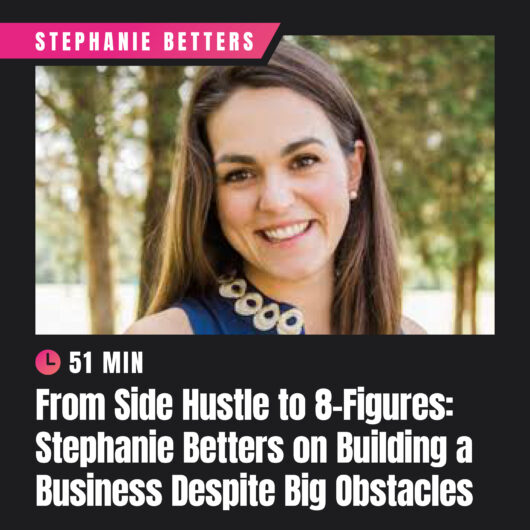
From Side Hustle to 8-Figures: Stephanie Betters on Building a Business Despite Big Obstacles
To be a guest on the show, email podcast@postcardmania.com
Listen and watch on your favorite podcast applications.




Episode Overview
Host Chris Foster talks with Stephanie Betters, who went from flipping her first house as a young nurse practitioner to building Left Main REI into an eight-figure, venture-backed software company, about turning constraints into systems, staying resilient through obstacles, and building a business alongside her husband and business partner.
Podcast
Episode Transcript
Here’s the transcription below of today’s episode, a conversation between host Chris Foster and Stephanie Betters, who went from flipping her first house as a young nurse practitioner to building Left Main REI into an eight-figure, venture-backed software company, about turning constraints into systems, staying resilient through obstacles, and building a business alongside her husband and business partner.
Note: This transcription has been formatted from the original episode transcript for readability.
Transcript
Chris: Well, all right — Stephanie Betters, welcome in to the Everywhere Small Business Podcast.
Stephanie: Hi, thanks for having me.
Chris: Oh, we’re so glad you’re here. Tell us a bit about yourself and your business.
Stephanie: Well, it’s a little bit of a long story, so I’ll try to keep it relatively brief.
Chris: That’s all right — that’s the point of this, because we’re gonna hear your story.
Stephanie: I know, right? I have kind of a non-traditional founder story, I think, so get ready for a bit of a ride — hang with me. I’m the CEO and founder of Left Main REI, and I’m also the co-founder of a real estate investment company called Better Path Homes. I’ve been on this really beautiful entrepreneurial journey for the last fifteen-plus years. Back in the day, what I went to school for is actually medicine — I’m a nurse practitioner, and I spent a bunch of money on an education that I only really use now for my family, for friends and family consults and things like that, which is funny, but still valuable.
Kind of how we got into business to begin with: my husband and I met in undergrad, super young, and got married right out of college. I was twenty-one and he was twenty-four when we got married. We had no money, a lot of school debt, and this was in 2007 — nineteen years ago now, coming up on our nineteenth wedding anniversary.
Chris: Congratulations.
Stephanie: In ’07, it sounded like a really good idea to buy a foreclosed house and flip it — this was the beginning of the HGTV sensation, right? So that’s what you do when you have no money, I guess. We did a live-and-flip, renovated the house ourselves, and sold it right before the crash — we got super lucky we got out before it was too late, and we made a decent amount of money on it.
Then we went to grad school — my husband’s a physician assistant and I’m a nurse practitioner — and he was like, we’ve got to do this again, we’ve got to get back into real estate. And I was the brakes in the relationship. I said, listen, we just spent all this time getting our degrees, I want to have babies, let’s settle down for a second, get established, then maybe. So that’s essentially what happened: we moved to Charlotte, North Carolina from Long Island, New York, specifically for the real estate market — a really great market, similar to Raleigh, Jacksonville, Nashville, but lagging behind a little, so we figured maybe it would catch up. Great international airport, great jobs in medicine — so let’s just move to Charlotte, we’d never even been there.
We moved, got great jobs, and around 2014 we took a HELOC out on our house — we had twenty thousand dollars and decided to go try to invest it in real estate. Back in 2014, it was very unusual to buy a house off-market — cash offers and dealing with investors wasn’t normalized yet — so we had to get creative about marketing, about finding people, and about finding a good deal before it hit the MLS and got overpriced. Actually, shortly after we started, I met PostcardMania, because we used you all for mailing our postcards and letters, which was a big part of it.
Chris: There we go.
Stephanie: Yep — so when we launched and busted our butts trying to find deals, put together marketing campaigns, and put together team members to help us, meanwhile I was still working in the hospital and had young children.
Chris: Right, right — so meanwhile, you’ve still got a full-time job and you’re trying to raise a family. Okay, keep going.
Stephanie: Yeah. But you know what, it’s funny, because you can either look at that like a reason not to do it, or you can look at it like, okay, these are the constraints I’ve got to figure out.
Chris: Oh, totally. We’ve known each other for four minutes, but you seem like a person who — like Newton’s laws, objects in motion tend to stay in motion — that’s the type of person you are, and thankfully your husband is too. It’s not a question of wanting to slow things down, it’s wanting to see what you can get done. Am I reading that right?
Stephanie: A hundred percent. Yep. The obstacle is the way.
Chris: The obstacle is the way? You mean like Ryan Holiday — are you throwing down some stoic ideas?
Stephanie: I’m kind of into stoicism too. Have you read Meditations by Marcus Aurelius? Freaking awesome.
Chris: That’s hilarious — we didn’t know that about each other, but I’ve absolutely read Meditations, the OG, and I do the stoic journal every day. For anyone who doesn’t know, Ryan Holiday has these daily prompts built from quotes from the stoic philosophers — a daily meditation. I know people are thinking, Foster, this is a small business podcast, why are you talking about stoicism? Because stoicism’s heart is action — the idea is you take these thoughts and go to work. One of my favorite passages from Marcus Aurelius is when he says, should I sleep in? But look, the bee is getting up, going off and doing its job — why am I any different in the laws of the world? Why doesn’t the natural law mean that I get up and do my thing too? So the fact that you’re aligned with that, Stephanie, means you’re a woman of action who takes her work and acts on it every day. I think that’s wonderful.
Stephanie: It’s funny, because I love that part, and I’m very motivated by action and the compounding effect of little actions. But what I really like about stoicism, and what was a big part of my entrepreneurial journey, is being minded for stamina and endurance — it’s little by little, the personal growth that happens with leadership, and having the mind for a journey instead of a get-rich-quick scheme.
Chris: Yeah, I love that.
Stephanie: That’s an underlying tone for me too — I need that constant reminder, because I’m so influenced by action and results, but it takes time, and it’s okay that it takes time.
Chris: It takes time. Have you ever heard of a guy named Simon Sinek?
Stephanie: Yes, of course.
Chris: One of his recent books is The Infinite Game, which I love. Are you familiar with it?
Stephanie: I actually haven’t read that one, but there’s a similar book called Rigging the Game, which is a lot about long-term outcomes and playing your own game.
Chris: Playing your own game — yeah. Simon Sinek’s treatise on this, the infinite game, is a nice parallel to the World Cup we’re having right now: in a soccer or football match, there’s a field, a score, and a time limit — and that doesn’t exist in business. The game of business doesn’t end. And it’s not really you versus another team — yes, you’re in competition, you might share or win customers, but that’s not the point of the game. The point is your own score, your own business. It’s a game, but an infinite one — there’s a journey that moves along, just like a person matures, the business matures. So I have to ask you, Stephanie — stoicism, resilience, looking at your business as a journey — is that something that grounds you day to day when you’re thinking about your metrics and stats for the week?
Stephanie: Oh, for sure. I’m a very impatient person, and when I’m not baseline emotionally healthy enough, I’ve got to remind myself of this stuff all the time and ground myself — that metrics matter, but the little things you do every day, the metrics you attack every day, will add up, and you’ll end up winning the game you’re playing if you stay consistent and resilient and get up and try again and learn. Otherwise, I think I’m way too impatient and will change course too quickly, because if you’re looking for the short-term gain, that’s not how you win the long game. You can’t be short-term minded. So when an obstacle inevitably happens or something goes wrong, that doesn’t mean you stop — it means you pivot, because it’s a long game. Bad news and good news, and you just keep going. If I hadn’t had to develop that muscle, I think I would have gone crazy, or I would have quit by now.
Chris: Right. That’s a really persuasive counter to the reasons people give for why businesses fail — eighty percent of businesses fail in the first three years, and everyone says it’s market conditions, it’s this, it’s that. But so often, it’s that obstacle that either blocks someone, paralyzes them from moving forward, or they find a way through it. Maybe those are the businesses that actually succeed — the ones whose founders are the resilient ones who keep pressing and finding a way, even when it seems like an unsurmountable task.
Stephanie: A thousand percent. You lose when you quit, when you stop, when you choose to. Here I am, fifteen years into the journey now, and I have so much more clarity looking back at the beginning. I get this question a lot: how did you do it with little kids, or a full-time job, how did you build this? And I think what generated that reference to stoicism is that your constraints will help you develop what you need. You can’t look at your constraints, your situation, as a reason not to do something — you take those constraints and ask, how do I thrive in this situation? For example, I had young children — three kids under one at one point; my youngest was one and my oldest was six when we started the company, fully officially.
Chris: So that’s a lot of action on the home front.
Stephanie: A lot of action. And I was working full-time at the hospital doing heart surgery, very high stress, unavailable — generally on call for seventy-two hours straight. I had plenty of constraints, plenty of reasons not to do anything else. But what that forced me to do was say, my husband and I have this dream, we want to buy real estate, we want to grow a portfolio, and I can see the vision of what that could do for us as a family long-term. That means I’ve got to figure out how to do it within these constraints. That meant I had to be really focused on systems, and I had to hire somebody to help — I couldn’t do everything myself, so it forced this organization to develop. I couldn’t just create another job for myself, I had too many of those already, so I had to create a system. And guess what — the system worked, and it thrived. Yes, there were additional punches in the face along the way, but I was able to build something out of those constraints. Somebody else would have had a different journey — if you didn’t have young kids or a full-time job, you probably could have swung more hammers or done more manual work, or gone longer without hiring somebody. We all have our own constraints during our origin story. Mine started with, we absolutely have to have good systems and people helping us, or this doesn’t get off the ground. That informed the rest of my entrepreneurial journey and where I stand now. I’m not in medicine anymore, except for friends and family, and I’m obsessed with systems and processes, and I built software to help me and to help others. That’s why it’s such a fun, unusual journey — as you grow and solve consecutive problems, it takes you down a path you may not have predicted in the first place.
Chris: Yeah, that’s beautiful. For our listeners — Left Main REI is a software platform for real estate investors. We worked with them because Stephanie already knew PostcardMania: PCM Integrations has an integration with Left Main REI, so all the automated direct mail a customer chooses through Left Main REI, built on Salesforce, flows through PCM Integrations. That’s how we met, and we’ve done some co-marketing and webinars you can check out. What we love about Stephanie’s journey, and why we wanted her on the show, is — you started with a lot of action on the home front, technical skill and expertise in healthcare, understanding that world, then practically started selling real estate, and to solve the problem of making the real estate business thrive, you had to create a system, which led to creating software — and now you’re a software company and a software entrepreneur. It’s very different, but nursing and hospital work require attention to detail — there’s procedure, process, a method of intaking patients, dealing with them, supporting the patients and the doctor at the same time. My hunch is there are parallels between that and what you intuitively learned building software.
Stephanie: Oh, a thousand percent, and I think that’s the case for probably anything — that’s what I like about entrepreneurship in general, it takes everything. It uses all of your skills, all of your life skills — motherhood, marriage, all those lessons apply to growing and nurturing a team, dealing with conflict. Same thing on the hospital side: dealing with high-stress, high-risk situations, making decisions with incremental data as things develop in front of you, connecting with people, listening really well, hearing the actual problem people don’t know how to articulate. For example — “I’m dizzy.” That could mean a hundred different things: neurological, heart, positional, medicine. People don’t know how to tell you, “I’m in AFib” — they don’t know how to say that, but they know how they feel. It’s the same with growing a team, or listening to a customer and hearing what’s happening in their business and translating that into something actionable, actually getting to the root problem. Everything is applicable to growing a business. But I think the crux of what you have to be really good at is people — you have to understand and listen well and love people, and you can get that experience from pretty much anything in life.
Chris: All aspects of life, if you’re paying attention and if you care about people. I think that was a really astute comment — that entrepreneurship doesn’t just bring business acumen, it brings all of your life experiences into it. A lot of folks forget that businesses aren’t run by pickles or fire hydrants, they’re run by people, and people bring their lived experiences into a work environment. When you’re an entrepreneur and a leader, you bring all of that too. My wife works with professors in the academic space, and they’ve told her, gosh, you speak with professors so well — and she says, that’s because I read Conflicts with Teenagers, Positive Discipline for Kindergartners, Positive Discipline for Middle Schoolers. I can handle a professor because I give them a choice — we can do this, or we can do this — the life experience of raising our two children. She said, I can’t believe I applied that in my work, but you do.
So with you now, it’s an interesting spot, I’d think. How long has the software for Left Main REI been active — how long has the company been around?
Stephanie: Six and a half years. We launched in January 2020.
Chris: That’s a great time to launch software — and then this boulder comes.
Stephanie: It turned out to be scary in the first half of the year, not knowing what was going to happen, but it turned out to be wonderful for real estate. Left Main had a real rocket-ship takeoff when we launched — and Better Path is still going strong too, that company’s fifteen years old now, which is crazy; I judge how old the company is by my kids’ ages. My husband runs Better Path full-time as CEO, and I was the COO there. It was actually kind of wonderful how the Left Main launch happened, because I got that deal with Salesforce right around the time I’d hired out my own role as COO of Better Path — my husband and I had been in a CEO-COO relationship for about eight years, and it felt right to bring someone else in as COO, to have some personal boundaries. So now we each run our own segment. There, I serve him — he’s my customer, in a sense — and I understand that really well because I ran that business and hear about it every day at the dinner table. But we’re not directly involved in each other’s company day-to-day, so we can be kind of a board of directors for each other. It’s an interesting vibe.
Chris: Yeah, that is an interesting vibe, and I want to come back to that — being married to your business partner — but first: six and a half years into Left Main REI, you’re probably at these interesting transition points, from entrepreneur to CEO, which is a different animal. As an entrepreneur, you’re scrapping, getting everything ready, touching all the stuff. As CEO, the responsibility is different — maybe not as hands-on day to day, you’ve got a team to handle issues, and you’re responsible for guidance, vision, the product roadmap, listening to customers — not just reacting to what each one says, but stepping back and asking, what’s the real message I’m hearing, what’s the story they’re telling me, because that shapes the direction of the product. Are you feeling that transition now? Am I close?
Stephanie: Oh, for sure. My own sense of that has grown, and I keep trying to grow as a leader. The landscape is different now than it was six years ago, when we were trying to figure it out. Left Main now has forty-plus employees, a full executive suite, we’re venture-backed — the conversations I’m having daily with other executives and venture capital are way different than when we were piecing the train together. But the core values are still there — what we’re doing for the customer, my personal connection to the customer, is still super present. You’re right that I’ve had to level up multiple times, through all these different inflection points of growth. What’s become more important to me personally as I’ve grown is my network, my advisors, what rooms I’m in — because I’m running the biggest business I’ve ever run, but this is probably the smallest business someone else in that room has run. It’s this journey of humility, network, asking the right questions, getting into different rooms as you grow, while still staying super connected to the customer and the product. You’re pulled in these directions — I need to think big, a couple of years out, but I can never lose sight of the customer, the product, what we’re building, what problems we’re solving, and what I’m hearing from that group. It’s an interesting dichotomy, but it’s really important to keep pushing yourself, get into different rooms, hear different ideas, avoid your own echo chamber, and still stay close to what’s happening in your company.
Chris: Yeah, I think that’s a beautiful pendulum swing for you — intellectually, emotionally, professionally — because if you lose your touch with the customer and the product, you might not make the best decisions about what the product needs moving forward. Yet if you spend all your time in what’s happening right this minute, you’re not prepared for the future. So you have to balance all of that. What I find so fascinating is the plasticity of our minds in certain situations — your mind expands, builds new muscles and skills by talking to new people, being in a different room. If you’re talking to the CEO of a two-hundred-fifty-person company, that’s a big difference from being at a forty-person company — but you’re different now than when you had a five-person company too. You’re different now than you were years ago.
Stephanie: Yeah, yeah, and it’s cool — especially talking to folks who are ten years ahead of you, hearing how they think about problems and reflect on their experience and their personal leadership growth, what’s important. It’s kind of cool to see ahead and relate to a lot of similar threads — just bigger numbers, but very similar threads.
Chris: Different numbers, same problems.
Stephanie: Very, very similar.
Chris: Yeah — and I think it’s great that you’re finding counsel and camaraderie with other business leaders, because from what I understand, it can get really lonely — everyone in the company is looking to you to make the decision. Do you feel lonely at times?
Stephanie: Well, yeah, absolutely. I’m the sole founder on the software side — my husband very much understands, but I’m the one holding the bag. What’s challenging about being a sole founder is — I love my team, they’re crazy good, I’m humbled every day that they’re here with me — but you can’t quite share the pressure and the losses with them to the level you feel them emotionally. When you feel crushed by something, you can’t fully share that with the team, because you have to keep their momentum going — you have to shield them a little from the weight of the crown, if you will. I’m the one who has to figure out these problems; I can’t blast my anxiety onto everybody, it’s distracting.
Chris: And it’s inappropriate too, in a way — it’s kind of like being a parent. You don’t share the challenges of adult life with your kids, because that’s not their burden.
Stephanie: Right, a hundred percent. You can’t say, I can’t afford to buy you this toy because somebody lost their job — you just can’t say those things, it’s not appropriate. And the reverse is true too — sharing the wins, the personal impact something has on you, you don’t necessarily share that either, because they get the credit for it. When something amazing happens, it’s not your win, it’s everyone else’s. That’s exactly how it should be — the blame is on you, but you can’t fully share it; the win isn’t you, it’s everyone else. So you’re in this kind of lonely place, without somebody directly in the company to connect with about it. You have to find that somewhere else — somebody on a similar journey who can keep you sane. It’s a crazy journey. And what’s interesting lately, getting to this new tier of company size and revenue, with venture capital being part of it, is I’ve never been more aware of how much rest I need. I can’t do it without rest anymore. I’m a workhorse — I can work a hundred and fifty hours straight, I can go three days without sleeping, I’ve done that in the hospital — but by the third day I’m getting pissy, things start to bother me. I can work really, really hard, but at this stage, that can’t happen anymore — my emotional wellness suffers. I’ve learned I need weekends, I need to stop, I need to triage better and get my own mental rest so I can handle the burden and shield people properly without becoming toxic, and still be positive and get what I need from my network, and feed back into the people in my network who need it from me. It’s just more important to me now than I anticipated five years ago.
Chris: Yeah, that makes sense to me, because the complexity of the day doesn’t increase incrementally, it increases algorithmically. The dynamic of a business with eight people has a certain number of relationships; a business with forty people has a lot more — you’ve got an executive team, a management level, individual contributors, dynamics between contributors and managers, managers and executives, executives and contributors, relationships within the contributor group to keep teams healthy — and like you said, when things go poorly you take the blame, when things go well they get the credit. That energy flow gets more complex. And when you add venture capital — congratulations on that, by the way — it means you’re beholden to another entity you weren’t beholden to before, so there are other folks you’re answering to besides yourself and your team. That adds complexity too. So I think rest is really important. And it’s a good segue into how you and your husband, as business partners, carve out rest and detach from business to focus on your relationship. This isn’t a marriage podcast, but it’s a pretty interesting story, being married to your business partner, this intertwining of life and professional experience.
Stephanie: I think any entrepreneur, whether or not you work with your spouse, will have their personal life affected by it — it can either help your business, because you have support, or it can not. It’s hard for people to understand what it’s like to carry that load. I think the true journey is really described in that relationship, the spouse relationship — even a significant other you’ve been with for years — that relationship is absolutely a component of the business, and vice versa, because you take it home, it’s impossible not to, it’s so all-consuming.
My experience is I would not be here without my husband. We get each other in that sense, and he’s the one, out of everything, especially on the rest side, who’s the only one who can see it before I hit the wall. He’ll say, it’s six o’clock, we need to have dinner, you need to get out of there, we’re going now — he’s the only one I’ll really let do that, pull me out of my own head. And he’s really, really good at the logical side, bringing me out of my emotional place back into the logical one — I’ll feel like everything’s crumbling, and he’ll say, let’s just take a look, what happened, and I’ll lay it out, and it doesn’t sound so bad said out loud, and I’ll say, okay, you’re right. I think you have to have that person — I hope it’s your significant other — who can help you get over the hill, and you do the same for them, because I see the same thing in him. Thank God we’re never both low, or both high, at the same time — we’re always a little yin and yang, so I can say, all right, let’s talk this out.
Chris: I love that, Stephanie, I think that’s actually very beautiful. My hunch is we all have some kind of survivor instinct in us — practical, emotional, or situational — and the two of you met young, you’ve grown up together as adults, generationally different than when you met, and you intuitively sync off one another so neither of you is low at the same time — there’s always someone who reads the room and helps navigate emotionally, and you understand each other well enough to be each other’s best support. My hunch is that’s probably how your relationship has grown.
Stephanie: A thousand percent. And what a blessing it is to be understood like that. I don’t want to speak for him, but I hope he feels the same way — for me, it feels amazing to have somebody understand you, and still love you. You’ve seen all these things, and you still love me? I was a total pain fifteen minutes ago, and you still choose me? Of course, with all your crap too. That support system is so important going through this craziness. And I think it’s challenging, because when you’re first starting out, maybe you don’t always get that from your spouse, but you can probably get it from the rest of your family — there’s often resistance from the people around you to not take a lot of risk. For example, my mom said, are you sure you want to do this, you’re going to leave medicine? You loved it, you worked so hard for it, are you sure? And of course, someone who loves you is going to ask those questions, but it also makes you wonder, should I doubt myself? You get a lot of resistance. And if you get that from the person you’re sleeping next to, it’s really hard to be successful if someone’s always asking, should we quit now, is this too hard, instead of, we’re gonna figure it out, you can do it, I’ve got your back, we’re gonna miss dinner sometimes and order pizza, we’re gonna have to scoop up the kids and go look at a house — we’ll figure it out. That’s what I’m so grateful for in our relationship, that we can do that for each other, while still being like, okay, we’re not gonna jump off the cliff, let’s put some safety on this, we’re not gonna do anything crazy and end up homeless, but we can still be super supportive of the journey and the vision without too much friction or risk-aversion — which I think a lot of outside family and friends bring, because they care about you and don’t want you to do it.
Chris: Sure — and also, those outside folks aren’t in your mind, because no one can be, and they’re not in those intimate conversations, after a second glass of wine, where you’re believing in yourself and want to lean into that belief, with your partner saying, yeah, Stephanie, I believe in you, I believe in us, we’re smart, we’ll figure this out, and more importantly, we’ll do it together — you’re not on your own. I think that’s beautiful. It’s a beautiful family business story, because it models to other people — and I’m sure to your kids too — that even though life is never perfect, things can work when everyone works together, when there’s love and an emotional connection. Beyond that, the impression I have, and we’ve known each other for thirty-eight minutes now, is that you and your husband are both committed to building a whole life — not just a career, but a whole life and lifestyle. The work you’re doing now will pay off when you’re in your fifties, sixties, seventies, for your family, your children, your children’s children — you’re creating generational wealth, hopefully, and it’s a life creation, not just, I’ve got to go to work today.
Stephanie: Yeah, I think it’s an unusual experience, hard to relate to for outsiders, but I’d venture to say all small businesses are family businesses — there’s an impact at the household level, a hundred percent, and you’ve got to have the support you need there to get you through. A lot of times they’re sacrificing along with you, and you have to acknowledge and incorporate that to stay healthy.
Chris: Yeah, and I don’t mean “family business” in a trite, cliché way, because it’s a whole family business — whether or not the kids work in it, they’re affected by it. There are different responsibilities that come with being a small business owner, a leader, an entrepreneur building something, than if you just clock in and clock out for somebody else. So, a couple of questions as we wrap up — first, this has been wonderful, I hope you’ve enjoyed the conversation, I certainly have. Who are business people you admire? You mentioned a network you’re cultivating — are there mentors or advisors or business owners who are especially helpful for you to model?
Stephanie: Oh, so many, and it’s evolved depending on where I am. It’s a bit like a parable — it means different things at different stages of your life and business. I have so many examples of fantastic advisors and mentors, some I don’t even know how much they’ve affected me with just a small piece of advice or encouragement. I have a board of advisors now that I meet with every month and every quarter, and it’s changed everything. There are business owners I admire that I’ve never met, who constantly inspire me — hopefully that changes one day — I’m super inspired by Sara Blakely, the founder of Spanx, and Reese Witherspoon and her journey with Hello Sunshine. I follow their careers and feel really inspired by how they were able to build what they built, as women and business leaders. I think Joy Gendusa is super interesting and inspiring too, with her business journey. It’s a little like trying to make a sandwich with crumbs — the collective sandwich.
Chris: Talk to me about that — you’re basically building inspiration from a variety of sources.
Stephanie: Yes — that network kind of comes together, and you’re piecing together all these interactions and amazing nuggets from people over time, and it builds the sandwich. These little pearls people drop — if you’re paying attention, you keep them. I love the sandwich analogy because it fuels you and feeds you. I think what’s so important is the voices in your head, and what you’re exposed to — podcasts like this, other people’s journeys — you pull out that little something you need at that point, that little crumb for your sandwich, and expose yourself to that positivity and those tools, whether it’s indirect through social media or direct through a coffee date with somebody ahead of you or behind you that you’re helping. You can derive something from everything, but it’s important to get that exposure, keep your head right, listen to the right voices, read the right content, and take something from people trying to do things. I’ve always tried to keep my eyes and ears open to the people around me, and it’s had such an effect on my well-being, my vision, and the stamina that comes at the end of the day — when you’re saying, okay, I’m going to pick up tomorrow, try again, get a little better tomorrow.
Chris: Get a little better tomorrow — that’s right. I think it’s interesting that this goes back to the first part of our conversation, about your nursing training — what makes a successful nurse is paying attention to all the clues happening around them with a patient: their movements, their moods, how they’re acting, what the medicine looks like, what the procedures are. That paying attention came naturally to you, but it’s really flourished in your entrepreneurial journey, because you’re paying attention not just to the influences around you, but to and honoring the journey itself — saying, this is the journey I’m on, and I appreciate it, I don’t take it for granted, but this is where I am right now, and I see it. That’s the same concept that came from the stoic philosophers — a sense of resilience, a sense of place. For our listeners, check out the original Marcus Aurelius — as a side note, he was the emperor of Rome, and Meditations, which he wrote, was never meant for anyone else to read, it was his own reflection. As emperor, he says, I’m going to be gone in two hundred years, and all those famous people from two hundred years before him are gone now too — this is just my time, what am I going to do with it? That sense of his own journey helped ground him, so he didn’t feel too inflated about who he was, and it helped him pay more attention to other people. I’m so impressed with you, Stephanie — you’ve really cultivated this art and practice of paying attention, which we know isn’t easy. It’s much easier to sleepwalk through life. It’s a lot harder to pay attention, to be engaged, to catch a clue instead of dismissing it — to say, okay, what is this customer telling me, what’s the experience our customers are having with the software, why is that button there, that shouldn’t be there, this should be somewhere else. Having that kind of detail really makes a difference in the success of the work you’re doing.
Stephanie: Well, thank you — and I think that’s why it’s important to also rest, to have a moment where you’re not taking in all the stimulus. Maybe that’s why I got to this point where I said, okay, I need hobbies, I need to go for a walk, I need a day off, just to observe nature for a bit, listen to someone else’s content for a minute, listen to some birds. A little bit of both — that’s wonderful.
Chris: Well, thank you so much for spending time with us — give our best to your husband and your business. We’re so excited you were here, and hopefully we get to keep in touch.
Stephanie: Yes, for sure — thank you so much for having me.
Chris: Thanks, Stephanie. Great day to you. Bye bye!