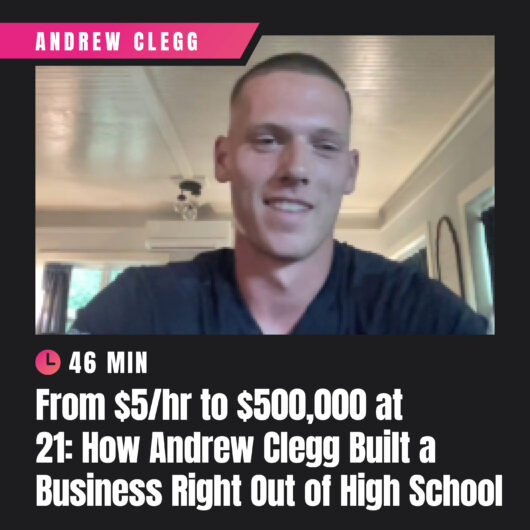
Podcast Episode 8
From $5/hr to $500,000 at 21: How Andrew Clegg Built a Business Right Out of High School
To be a guest on the show, email podcast@postcardmania.com
Listen and watch on your favorite podcast applications.




Episode Overview
Host Chris Foster talks with Andrew Clegg, who launched Sweetwater Softwash at seventeen and grew it into a half-million-dollar business by twenty-one, about starting young, learning to hire and lead employees, and building a family business rooted in faith and consistency.
Podcast
Episode Transcript
Here’s the transcription below of today’s episode, a conversation between host Chris Foster and Andrew Clegg, who launched Sweetwater Softwash at seventeen and grew it into a half-million-dollar business by twenty-one, about starting young, learning to hire and lead employees, and building a family business rooted in faith and consistency.
Note: This transcription has been formatted from the original episode transcript for readability.
Transcript
Chris: Alright, well Andrew Clegg, welcome to the Everywhere Small Business Podcast.
Andrew: Thank you, Chris. It’s an honor to be here. I really appreciate you inviting me.
Chris: Of course, we’re so glad you’re here. Tell us a little about yourself and your business.
Andrew: I’m twenty-one, and I’m the owner of Sweetwater Softwash. We’re located in Monroe, Georgia, and we serve a variety of surrounding areas.
I started this when I was seventeen, so I’ve had a passion for running my own business from early on. I started off detailing cars — I played some sports in high school, but I also worked a part-time job at an auto shop, so I had multiple things going on. Detailing cars is what pointed me in the entrepreneurial direction, and I quickly realized I liked working for myself. I just needed to find something more feasible — something I could actually make a living at.
That’s how I discovered soft washing. I thought, everybody pressure washes, so I needed to differentiate myself a little. I found a training program and decided to get trained before I bit the bullet and went into the business, just to get an idea of what I was getting into. It’s not a franchise — it was more of a training to give you an idea of what you’re getting yourself into. And it turned out to be great.
Fast forward to this being my fourth year in business: we have two trucks, both paid off, two employees, and I’m happily married. It’s been an absolute blessing. I’ve got people on my side — PostcardMania, a website company, a Google company — and having that support has really put me ahead of the curve.
Chris: That’s incredible. There’s a lot to unpack there, Andrew. First, I want to say congratulations — for starting your own business, and for being happily married. You’re the youngest guest we’ve had, and you might be the youngest guest we’ll ever have, which is awesome. You could technically say you started the business at seventeen, and we’re just catching you now, four years later, at twenty-one.
Andrew: Thank you. Appreciate it.
Chris: Talk to me about this entrepreneurial spirit in you. Has it always been there?
Andrew: My granddad owned the Ace Hardware in our town — we live in a small, pretty quaint town about an hour from Atlanta, so we can get to a city if we want to, but everybody knows the Clegg name because my granddad owned Ace Hardware for a long time. Then he passed it to my dad and his brother, and so on.
I watched that a little growing up, but college just wasn’t my thing. It felt like it was either college, the military, or the workforce — nobody really mentioned starting your own business. I’m glad I jumped into it, and I give a lot of credit to my dad, who helped me start my detailing business. Once I did that, I realized pretty quickly that I could sell to people and build relationships, and it just grew from there.
I think, to an extent, you either have it or you don’t — people like to buy from people they like, and if you can’t sell, it can be difficult. It’s been amazing, honestly. It comes with a lot of different challenges, but I wouldn’t trade it for anything.
Chris: Sure — we’ll get to the challenges a little later. I think you said something really cool: that young people have this exit path out of high school — the military, maybe college, maybe the trades — and you started your own business. I love that your grandfather owned Ace Hardware and passed that down to your father, so there’s this entrepreneurial thread in your family. Did you guys have kitchen-table conversations about running a business growing up?
Andrew: It was kind of one of those things — my granddad passed the hardware store to his two sons, my dad and his brother, and then my dad got out of it. My dad also had a siding and painting business, so he had business wisdom from that too. I mostly watched the Ace Hardware side from afar, but my dad helped me start my own business, and it was really a gamble because I’d never done anything like it before. It’s pretty intimidating at first — there’s a lot to risk, and you don’t know how it’s going to turn out.
You really have to put a lot of faith in yourself, and it can turn out well. Honestly, I just had to jump right into it to figure it out. But if you can find someone who’s been through it, that can be a huge help.
Chris: Sure. I’m glad you had your dad to help you get started, but I think what’s interesting is the courage it took to believe in yourself — to say, this is a risky, uncertain, somewhat unconventional choice, but I believe I can do the work and get started. Where do you think that belief came from, Andrew? Was it always in you, or did you have an aha moment?
Andrew: I worked a part-time job making five dollars an hour — it was flexible around my sport, and I had a great boss — but it put working for somebody else into perspective for me. It’s not a trap, but once I started detailing cars, I realized pretty quickly I could do much better for myself going that route.
Then once I started the soft-washing business, I had another aha moment: this could be even better. And it just kept going up from there. What I really realized was that so many businesses don’t give first-class service — they don’t take care of their customers, they don’t pick up the phone, they don’t give quotes fast. They don’t do the basic things a great business needs to succeed. Once I started implementing those basics, the business grew very fast.
A lot of it really is just doing the basics, simple as that sounds. I think the drive was always in me — it just got ignited a few times along the way.
Chris: Yeah, I think you’ve got real insight there — the blocking and tackling a lot of folks tend to ignore in a business. You mentioned earlier that you’ve always been a people person and that you like the sales side of things. I think a small business owner starting out has to know sales — has to be good at talking with people. Has that been helpful for you in your journey?
Andrew: Yeah. You wouldn’t want to buy from somebody you don’t like or feel comfortable spending money with. Believe it or not, I was an introvert and didn’t talk much until high school. Once I started my business, that was the switch that flipped, because I realized real quick you’re not going to sell anything if you don’t open up a little, smile, and seem approachable. It flipped, and I’ve only gotten better at it since.
You don’t want to be fake-nice, but you want to show that you care and that you’re there to take care of your customer. So many companies don’t give that level of attention, so it’s refreshing to a customer when they see it. You’ve got to have it — at least in my opinion.
Chris: Yeah. I think it’s interesting that the business changed your personality in a way — you had to move out of an introverted bubble, and the business did that to you.
Andrew: Right. Yeah, it really has. And it’s a good thing — I think it’s a good thing. But yeah, it’s definitely changed that.
Chris: It’s funny, because for you, you and the business are the same — the business is you, you’re the business. How has this business grown you as a person over the last four years?
Andrew: It’s changed me in a lot of ways. I’d say the number one way is spiritually. It’s pretty spiritual, honestly — when you’re in business, you’re kind of on the outskirts of everyday society. You’re not talking to a ton of people; you’ve got your employees and that’s about it. You’re just working every day, trying to make ends meet and grow the thing, and it’s a lot of trial and error.
Over the past four years, it’s really changed me for the better. For one, it’s hard — my business is seasonal, so we really have to knock the work out in four or five months of the year, because it slows down in the winter. That was a mindset shift for me, because I don’t like doing nothing — I’m kind of an antsy person when I don’t have work, and business is always up and down. Hard to predict. I’m finally starting to get used to that.
Dealing with people has always been difficult for me — reading people, trying to understand them — but the more people I meet, the more it’s been a real learning curve. The longer I’m in business, the better I get at it. It’s just trial and error. But it’s grown me a lot.
Chris: Well, there’s that learned skill of reading people. It’s almost like, as the years go by, you’re getting better at it.
Andrew: Yeah. No, I agree with that. Absolutely.
Chris: So as you manage a seasonal business, Andrew, there’s suddenly a new thing you have to handle — it’s not just getting the work done and scheduling it, it’s managing payroll, managing revenue, managing expenses. What skills are you learning about managing the business now?
Andrew: That’s tricky, because there’s a fine line — if you mess up the vital things, like taxes, you’re going to be in trouble fast. I went through a couple of CPAs, but luckily, being married helps, because now I have a partner to help me with it. My wife is taking over the bookkeeping side, and we’ve got a CPA who’s really good. You have to have those things in place, because for somebody like me, I don’t care much about the bookkeeping side of things — I can handle scheduling and quoting, the stuff I know off the back of my hand. But for all that other stuff, I’d rather have an expert do it for me — kind of like I have you all do the marketing. I tried doing my own postcards, and I came back to you all, because it just wasn’t worth it — how much money could I be making while I’m wasting time doing this instead? So yeah, you want to find people who are good at different things, and make sure you have the right people in place to help you run smoothly.
Chris: Yeah, that’s part of the learning curve of a small business owner — figuring out the resources you need. What you’re really good at, Andrew — I’m assuming, I think — I’ve known you for about eleven minutes, but I think you’re really good at talking with people. You’ve got a friendly, gentle demeanor, and I’m sure that makes people feel at ease working with you.
Andrew: Thank you.
Chris: And then you’re like, well, I don’t want to do the books, so I’ll find somebody. What I think is cool is that your wife is doing the books — a lot of these stories happen where a small business becomes a family business. So now it’s a family business.
Andrew: Right, right. In my industry, a lot of guys just want to get off the truck, build a bunch of crews, and get as big as possible as fast as possible. I figure if you stay small enough long enough, you’ll be big enough soon enough. So I try to keep that principle and keep it in the family — keep things the way we built them. We’ve been blessed, and the amount we’ve grown in the time we’ve done it has been great. I’m just trying to keep my head on a swivel and not lose sight of our morals and what we built this on. I think a lot of companies get sidetracked at a certain point.
Chris: You know, you said something really interesting that I find refreshing — it could be the way you operate the business. You talked about being ethical, and earlier you talked about it being spiritual. What does that mean to you, Andrew? I’m curious about ethics being such an important part of the business.
Andrew: In a sense, this business is my ministry. I’m a Christian, and on my shirt it says my name, then “owner,” then “servant.” That’s just a small word, but we exemplify servant-based leadership to show people we’re here to serve them, just like the Lord serves us — and we serve the Lord in turn. Little things like that can lead somebody to faith, or to a huge change in their life. I’ve noticed that the more generous things I do for people, the more I can help people, the bigger the business gets. All of that, I give the glory to God for. Once I realized that, it started growing exponentially. That’s what I mean by spiritually — I run this business like I’m running it for the Lord. I take that approach, and some people might not agree with it, but that’s how I run it. It’s been good.
Chris: That’s how you run it, and it’s been successful — you have employees now. Tell me about the moment you decided you had to hire your first employee, because that’s a big commitment. Suddenly you’re responsible for someone else’s livelihood — you take on this responsibility, this opportunity, but also this burden, because now you have someone on payroll. When did that happen, and what made you decide you needed to hire somebody?
Andrew: Probably the scariest thing I’ve run into so far in the growth is the employee side of things. In the busy season, I have plenty of work, and I can hire two or three people — but when it slows down, I’m still paying them and there isn’t as much work, so I have to think about that.
Jim is forty-five, part-time, and he’s been with me for about two years. He has a full-time job but works with me two days a week, in the afternoons — pretty flexible, and I can manage that. He was my first experience getting my feet wet with employees, and he’s still with me. Then last year I got lucky and found Nate, a really good guy — he’s sixteen, believe it or not, and he works with me full-time, four days a week.
I finally realized I just had to pay these guys and suck it up, because that’s where the business was going — I was turning away work without more help. I don’t want to be there, so I had to pull the trigger. I’m still under the impression that fewer is better — I’ll pay these guys more, and until we absolutely can’t take on more work, I won’t hire anybody else, because it is a burden. It’s a blessing and a burden, but it’s been very stressful. Luckily, good people.
Chris: I’m sure. And you found a sixteen-year-old — because now, Andrew, I’m sure you’re aware, but I have to point it out — you’re older than he is. He’s literally looking up to you, because now you’re his employer. Not only are you his employer, Andrew, but you’re also his mentor.
Andrew: Yeah. It’s exciting because he’s ambitious — he wants to be a pilot. I figure, I don’t have to raise somebody, but if I can be a good influence on somebody, or every person I meet in some way, I feel like that’s a good thing to do. So I try to take him under my wing. I’m his first job, so I’m glad he’s with me, and I try to give him the most out of it that I can.
My dad works for me too, but only part-time — about ten hours a week. That’s exciting too. I have good people, I have to say that.
Chris: That’s awesome. Good job, Pop. Your dad must be really proud to be able to work for you and get a check from you — I think that’s pretty awesome. So you said hiring was one of the scariest things you’ve done. Was there a moment early on when you didn’t think it was going to work out?
Andrew: I always kind of felt like you have to run away from the doubt and the doubters, because everybody’s going to have an opinion about how your business is going to do. Really, the only person who knows how it’s going to go is yourself. Like I said, you have to have enough belief in yourself that it’s going to work, because you can think of a thousand reasons why it won’t — there are plenty of reasons why it won’t. A crash could happen, a recession could happen, all kinds of things could happen and you could be out of business. But I chose to block that out and move forward — I was going to make it work.
I started off knocking on doors. After school, I’d be in class literally making postcards — this was before I even knew about EDDM and all that. I was writing postcards by hand and sending them to dirty roofs, door-knocking on the weekends, just making ends meet and working every day, pretty much. I was going to make it work. It’s exciting to see the breakthroughs, because you’ve worked so hard for it. It’s more consistent now — I know what to expect going into year five next year. I know when the busy times are, when it slows down, and I have a customer base.
All of that’s working for me. But at first, it is scary — the unknown.
Chris: Very scary. You mentioned that after all that fear, you started to make it happen — working every day, writing postcards, knocking on doors — and then there were a couple of breakthroughs that really helped move the business forward. What was that moment where you thought, this is actually going to work?
Andrew: The funny thing is, I don’t love getting into the numbers, but my first year in business I really only had six months to work — from graduation to December — and I did about a hundred and fifty thousand dollars when I was seventeen. That was a breakthrough, because I thought, whoa, I just made this money and I’m not in college, not in the military, not doing anything else. That’s gross revenue, but it really excited me, because I’d never made that kind of money before — I was making five dollars an hour before that. It kind of put me on a chase.
The next year it was two hundred fifty thousand, last year it was around four hundred thousand, and this year we’re looking at about half a million gross. It’s been super exciting — you’re on the chase. The breakthrough was definitely the money side of it at first.
Getting my trucks paid for was another exciting thing — having your own truck and rig. There have been a lot of cool little moments like that. At some point I had a realization that this was going to work out — don’t tell my dad, since he works for me now.
Chris: That’s incredible. That’s phenomenal growth, especially for someone so young. I’m sure you have friends your age — are you unusual among them, being so young and owning a business that’s actually growing? Do you feel a little different?
Andrew: Yeah. Like I said, I kind of feel like I’m on the outskirts — which, in a sense, you are. I’ve got a handful of friends I trust who are all going places, but some people will kind of hold you back, so you have to spread yourself apart a little, because it’s just not going to work out otherwise. Most of my friends are actually older than me, much older. I have several mentors who’ve helped me — we mainly do high-end residential work, so I run into some pretty wealthy people, and I always ask them for advice. People who know more than me — why wouldn’t I ask? I’ve got everything to gain and learn, and I’m eager to learn. If I were telling my friends what they should do, I’d say listening to people who know more than you is a good place to start, because a lot of people won’t do it.
Chris: Yeah, well, you’re receptive to the lessons you’re getting. I’m curious — as you ask mentors and successful people for advice, what kinds of questions do you find most helpful to ask?
Andrew: Usually, right off the bat, once I’ve done a great job for somebody, I’ll gauge in my head whether I want to ask them for advice — it depends. But if it’s someone I’d want advice from, I’ll say something like, I really look up to you, I think you’ve made some good decisions in your life, and I’ll ask what piece of advice they think is important for a young entrepreneur like me. They’ll usually open up, and what they say is really interesting — every one of them is different, and a lot of it I’ve taken to heart. Some of them have really wanted to pour into me, which has been great.
I’ve had one mentor who’s a business mentor and helps me make some of the inner-workings decisions, and another who’s a spiritual mentor and helps me build the business on the principles of Christ. It’s exciting — it can be overwhelming, because when I ask everybody, I end up pulled in a million different directions, so I try to narrow it down a little. But it definitely can’t hurt.
Chris: Absolutely — learning from other people is how we grow and get better. One of the reasons we have this podcast, Andrew, is to share stories like yours so other small business owners can learn from you. I think your whole approach — entering this business with humility, gratitude, a mindset of always doing the right thing for your customers, always showing up on time, always being fair with your quotes, always following up afterward — I’m assuming, or hoping: are you getting repeat revenue from your previous clients now?
Andrew: Yeah. Actually, another aha moment was figuring out who I really needed to be doing work for. I want to take care of and accommodate everybody, and I get all kinds of calls through the website and elsewhere, but my ideal client is high-end residential, and there’s one area specifically — around a lake — that I targeted with postcard campaigns, and that absolutely changed everything for me. Those people call me every year, sometimes multiple times a year, which is a big deal, because otherwise it’s uncertain unless you have commercial contracts. It’s been fantastic — I want them to call me back, and it worked out.
Chris: Of course. And that recurring revenue lets you build a base of business, and when you land new customers, you know what their value is going to be over multiple years. If you do a really good job, it’s not just that one job — it’s that job every year for three or four years, so you know what that customer is worth. You mentioned postcard marketing — talk to me about the evolution of your marketing. I love that you were writing postcards at your high school desk, and door-knocking. What are you doing now?
Andrew: As far as online marketing goes, I have someone manage my Google presence, a website company that handles my site, and I run two sets of Google ads. I haven’t really dabbled in Facebook much — I probably could, but I just haven’t yet. I’m in a couple of magazines, and I did a radio show once, which was interesting. And then there are the postcards.
The first year, I used you all for three months prior to the season — five thousand, five thousand, four thousand homes each month, so twelve thousand total the first year. That was fresh — a gamble, because I didn’t know if the area was going to be good. It paid for itself every send, and I got three or four calls each time, so I started meeting people and making connections in that area, and I realized pretty quickly that’s where I needed to be doing most, if not all, of my work.
The second year, I took it upon myself to do my own postcards — I don’t know why I decided to do that. I did about twenty-five thousand cards and hand-did everything, and I said, never again. I still got a good return, but the time I spent doing it wasn’t worth it. So this year I really amped it up — we send every month now, sixty thousand postcards, because it’s paying for itself every month. There’s no reason not to do it. I plan to run twelve months a year going forward, because it’s been great for me.
I feel like door-knocking is fine when you’re starting out, and yard signs are okay too, but postcards really let you target homeowners who’ve paid off their homes — maybe they’re retired and have a little extra money to spend on cleaning their house. It’s not harassment, and in gated communities, you can get into the mailbox without running into the HOA. It’s an easy way to reach people without really bothering them, and it’s worked out great.
Chris: Fantastic. So, the first time you decided to do a big mailer campaign and test it out — what gave you the belief that this marketing was going to work?
Andrew: I have a dear friend in Alabama who has a similar business — a landscaping business. He’s older than me, and I look up to him a lot. He knew about postcards before I did, and he told me he does them every year, so I asked what he had going with those. I took a play out of his book — I’m pretty confident he uses you all too — and I decided to go with it. That was the moment I tried it. As far as the area goes, it’s hit or miss — you could get nothing, or you could get a great return. You just don’t know. Hopefully it worked out.
Chris: It did work out. And what’s cool is that you took the word of a trusted friend — it’s a hard thing to say, I’m going to invest in this, but I trust this guy, it worked for him, it might work for me. And it did. It’s almost the same way your customers trust you — they’re calling you hoping this guy does a good job, hoping he’s nice, hoping he’s on time — and then you deliver, and they love it. So, four years in, what was one of the biggest challenges you had to overcome, and how did you overcome it?
Andrew: One of the mistakes I’d call a challenge — right off the bat, one of my first jobs, back when I really didn’t have much — we did a roof wash, and it turned out the house had this rare paint called organic paint. Bleach kills organic paint, so when it hits, it changes color. We did the roof wash and it turned the house from dark blue to neon green within about five minutes. This was one of my first jobs, and it scared the snot out of me, because that paint is really rare — I couldn’t believe I’d run into it already. It cost five thousand dollars, and I had to just write the check. That didn’t feel too good at first, but it was a hardcore learning lesson.
After that, I bought another rig — my dad had a pretty heavy-duty truck, and I bought it from him at a good deal since he didn’t need it and I did. I bought the truck and the equipment for it. That truck only had about eighty thousand miles on it, and the motor blew up randomly — which normally isn’t a huge deal, but it’s a diesel, so it was thirty thousand dollars. I had to write another check. I told myself, I’m just going to have to get used to this — this is running a business.
Having things paid for gives me a peace of mind you really can’t get any other way. It’s all nice to have flashy trucks and the newest equipment — my trucks are clean, and I have the best equipment you can get — but it’s all paid for, and that’s the biggest thing. If I were telling somebody starting off, I’d say: have your stuff paid for. Spend a little more time growing it, and pay things off, so that if something happens, you still have your business. It’s real easy to say you need the newest thing, the newest this, the newest that, and you can get upside down pretty quick. I’ve watched people do that, so not falling for it has probably been a pretty good learning curve.
Chris: That’s excellent — and wise, especially coming from somebody so young. You’re really building this on the right foundation: creating a business, getting customers to renew, paying off equipment so you’re not in debt. What’s some other advice you’d give to newer entrepreneurs or first-time business owners just getting started?
Andrew: Across the board — and this is service-based business, so it’s a little different from corporate — they all have the same problems. You don’t have honest business owners, you don’t have people who pick up the phone, nobody shows up. I hear it all the time from homeowners, and it carries into all sorts of different fields. If you have that in you, and you think you might want to start a business — don’t wait, because there’s never a perfect time. I started this right around COVID, and people said that was a terrible time and a terrible economy, but I started it then, and I guess it worked out. You never know, so you might as well start. But be careful about the growth, and make the wisest decisions you can. You only know so much — I only know so much, I don’t know everything — but I try to be as careful as I can.
Chris: What do you wish you knew more about, Andrew, as you build your business — whether that’s marketing, sales, or operations? Where do you find yourself thinking, man, I wish I knew more about that?
Andrew: The online side is interesting to me — Google ads, and all this AI stuff. I don’t know much about it, and I wish I could take full advantage of AI and those kinds of tools to help grow the business. It’s just not really my forte — I don’t fully understand it, and honestly I don’t really want to have to. But I can see the benefit, and I think things are headed that way. Luckily, I had enough sense to really hammer the reviews — I’ve got over three hundred five-star reviews, which is unbelievable compared to my competitors, who might have a couple hundred after being in business for thirty years. That’s a big deal, especially starting out — you have to have reviews.
I’m interested to see where the online presence side is going to go. I think I’ve got it pretty well established with the right people running things, but I really don’t understand it — I know the basics, but it’s pretty evolved.
Chris: It is evolved — but maybe that’s not something you have to be an expert in, since it changes so quickly. You can lean on other people and outsource that piece, like we talked about earlier, so you can focus on your customers, your operations, and your equipment — and figuring out new areas for growth, because it looks, based on the map on your website, like you’re expanding into more neighborhoods.
Andrew: Yeah, we service a lot of areas and get calls from all over, so I’m open to going into other areas. I’ve figured out who I want my clients to be, and I’m trying to figure out where those neighborhoods are and take advantage of it the best I can.
Chris: Wonderful, that’s fantastic. This has been a great conversation — I really appreciate you sharing all this with us, Andrew. So, final question: if you could wave a magic wand, what does your business look like a year from now?
Andrew: Thank you for having me. I think I might bring on another employee — year over year, it’s pretty overwhelming how much work we have, and I don’t want to turn people away, so I might have to bite the bullet again and figure that out. I think we’re going to get a lot busier.
Me and my wife are actually expecting a baby right now, so I’ve got about a year, and that’s going to be another exciting change. It’s a blessing, but I’m going to have to restructure things so I have more time — we’ve got to figure that out.
Chris: Wow, congratulations to you and your wife — that’s incredible. In your early twenties, you’ll be a business owner, a husband, and a father, all three. That’s remarkable and exciting for you and your family, and it truly becomes a family business. I think that’s fantastic.
Andrew: Thank you. The funny part is, the postcards started with just me on them, then me and my wife, and soon it’ll be me, my wife, and the baby. We’re going to be rock and rollers.
Chris: A hundred percent, because it’s a family business. I love it. Well, Andrew, you’ve been an absolute delight. We’re so grateful and honored to have you as a guest on the Everywhere Small Business Podcast, and we wish you all the success in the years ahead.
Andrew: Well, thank you, Chris. Hey, let me know if you need anything — it was a pleasure.
Chris: Great. Take care, have a great evening.
Andrew: Thank you, you too.