Podcast Episode 10
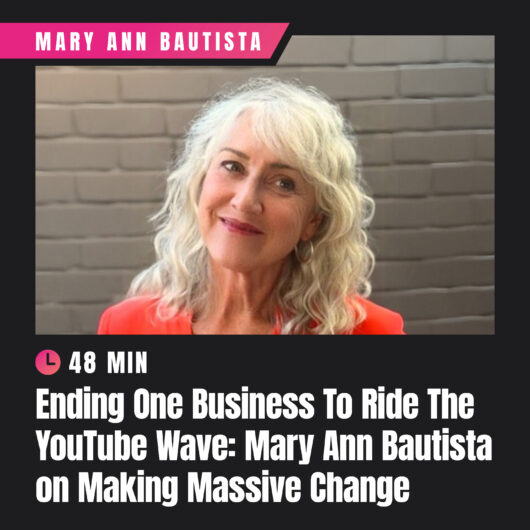
Ending One Business To Ride The YouTube Wave: Mary Ann Bautista on Making Massive Change
To be a guest on the show, email podcast@postcardmania.com
Listen and watch on your favorite podcast applications.




Episode Overview
Host Chris Foster talks with Mary Ann Bautista, co-founder of TurboRank, about sunsetting the direct marketing agency she built over 25 years to go all-in on a YouTube-only niche, building the operations and partnership that let her replace herself, and why the skills that got her here aren’t the ones that will take her to the next level.
Podcast
Episode Transcript
Here’s the transcription below of today’s episode, a conversation between host Chris Foster and Mary Ann Bautista, co-founder of TurboRank, about sunsetting the direct marketing agency she built over 25 years to go all-in on a YouTube-only niche, building the operations and partnership that let her replace herself, and why the skills that got her here aren’t the ones that will take her to the next level.
Note: This transcription has been formatted from the original episode transcript for readability.
Transcript
Chris: Well, all right — Mary Ann Bautista, welcome into the Everywhere Small Business Podcast.
Mary Ann: Thank you. Thank you for having me.
Chris: So glad you’re here. Tell us a bit about yourself and your business.
Mary Ann: Sure. My name is Mary Ann Bautista and I’m the co-founder of TurboRank. TurboRank is a specialty niche agency that focuses exclusively on YouTube — specifically on the organic build-out of the foundation of accounts and channels. We don’t really get involved very often in the paid media side of YouTube. We help businesses and brands capture the demand in search that already exists within YouTube, on Google, and in AI citations nowadays.
Chris: That’s fantastic. So I have to ask — clearly you’ve been in business since before YouTube, because YouTube hasn’t been around that long.
Mary Ann: Oh, so you’re assuming I was around before YouTube?
Chris: Well, most of us were. So the question I have for you, Mary Ann, is how did you get started in your professional career? I’m curious about the story and the arc that led you to where you are now.
Mary Ann: Sure. Geez, should I go back to the very beginning? I’m going to make this a little quick, because I have been around a little while. I got my degree in communication studies from UCLA — go Bruins — a very long time ago. Then I worked in the agency world. There was a very small, medically focused agency I worked with for a couple of years.
From there I went on to a large publisher at the time, Knapp Communications. They were based in Los Angeles and they had some very famous titles: Architectural Digest, Bon Appetit, and Home Magazine. I worked on the circulation side for Home Magazine. All three of those titles are still around, but they’ve been bought and sold a few times.
What drove me from the agency to Knapp was the fact that they did direct mail. They used to do very large direct mail programs to maintain their rate base. I had done a little bit of direct mail at the agency, but I really got an education when you were dropping millions and millions of pieces to maintain a rate base. I learned a lot there.
From that position, I actually moved to the Bay Area, which is where I am now, to work at a company called Cybervision, on the circulation side of their catalog. Some of us oldies may remember that back in the day, when you got on an airplane, in the seat back pocket there was a little catalog — that was Cybervision’s catalog, self-help and self-improvement types of content. Then I went on to Hooked on Phonics.
I worked for Hooked on Phonics for a couple of years and learned a lot more about linear TV and radio in particular. And then I went out on my own and created a business called Bautista Direct Marketing. Our foundation was in radio. But what happened, which was a little interesting, was that we somehow, someway got this very large account.
They were in a category that was very challenging to place in paid — all legal, but just challenging to place. We hit the wall pretty quickly with what we could do for them, and they asked us, what else can we do? They were very hungry for growth, and YouTube had just come on the scene. We said, let us get in there and fiddle around with YouTube a little bit and see what we can do. And that was in 2006.
So we have basically been with YouTube since — I like to say — when God was a little baby. We’ve literally been with YouTube since the beginning. We’ve really cut our teeth and learned how to grow and build out strong organic foundations, earned media, so that our clients can grab the demand that exists and turn it into ROI, into business impact and sales.
Chris: That’s interesting. So I guess the question I’d like to ask is to wind back the clock a bit — why did you strike out on your own? Some entrepreneurs are in the corporate world just for a little while and then they eject and start on their own. But you were in the corporate world for quite a while, and through multiple iterations of it — Hooked on Phonics, I remember that was a pretty big brand. So what prompted you to decide you were going to start your own agency? That’s a pretty bold move.
Mary Ann: I have to admit that I really didn’t have a great plan. I really didn’t. It was a colliding of a couple of different events. I was at Hooked for a few years, and I think it’s fair to say it was not a match made in heaven between the leadership there and myself, in terms of skill set and expectations. And I had been married for a very long time at that point, and we finally were able to conceive our first child after many years of trying. I was expecting, and had my son — yay — and that was all great.
But then I really came out of that experience feeling like I didn’t want to go back to work for the man. I really was not excited about going back into that kind of environment. So I was able to negotiate an out — and ironically, Hooked on Phonics became a client of mine. So we really parted on great terms and all that good stuff. It was a combination of personal issues and being in a place in my career where I think I had attained enough skills and had enough confidence, and knew enough about what I knew, to feel like I might be able to make a livelihood out of it.
Chris: That’s interesting. I think that’s such a common story, where there’s maybe a culture clash, or something about the organization someone’s with that’s such a turnoff and a push away. And oftentimes there’s something that coincides with a life event that puts you in a position where you decide, this is the moment where I’m going to actually strike out on my own. This is the moment where I trust myself to get myself moving. For those first couple of months, what kind of feelings did you have when you started launching yourself?
Mary Ann: I had an infant with colic. I had waited 13 years to get this little bundle of joy. I was losing my bloody mind with no sleep. And we’d sold a house. We did everything wrong — we had a baby, we sold a house, and I quit my job, all within about a two-month time frame. Way too much going on at one time. So how did I feel? I was terrified.
Luckily I knew, or felt confident enough, that I would be able to go back. The plan originally was six months. I’ve got some friends in the industry, let me see if they can throw me a little bit of gig work, see how that goes, and in six months I’ll go find another job. But let me get this baby situation settled, find the nanny, do all the things. And then the phone just kept ringing. Bring, bring — can you help with this or that? So it just kind of grew. Before I knew it, a few years had passed, I was having fun, I had a couple of people working for me, and it just sort of grew from there.
Chris: Wow, that’s amazing. It’s funny how sometimes life unfolds in a way you don’t expect it to, but it just keeps unfolding, and while it’s unfolding you’re just kind of riding along. So a question for you: when did you think you needed to hire? That first hire moment is a big step in a business, because not only are you supporting yourself, now you’re actually needing to support somebody else. When did that happen?
Mary Ann: It was when I became pregnant with my second child — my second and final. I had a little girl, and I just knew there was no way, I was going to have to get some support. So I hired someone at that point. Effectively they were an assistant media buyer. At that time we were placing largely radio, because that was something I had learned out of my years at Cybervision — how to make the phone ring from a radio ad and get a sale. And I honed that a little bit further when I was at Hooked on Phonics, so it was sort of a unique skill set. We were buying a lot of radio, so I hired an assistant radio buyer.
Chris: That’s cool. So you knew you needed the help. And then a question I have for you now is that it’s been a couple of iterations. Your first business was direct marketing, and then you pivot with a client that takes you into YouTube. You start looking at YouTube as this channel that becomes predominant, maybe a must-have channel for your client. What kind of pivot or transition did you have? Was it abrupt, or was it a gradual transition and a gradual awareness that you needed to pivot the business?
Mary Ann: It was gradual. We had a lot of success with that one very large client — that client is still a client today, so we’ve had them for a very long time. It just became more and more obvious that we were on to something other people weren’t really doing or using. We weren’t hearing a lot about it, and yet we were making this one client literally hundreds of millions of dollars through the use of branded and non-branded YouTube content that we would plan, produce, optimize properly, publish, and then market. And it worked really great for a long, long number of years.
And then life sort of changed a lot. I was working with a business partner of mine who was not inside my agency, but a close, close relationship. And we ultimately decided to form TurboRank, which is the business we both now run together — and sort of sunset BDM. It’s still around, but it’s not doing much. This new YouTube thing is a twenty-four-seven job. It’s hugely focused. Plus, there’s a trend in agencies of niching down, so it seemed like the right thing to do at the time. That’s how we got started and where we are now.
Chris: That’s interesting to me, because when you decide to fully commit to a business model or a business plan while you have an existing business, this is a common challenge business owners have. How do I protect and defend what I’ve got, but nurture and develop something that could be new and even bigger than what I have right now? How do I push both forward, but then eventually lean into where I think the growth is? That’s an interesting challenge.
Mary Ann: Yeah. Well, given where we were with the client base we had and the employees we had, I made the decision that it would be smarter for me — knowing my skill sets as well — to not try to continue to grow both. I really felt like the opportunity was there. There are a lot of people out there doing what I did at BDM. A lot. There’s a lot of competition for paid media support. And in the YouTube space, not so much. There’s not as much competition, and it was really unique.
I will say that one of the challenges is that because it’s so unique and so niche, it’s a little bit more of a hard sell. It’s a little tougher to educate people to understand why they really need a strong foundation on YouTube. But boy, can we make a big business impact for them — especially when we can integrate YouTube Shop and create that direct funnel, that directly attributable sales line to their business that they weren’t getting before.
Chris: Sure. What I like about your story is that I just spoke with a gentleman in the software business who is doing the same thing — he went from one business model that was somewhat outdated, with a lot of competition in the CRM space, and is moving now to another business model where there isn’t as much competition, where it’s relatively unique in terms of the service offering. And that seems strategically to make sense. If you go to business school, it’s like, if you’re in a red ocean with a lot of blood in the water, you need to move to a blue ocean — they wrote a whole book about that, Blue Ocean Strategy. I guess my question for you, Mary Ann, is: did that decision come organically to you, or was that something where you read a business book and said, I need to do a business thing? Or did it naturally just reveal itself?
Mary Ann: It naturally revealed itself. A hundred percent. No one would ever accuse me of having that much insight or research or elevated intelligence. A lot of what I have done in my career has been a little bit of swinging from the vines and flying by the seat of my pants, and I think that has served me very well.
Although I will tell you this: what I have learned to this point is absolutely not going to be what takes me to the next point. And that is a hundred percent true.
Chris: Love that. I love that idea, because business challenges are so unique now. The business landscape is totally different. Consumer buying patterns are changing rapidly. Generation Z and Generation Alpha are totally different than Gen X and Gen Y — the whole way they approach brands and shop is completely different. It doesn’t matter what you’re shopping for, whether it’s sneakers or snow shovels or pool service. So everything’s different. How are you constantly adapting your skill sets, and how are you constantly changing the way you’re looking at things?
Mary Ann: I’m reading, I’m listening, and I’m getting advice. And I will say that now that I’m in a partnership with my co-founder, I’m just more open to hearing and seeing and learning from the outside than I ever was when I was at BDM. I was always a solopreneur — while I had staff, I was at the helm, I was at the lead. And I was raising two small children, so it was a lot on my plate. I didn’t have the time, or I didn’t take the time, to continue to educate myself.
I’m now at a stage of my life where I have more time to do that, and I love it. We have a consulting firm that helps us. My business partner has some great lived experience. I’m reading, and watching YouTube videos, and listening to podcasts more than I ever did before. So I really feel like I’m learning so much. And I know the number one thing I have to do in my business now is replace myself. I have to build out an entity where I do not have to be involved every single day in order for this business to scale and do what it’s capable of. Because as long as I stay in this position and I’m managing everything I’m managing, there’s only going to be so much growth.
Chris: Right. That is one of the challenges business owners have — to figure out how they’re going to scale and then have that role duplication. Someone who can fill in for me, or do some of the things I can do, so that more people are doing what I’m doing and the business can actually scale farther. And then hopefully the role duplication happens generationally, quote unquote, where the person you duplicate duplicates someone else, and so you start scaling out. I think with someone like yourself who is nurturing the business right now, I’m assuming you have to be involved in everything while you’re building the model, because you have to know it all.
Mary Ann: Well, luckily for me, I have a great business partner and we have sort of divided and conquered. I am sales, marketing, and development, and he is managing the team and execution and implementation. We do cross over and support each other where needed, but my day-to-day is mainly about driving business forward, and his day-to-day is mainly about making sure the infrastructure is there and working right.
Chris: So it’s almost like you’re doing the business development side of getting new clients and he’s doing the operational side of serving and satisfying and servicing the clients. That’s a good division of labor.
Mary Ann: That’s right. There’s a little bit of crossover — I have a couple of accounts that I really manage because I know them really well, and he has some like that on his side. And then every time we talk about a marketing plan or doing something a little different, we get together and discuss and collaborate on that, because he has great marketing skills as well. I wouldn’t say I have great operational skills, though, so I’m so glad that’s his area, because I feel like he’s really good at it and I’m not as strong.
Chris: I think that’s probably a place a lot of small business owners find themselves — they can’t do it all. They need to have a teammate who can do some of the things they maybe aren’t as strong at, or aren’t as interested in, or can take to a higher level of efficiency than they would. And knowing that about yourself and about your team matters. So in terms of your team, I’ve got a question for you. How is your team structured? Are you in an office? Are they all remote? Is it really remote, where you’ve got people in other countries? What does the blend look like?
Mary Ann: We are fully remote. My business partner and I happen to live literally a block away from each other here in Alameda, California — we’ve known each other for like 30 years. And our team is spread all over the world. We have a great, great YouTube analyst up in northeastern Canada. We mainly have staff in the Philippines — our digital marketing team, and our bookkeeper is in the Philippines as well. They’re all over the islands, all in different places. They are not centrally located. So we are a hundred percent remote.
Chris: That’s interesting. So how do you find managing that team? Are you on conference calls every day? Do you use email, Slack? How does that actually work operationally? I’m curious.
Mary Ann: We do all of those things. We are largely on the Google platform, so we’re using Chat. And we did something I think was really smart a couple of months ago — we took some good advice and put a person in place who is helping us organize ourselves, building out SOPs and playbooks for all of our staff for the functions they do, testing them and revising them, so that we have lots of duplication.
And literally — my gosh, a couple of days ago there was a horrible earthquake down in the southern part of the Philippines, you may have heard about it, a massive earthquake. We have a guy who works down there for us. He’s okay, thank God, everything’s all right. But we need to have some duplication, because he’s offline for a couple of days until he gets everything back. So we are really building out a much stronger infrastructure. Yes, we meet — but we hired someone full time to build that out for us, because we knew it was something we desperately needed.
And it’s also something to think about if you ever are interested in selling your business. If you have strong, strong operations that are set up so almost anybody can slide in and do the job if they have the skill set, that just makes you vastly, vastly more valuable.
Chris: That makes a lot of sense. And it’s interesting to me, these stages of how the business unfolds and grows and matures. You’re starting with the premise, you’re starting with a few accounts, you’re servicing those few accounts — I’ve got something here that we can move out to other customers. And then when you start adding more customers, you realize, I need operational flow to make sure we can satisfy volume. Because then you create the possibility to scale.
Mary Ann: That’s right. That’s exactly right.
Chris: That’s exciting. What I’m curious about and interested in is how businesses go through different stages. There’s a stage of business that is just born — just beginning, just getting started. And now you’re almost in a place where you’re in a transition. It seems to me you’re in a transition from, quote unquote, figuring it out and flying by the seat of your pants like you’re used to, to creating more structural and operational efficiency.
Mary Ann: Yes. We’re through the proof of concept stage. We know what we do works, and helps people, and delivers what our promise is. We’re definitely through that. Now we’re at the stage of, how do we organize ourselves to do this at scale? So we have reverse-engineered the entire thing, which is totally new to me.
I’ll give a plug — we are a member of Scalable, and specifically their founders board group, and they have helped us so much. Tons of trainings, tons of coaching, lots of help to get organized. There are other similar organizations out there, but we chose Scalable because they’re really, really good digital marketers for themselves, and a lot of their clients are digital marketers, which we consider ourselves to be a part of.
So we are building out now the capability to scale. We have reverse-engineered how many new accounts we can handle, what is our number, what is our profit number. We have to state a certain profit number. We read a book — and I’ll give these guys a little plug, am I allowed to do this? — it’s called Exit Ready. It’s by a gentleman who’s also involved in Scalable, and it’s called Exit Ready because it helps you understand, as an entrepreneur who doesn’t have an MBA and never did this in MBA school, what’s important to the marketplace in terms of the value of a business. And whether we sell or not, or whether we decide to put a management team in place and ride it out for a lot of years, or whatever we decide to do — we want to be valuable. We want our estimated valuation to be strong. That’s what we’re doing. We’re really trying to build out a smart organization this time around.
Chris: That’s so interesting — this time around — because that’s a very different type of work. Instead of working in the business itself with customers, you’re actually working on the business and the organization of the business.
Mary Ann: Yes, that’s right. Every day at the top of my to-do list it says, what are you going to do today to push this business forward? And that’s about working on the business. And this comes back around to that comment I made earlier — what I learned up to this point is not the same skill set as what it’s going to take to get me to the next level. That is exactly what that’s about.
And you really have to get the support. I didn’t realize that for the first 25 years of my career. I was lucky. I’m one of those gals who can put my nose down and work hard and listen to the clients and deliver and figure things out as I go. But I didn’t build that business the way I should have. And I’m not going to make that same mistake with this one.
Chris: I think that is marvelous. There are certain times in a business life where experience is great, and certain times in a business life where experience is terrible. If you knew something was going to happen, or if you knew the challenges ahead, you’d never move forward — you’d be paralyzed. But you do move forward, you do go ahead, and then suddenly you say, my gosh, I can’t believe I did this. I would have done it a whole lot easier if I had known this, this, and this.
And it’s kind of like there are very few quote unquote playbooks for a business, because each business is different. Each market space is different, the personalities of the owners are different, their skills are different. But what I love about your journey now as an entrepreneur and business owner is that you’re moving from this place of entrepreneur almost to CEO-ish — manager of, because you’re learning how to manage the business.
Mary Ann: Right, that’s right. And I have to say, I don’t regret anything. I have no regrets. BDM was a great business for me. I had a couple of young children — literally, I started the business when my first child was born, and he’s almost 28 now, so he’s not a baby anymore. My point is, a couple of kids through college, several houses later, some amazing vacations, a lot of flexibility. Gosh, if I wanted to do reading mom on Tuesdays at two o’clock, I did it. Whatever it was, within reason. We had a really, really good life as a result of BDM, and I don’t regret it at all.
But now I’m at a point in my life where — okay, this is probably my last hurrah, my last business hurrah. And I’m going to do it right. We’re going to come out on the other end of this with something a little stronger, longer lasting, something that really builds some value that we can potentially trade on at some point.
Chris: That’s awesome. I love that new vision you have — not just of the business you’ve got, but of yourself. Because you personally, Mary Ann, have also transformed. Instead of being the entrepreneur, the agency, the creative, you’re moving into this place of being a true executive of your small business.
Mary Ann: Old dog, new trick.
Chris: And learning all those skills — but more importantly, embracing those skills. Really figuring out and being excited about this next stage.
Mary Ann: Right. I am really excited about it. Although I will not deny that it is harder now. It is harder to retrain yourself than to learn the right skills to start with, for sure. It’s also harder when you get to a certain age. And I think the marketplace is harder. It’s harder to penetrate the marketplace. People have so many options — so many options about everything they do, that they consume, that they choose to buy or not buy. It is not as easy as it used to be when I started my business in 1998.
But I also like to think that I’m smarter, and I don’t sweat the small stuff as much. And I know — and I’ve always been this way — but I’m kinder, I think, to everyone. I’ve always been pretty kind, but I think I’m kinder and a little more forgiving. Demanding when I need to be, but I’m compassionate toward my employees and toward my clients. I understand that life is hard for people sometimes, that things can be challenging and choices have to be made.
Chris: That’s so interesting to me — the personal growth that happens along with the business growth. People say, well, there’s this quote unquote work-life balance where I separate work and I separate my life. I find that’s kind of nonsense. I find that as you start moving along in a career, there really isn’t a difference. There’s this complete blend of what you do professionally and how you are personally. It’s very rare to separate those, because the things you learn as you grow as a person you apply to your professional life, and the things you learn in your professional life you apply to your personhood.
Mary Ann: Yep, a hundred percent. I will say also, I’m better about taking care of myself. I don’t have two little kids anymore, so I have a little more free time. I attend a lot of Pilates classes, four to five a week. I love that. I try to do it early in the morning, and then in the evenings after I log off, I try to walk. We live in a beautiful flat island situation here, and there are some beautiful neighborhoods.
I’ve got this goal right now of sixteen to twenty miles a week, which probably doesn’t sound like much to anybody else, but for me it’s about what I can do, and I’m loving the impact of it. And then I listen to stuff — I listen to audiobooks and I listen to podcasts, and I learn so much during that hour or so. So, trying to take good care of myself, trying to learn some new things all the time.
Chris: That’s great. It’s funny — to me, Mary Ann, just from an outsider’s view, you’re at a stage where, as people get older, their arc might bend toward retirement, their arc might bend toward detachment from the world, from the market, leaning away from being engaged and involved. You seem to be doing the opposite. Your arc seems to be more engaging, more involved. I’m not going to say it’s a new lease on life, but it feels very fresh and new coming from you, in the sense that you’ve got this renewed energy about your own next chapter. Am I reading that right?
Mary Ann: No, it is. And there is going to be an end date. There’s going to be a day when I decide I’m not going to work anymore. And my husband, who retired five years ago, thinks that should be today. Maybe tomorrow. Luckily I’m very, very well supported at home, and he is willing to wait for me.
There are a lot of things we want to do. We have a really beautiful vacation home up at the top of Healdsburg. We want to spend more time there. We want to travel. We’ve got a huge bucket list of places we want to go. And some of that is not possible today. But like I said, my job is to replace myself. So I think, frankly, within a year or so-ish, I should be at that stage and should be able to have a lot more flexibility and freedom. And I will also say that with the World Wide Web, you can really work from anywhere. If we want to go to Marrakesh for two weeks, as long as I have decent internet, I can do some work and keep up on things.
Chris: Sure. It makes it possible now for owners to do things in a way they couldn’t before. And I also think it forces you to ask yourself, what is next for you? It’s such an interesting question, because some people don’t know. Some people want to keep driving forward because they’re invested in the growth of the business and they don’t want to detach from that. It seems to me like right now, because you’re doing a lot of work on the business and figuring out the management of the business, that’s a means to an end — so you can maybe not only step away from the day-to-day, but it also gives the business the opportunity to scale itself.
Mary Ann: Yes. It would not shock me at all if, once I exit my day-to-day management of what I’m doing right now, it actually grows even faster. Because I know there are plenty of times when I’m the bottleneck, when I’m the problem. I think I do a lot of good too, and I have a lot of positive impact, but there are absolutely some things I don’t do well that somebody else could do better.
So yeah, I kind of see it that way. I sort of think it’s going to play out exactly as you just described. I think there’s going to come a time in the not-too-distant future where I step back from the day-to-day but keep my fingerprints there — sort of maybe almost at an advisory board level or something like that — and then have a lot more freedom, but not be completely detached. Because having no business interest, having nothing that I’m growing or contributing to, that kind of scares me. I don’t like the idea of that.
Chris: Right — that’s where I was going to go. Because you ran your own agency for a long time. When your child was first born, suddenly you put it upon yourself to move that business forward yourself, and that habituates things in your mind in terms of what you do every day and what you’re connected to.
Mary Ann: Yeah, I’m very wrapped up. My identity is extremely wrapped up with my professional career. It really is. And I don’t know how I could do it otherwise. It is an area where I have been successful. It is an area where I’ve gotten lots of encouragement, pats on the back.
Although I’m not embarrassed to tell you, I’ve been married to my husband for forty-plus years — over forty, just a little over forty. So we have a very great, strong relationship and a wonderful marriage, and that is somewhere I should feel really good about, right? I have two great kids, they’re all making their way in the world and doing their thing. Very proud of them. But I am very wrapped up in my business.
Chris: Did that start before you started your own business, or did that begin as soon as your child was born and you began on your own?
Mary Ann: I guess I think it started more when I started my own thing. I’ve always been a good worker. I’ve always been very dedicated and willing to put in the extra hours, trying to deliver more than I was asked, all that. I’ve always been a hard worker. But I think it got multiplied when it was my own thing.
Chris: Sure. And it’s interesting — there are some folks who, if they retire, if they eject out of the corporate world, they decelerate. And they also decelerate personally. They just stop being as active or engaged, they lose qualities. Whereas it seems to me you’re not losing qualities at all. You’re gaining qualities now, as you’re getting older and more experienced and into this arc of your life. And the idea of wrapping your identity around a business — a lot of people say, well, you shouldn’t be doing that. And I’m like, well, why not? Is that such a bad thing?
Mary Ann: There has to be some balance, right? There has to be some balance. You can’t just be about the business. What is that old phrase about, you know, too much work makes Jack a boring person or whatever. I’m not doing it justice.
Chris: All work and no play makes Jack a dull boy. But I think that’s different than identity. If you identify with the business that you own and that you’re in, and that is part and parcel of who you are, why isn’t that a good thing? Because you’re connected to things that are bigger than yourself. You’re connected to an organization, or a business, or a series of work, or some type of activity that is part and parcel of you. I guarantee Picasso had no problem identifying himself as an artist. That’s what he was and what he did. The same is true with authors. So why wouldn’t the same be true with folks in business?
Mary Ann: A hundred percent. Do you think Cher identifies herself as something other than a great singer and performer? Just as a random example — I think she just had her eightieth birthday or something. My goodness.
Chris: Right, she’s Cher. She’s the whole thing. And it’s also true — from a fame perspective, famous entrepreneurs like Jeff Bezos or Elon Musk, their identity is wrapped up in their business. But the same is true with the small business. I just spoke with a gentleman named Stuart Benjamin, who runs his own jewelry and design store in San Diego. The name of the store is Stuart Benjamin. And he is Stuart Benjamin. There’s no distinction — the identity of him and the store is one and the same. And I don’t think that’s a bad thing.
Mary Ann: Well, it actually has an unfortunate implication, and that is that if the store is named Stuart Benjamin, if he ever wants to sell or transition it, it might be harder. I actually regretted naming Bautista Direct Marketing after my last name. I’m glad we didn’t do that this time with TurboRank. I think it’ll transition a little bit easier.
Because what happens when Bautista Direct Marketing no longer has a Bautista in it? Is it still the same business as it was before? I just think questions come up. So I’m kind of glad that TurboRank is TurboRank. It was going to be TurboTube, by the way — I don’t know if I told you about this, Chris. It was going to be TurboTube, until YouTube decided they didn’t like that.
Chris: Yeah, they were not going to let you do that. Are you kidding me?
Mary Ann: We tried it, it didn’t work, so we renamed it. We decided we didn’t have the deep pockets to want to go to battle on that one.
Chris: Really? You couldn’t lawyer up the way YouTube could? What a shock.
Mary Ann: No, no. We decided it wasn’t really worth the fight. But we’re really happy with TurboRank. It’s a solid name. And actually, ironically, we’re now having to send out some cease and desists, because we’re doing well enough that we’re getting some attention and we’ve got some people out there who think they can use our trade name.
Chris: Wow, that’s interesting. Well, good for you for moving to a place of leadership within the market space. That’s wonderful news. Thank you so much for being on this podcast. We wish you all the success for TurboRank, and I wish you success not only from the business side but also personally, with the new growth you’re experiencing now over the next year or so as you start bringing more people on board and creating the management structure and the organizational efficiencies of the business. That’s a brand new chapter.
Mary Ann: Yep. Can I throw out a little offer to your audience? Give them a little bonus. If anybody is interested in a quick little readiness check for your YouTube channel, call me up. We’ll be more than happy to take a look at your YouTube channel and give you a few pointers, completely complimentary, if that’s something that’s of interest to you. And find me on LinkedIn — probably the best place to find me is on LinkedIn. But it’s turborank.co.
Chris: Wonderful. That’s TurboRank.co, and you can find Mary Ann Bautista on LinkedIn.
Mary Ann: Very active on LinkedIn.
Chris: Wonderful. Well, Mary Ann, thank you so much for the time. Have a wonderful day.