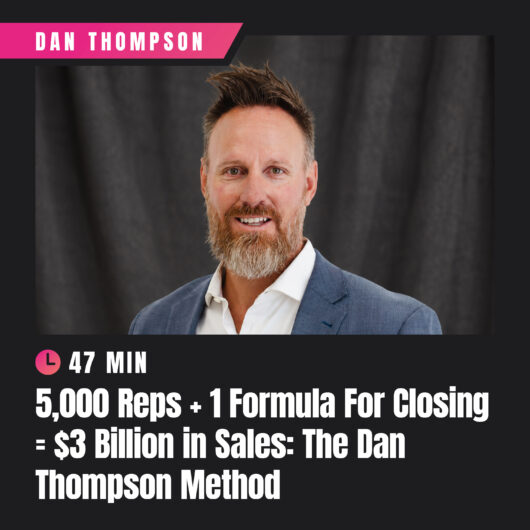
Podcast Episode 14
5,000 Reps + 1 Formula For Closing = $3 Billion in Sales: The Dan Thompson Method
To be a guest on the show, email podcast@postcardmania.com
Listen and watch on your favorite podcast applications.




Episode Overview
Host Chris Foster talks with Dan Thompson, executive vice president of Plus One Company BPO, about running a 5,000-agent call center across the US and Ecuador, treating every script as a scientific experiment, and why a sales call is really about keeping someone from reaching into a pocket full of excuses.
Podcast
Episode Transcript
Here’s the transcription below of today’s episode, a conversation between host Chris Foster and Dan Thompson, executive vice president of Plus One Company BPO, about running a 5,000-agent call center across the US and Ecuador, treating every script as a scientific experiment, and why a sales call is really about keeping someone from reaching into a pocket full of excuses.
Note: This transcription has been formatted from the original episode transcript for readability.
Transcript
Chris: All right — well, Dan Thompson, welcome into the Everywhere Small Business Podcast.
Dan: Thanks, man. How are you?
Chris: Doing great. Tell us a bit about yourself and your business.
Dan: Well, first of all, it’s a pleasure to be here. Thanks for having me on. So we’re going to be talking about a lot of things, but my name’s Dan Thompson. I’m the executive vice president of Plus One Company BPO. We’re a call center out of Utah. We’ve expanded into about ten different states here in the US, and two locations in Ecuador.
Chris: That’s interesting. I want to talk about the multinational approach later, but how did you get into the call center business? And why don’t you describe for the audience what the call center business and the industry is?
Dan: It’s crazy, and don’t ever get into it. That’s the first thing I want to talk about.
No, but seriously — we really didn’t set out to build a call center, we set out to solve a problem. I think that’s what you really have to do as an entrepreneur: go and solve problems. We kept seeing companies spend millions of dollars on media and advertising and lead generation, only to lose the opportunities because nobody was focused on the customer experience, on the sales piece of the phone conversation. It’s really the psychology of phone sales.
We also wanted to create a venue where someone could come and learn a skill and become a better person, and go on to do bigger and greater things because they learned how to sell. It’s one of the greatest professions in the world.
Chris: Talk to me about that, Dan — this idea of selling. Our CEO Joy Gendusa is very interesting, because she said that she was a good salesperson. She could sell. And starting a business from the concept of selling — she even made an interesting comment. She said all small business owners and leaders need to learn how to sell. You just have to, because you have to talk with people. Have you always been interested in selling, and have you always had a knack for it?
Dan: Well, I think as a kid is where you really learn how to sell. But it’s not an organized way to sell. It’s more like, I’m five years old, I want that piece of candy, and I get creative in trying to find a way to get my parents to give me this piece of candy. It starts off with trade — hey, I’ll give you this, or I’ll do this, or I’ll give you hugs and kisses. And I think it evolves over time, and you either get comfortable with the conversation or you don’t.
So the way we define sales at Plus One is: sales is the ability to give confidence that the decision you’ve already made is the right decision.
Example. A customer calls on the phone. They saw the product on TV, radio, digital, a postcard, whatever it is. They make a phone call, or they get on the web. They’ve already made a conscious decision in their brain that they want it — and the reason they’re actually calling is they’re hoping somebody will talk them out of it. So your job as a salesperson is to give them confidence, to reassure them that the decision they’ve already made was the right decision.
Chris: That’s hilarious. I love that idea, that you’re affirming the choice the user already made. Because if they didn’t call, they’d have no interest at all. The fact that they called in, the fact that they engaged with us, expresses an interest and a need and a want that they have, that you as a business owner can solve for them.
So then the question is, why isn’t every single call a sale? Do they want to learn more information? Do they want to be put off? It’s an interesting question. As someone in the call center space, you must see all the stories of people calling in and then, during the call, talking themselves out of buying what they were interested in.
Dan: Right. They come to the phone call with a pocket full of items. They know they can reach into their pocket: I need to talk to my spouse. I forgot my credit card. I was just looking around. All of these things that they have in their pocket.
But they don’t have to reach into their pocket. If I answer the phone — XYZ product — like that, that’s a reason for them to think, I don’t want to do business with that. But if you answer the phone with a smile, a trusting attitude, and you build trust, they think, okay, I don’t need to reach into my pocket yet.
And then you can build value. You can probe and ask them questions that will benefit them, and get those use cases that will solve their problems. Because it’s not only giving them confidence — we’ve got to find out what the problem is that we’re going to solve. Otherwise they’re going to reach into their pocket and pull out that excuse. So it’s preventing them from reaching into their pocket and getting out that excuse. They come armed. They still want it, but they’re finding reasons not to buy.
Chris: They’re finding reasons not to buy. So in terms of the sales scripting that comes into play with your call center — do you write those sales scripts? Have you, throughout the years, developed an approach for scripting sales calls, so that the person answering the phone knows what to say and how to say it?
Dan: Absolutely. A script is a tool that you follow, not one you read. We have an entire methodology — I’m not plugging, but we have a Plus One Academy, and our Plus One methodology is used and accredited by universities. So yes, it’s an entire methodology that we use for sales, created by Plus One Company.
Chris: Interesting. So how did you learn to do that over time? Was that through experience? From reading other books? How did you develop this methodology?
Dan: Well, one, you’ve got to take thousands and thousands and thousands of calls. A call center is a big experiment, where you can take a thousand calls, change one thing, measure the results, and see if that one thing improved or decreased them. So you have to put your script and put your people inside the environment of a scientific experiment. You have to be a mad scientist.
We have an MC/PC model. An MC is a master converter and a mentor coach. They’ve typically been with us eight to ten years — I mean, you can be an MC, we have MCs that have been here for two years. But we’re nineteen years old as a company, and most of our MCs have been with us a long time, an average of ten years.
They are script engineers. The reason they take calls is to go and engineer the script on new campaigns, but also on existing campaigns where you’re pushing the limits of conversion. And also to create that full feedback loop with the client — hey, this is what’s actually happening on the calls, we should change the offer, change the pricing, change these things.
Chris: From that perspective, Dan, I know it’s a cliché to say you’re in the trenches, but you guys are truly in the trenches, listening to these calls and trying to engineer and tweak and adjust as campaigns are going on. Is that correct?
Dan: Every day. Every day.
There are several reasons to listen to calls, and most BPOs listen to calls for quality assurance. It’s a fantastic idea — you can create a great feedback loop there. But what else can you do with that data on the performance side? And we’re performance driven. That’s where we come from.
When we started this business, we threw out all the KPIs. All the metrics the industry uses to measure the effectiveness of a call center, we threw them out the window and never looked back. What we created instead were KRIs — key revenue indicators — because revenue is the goal.
Chris: Sure. That’s pretty interesting, as you start to develop your own methodology — you develop the Plus One way, you have your Plus One Academy and the like. What I think is interesting about businesses is that they develop an expertise and they really know what they know, because they do it over time, every day, throughout years and over decades. Then they start developing their own way and their own culture.
So as you started to move it out — because you’ve been at the business so long — how have you seen your methodology change and adapt to the changing behaviors consumers have now, versus the ones they had two or three or four years ago?
Dan: Yeah, I think one of the biggest things — and honestly they haven’t changed a lot — but one of the biggest things consumer behavior has been taught is speed and impatience. Twenty years ago you couldn’t get on Amazon and have the product at your door within a couple of hours. So that has changed.
You call in on a product from TV, a postcard, digital, wherever it’s coming from — and you’re still mailing the product. So you’ve got to manage that conversation as well. Hey, shipping’s five to ten days out. And they’re like, what? I can’t have it tomorrow? Because we create such urgency on the phone, such demand on the phone, they’re like, I need that today. So we bump up against that a lot.
But consumer behaviors in the last twenty years — purchasing behaviors, buying behaviors from a psychological standpoint — really haven’t changed. We’re still human.
Chris: Yeah, and I still think that we go through these cycles as people, where we see something we might want to buy. We go through that awareness, that interest, that consideration stage. And as you start understanding what that looks like, then you can adjust your scripts a little, because your business is slightly different than others.
I just recently spoke to a woman who runs a dental office — a very different business than a call center. Some of the principles apply, where she has to have alignment, she has to have purpose, she has to have her team ready to go and figure out what they do best. But your business is also really focused on understanding customer psychology, to use the right words and cadences and sequences, to understand what they’re going through so you can move them along the path they’ve already started.
What have you learned about customer psychology? What has changed — and you said a lot of it hasn’t changed — that is a key insight into helping your business be successful?
Dan: I’m going to answer that a little differently, because we have two customers. We have the brand, which is our customer, and then we have the end user consumer.
Chris: Right, of course — you’ve got to serve two. You have to serve the customer calling, but you’re beholden to the brand whose product it is that they’re buying.
Dan: That’s right. So I’m going to answer both.
On the client side, one of the biggest shifts we’re trying to create in the industry is moving brands and companies from a cost center mindset to a revenue center mindset. Call centers have had a stigma, and we’re moving out of that. We’re actually the executive sales arm of brands. They hire us — they have a marketing team, they don’t have a sales team. We need to partner with them on their sales team, not as a cost center but as a revenue center. If you build out your sales team, it’s going to be the biggest revenue piece of your entire business.
Because most businesses spend a ton of energy trying to save a few dollars per call, per lead. It’s like that old thing — you’re stepping over dollars to pick up dimes, because you’re overlooking opportunities to generate thousands in additional revenue.
On the customer side, there’s a lot that goes into it, because you have the psychology of the creative. What is the call to action? What’s the price point? What is the product and how does it fit their need? What demographic are they in?
Right now the biggest demographic being attacked in the market is the fifty plus — I’d really say sixty plus — demographic, because that’s where a lot of the money is shifting. So we’ve got to be careful there and ensure that we’re serving that demographic in a safe and protective way, while also supplying them with great products.
Because the products now are way different than they were fifty years ago. To be able to support an individual lifestyle — let’s say you’re a couple at seventy-five or eighty-five years old — the products now are invaluable to them. People are staying in their homes later and later in life because of technology. So the buying habits of those older demographics are changing as well.
I think of my grandma — she still tries to write checks. I can pull out my debit card, and the phone is really comfortable to her. I don’t know that my kids are going to be calling people to buy stuff.
Chris: Sure, that’s comfortable for her. As you start looking at this new navigation of younger customers coming in who might not be on the phone a lot, there’s still a phone element to it. How do you see your business adapting if there’s a whole generation that isn’t used to picking up the phone to place an order, and they’re just doing things online? How are you guys going to adapt to that new environment?
Dan: I’ll answer that by telling you about a test that blew us away. It was a product for young — I mean, we had eighteen to twenty-five-year-olds calling, and there aren’t a lot of products tailored to that demographic. We knew the phone wasn’t going to work, so this was an opt-in digital text. And we communicated in emojis.
Almost exclusively. I mean, you have to have words, but the emojis held the conversation. It transitioned the conversation into the purchase, via text. So language is changing. The way we communicate is changing, and what we say is changing.
Chris: That’s an interesting play, because the call center doesn’t necessarily have to be that voice on the phone. Like you said, it can be text, it can be emoji — it’s just communication to the person who’s interested in the product. And that opens the door for a lot of things.
So as a business leader and business owner, Dan, how then do you plan for the future? Are you planning in six-month or nine-month lead times, or is that just too long? Are you planning in three-month lead times?
Dan: I think we’re planning week to week. And I’ll tell you why.
I didn’t even want to get into AI, and I really don’t want to, but as a technology you need to have it. And as you know — Fable just came out. That just changed everything. We don’t know what’s going to launch next week. We don’t know what’s going to launch two weeks from now.
And we’re not using AI exclusively to answer calls, or to manage any of the customer experience exclusively. What we’re doing is — AI isn’t replacing people in call centers, it’s eliminating the friction. In a sales process you have friction. So eliminate the friction in the customer journey, especially eighteen to fifty.
Customers don’t want to wait. This is what’s changing. A lot of our business is an older demographic, which is status quo, but then wealth is shifting fast. It’s unprecedented how fast the wealth is going to shift into the thirty to fifty-five range. And those customers don’t want to wait. They don’t want to fill out forms. They don’t want to leave a voicemail. They don’t want to do these things that their parents did.
So that’s where eliminating the friction on the customer journey and providing real-time response matters — where they’re at, when they’re there. And when I say where they’re at, they could be on digital, social, phone, in different places all at the same time, and you have to be there when they’re there.
Chris: Correct. And I think that’s probably true with all small business owners, whether they’re in technology or not. Their customers are looking at those businesses in a variety of ways — on Instagram, on Facebook, probably on TikTok. They’re going online, they might be calling in. There needs to be a way for those businesses to be responsive and prepared, so they can receive those inquiries or communicate with their customers in whatever fashion the customer wants.
Dan: That’s exactly right. I mean, we’re a product of that. You and I buy products from user content. We have confidence to buy because our peers are purchasing the same products. And that goes back to one of your other questions — what’s changed in buying habits. That is peer-supported products being seen and used, so I don’t have to talk to somebody, because I’ve already got the confidence that this will solve my needs.
Chris: Right. And what ends up happening is that the power of reviews, the power of that peer confidence, is such an important piece of it. We always recommend to all of our customers to have reviews, to make sure they show that other people are enjoying this product. That’s a critical piece for every business to have — because people actually are buying not because of a marketing message. They’re buying because of what their friends said. They’re buying what other people are buying.
Dan: Yeah, that’s right. And if you’ve studied Bernays, the psychology of Bernays, that’s really where it stemmed from.
Chris: Sure — people do follow a herd. Reviews are the equivalent of when someone sees a huge line in front of one place and no line in front of the other. Clearly the one with the line is the most popular one, so they gravitate to that anyway.
So as you start thinking about managing your team — you said you’ve got a team spread out in the US and also a team in Ecuador. How do you communicate that message of these changing customers to everybody, especially with a global team?
Dan: It’s actually really easy, and it came from a military background — I’m an Air Force veteran. To be able to get messages from front lines to back lines is really easy, and it’s done by having small groups, squadrons.
The way we’ve built this is kind of a spoke-and-wheel model. We have MCs and PCs, and then you can level up through an agent rank. An MC has five PCs, which are peer coaches, and then every PC —
Chris: Okay, so an MC — a master converter — has five peer coaches.
Dan: Yeah, master converter and mentor coach. And if you have an MC on your campaign — let me give you an example. We have an MC we were just working with last week. They’re converting at almost sixty percent, where the entire team is flirting with thirty percent. Thirty percent on this campaign, by the way, is killing it. It’s a high price, it’s a $400 item, it’s killing it. But the MC knows how to convert that at sixty percent, and then they try to get the entire group to convert at sixty percent.
What you do is you push the top. Performance is like a teardrop — think of a teardrop or a raindrop, where it’s really heavy at the bottom. If you can push the top, that teardrop changes. So you’re always pushing the top and cutting the bottom, because of gravity.
Chris: Right. So that master converter at sixty percent, which is two X the conversion rate of the team — clearly that has to do with experience and training. But you can train as much as you want; there’s also got to be a certain skill that’s unique to those master converters, in terms of changing their attention on the fly, having that conversation with the customer that moves around. Because not every customer is going to talk the same. There has to be an innate skill that they have.
Dan: Yeah. What the Plus One method does is it eliminates the drag on the agent, because you’ve only got so much RAM in your brain. Once you’ve mastered the Plus One method, you don’t have to think — you just execute, and your RAM is freed up. So they have mastered the Plus One method and it’s just automatic. They know what challenge A and challenge B questions are without even thinking about it, without even accessing the RAM in their brain. It comes with experience, it comes with confidence, and it comes with taking lots of calls.
Chris: You develop a muscle memory. In manufacturing you have a memory of steps and procedures and operations, and someone who’s been there eight-plus years knows it like the back of their hand versus someone who’s been there eight days. The same has to be true with those scripts and messages that the master converter knows, because they’ve done it so long there’s a muscle memory.
Dan: That’s right. And the way we design scripts is to implement the method in the script. We break our scripts down into the steps of the method. This is the goal in section one — what’s the first goal? To create trust. Smile, be confident, create trust. How do I do that? I smile. I answer, and I use statement questions, and I use their name — these things, and it’s just automatic now.
That’s why we have MCs: to shortcut an agent trying to learn that on the phone, to bring them up into mastery in the Plus One method. That’s the job of an MC — mastery.
Chris: Got it. What I like about that is that it’s so interesting how businesses develop an expertise about one thing. Oftentimes businesses organize and structure and compartmentalize and break things down so an operation becomes easy to follow. But what you’ve done is make a sales conversation easy to follow and replicate, because you’ve made it almost like a formula in terms of how you’ve broken up those scripts. Does that sound right?
Dan: Yeah, absolutely. If I’m a customer on the phone and I say, no, no way, don’t talk to me, just tell me the price or I’m going to hang up — how do you answer that as an agent on the phone for the very first time? You’re like, whoa, wait a minute. I have a tool right in front of me and I can answer that. I just have to go to my script.
Chris: I just have to go to my tool. I just have to go to that script, because it’s all there. That’s a really interesting approach, Dan — you create the formula for a conversation, and that’s really the business. The business you’re in is honing that formula down so it can be replicated across a number of different product types, and thousands of different customers calling in, and hundreds of different reps using that script.
Dan: That’s right. And I like that you said use the script, because we don’t require agents to read the script. They use the script and give it power. There’s a big difference between those two. If you’re in the call center space, you’re trying to get your agents to read the script — not use the script. We have our agents use the script and give it power.
Chris: That’s really interesting, because what that does when you tell your agents that is it gives them agency, and it gives them the freedom to be themselves.
Dan: Yeah — use your personality. Use your strengths. We could have a whole different podcast on personality types and how to empower individuals with their power.
Chris: Give us a little bit of a hint. Give us one example, because look, there are other small business owners listening and they’re probably thinking, man, how do I train my team to be good on the phones? How can I better train my team to be good in front of customers? You seem to have unlocked a method or a formula for that. So based on a personality type — you can just choose one as an example — how do you adjust for the personality type of one of your agents, to make sure they’re themselves but they’re also using the script you have?
Dan: Well, the first thing is we don’t want them to change their personality at all. But a lot do — and I kid you not, we have had in the past, and I think we still currently do, an agent who uses an accent. They talk as plain as I do, and then they add an accent, and it gives them — something switches in their brain and they just convert like crazy, because they use an accent.
Chris: It’s almost like a persona that they have, or a character in a play. They’re the converting person. I’m myself with my normal talking voice, but as soon as I get on the phone and I’m talking to a customer, I put this persona on and suddenly I can be that guy I want to be to convert.
Dan: It’s their alter ego, right? And by the way, Chris, we don’t teach that. We don’t talk about it. This just happens naturally. It’s so organic, it’s crazy. But in order for them to — that’s their Plus One method persona. Like, if I’m going to do this, Joe is going to do this, not Jack. It’s the craziest thing.
Chris: That’s right. I love it. What’s interesting is that for that agent, it probably helps him or her in life — because in life they’re one person and they might not be this confident, conversant, converting person in real life. But this is what they can do when they put that hat on. They can be that in their role.
Dan: Yeah. But to your point, we did create Plus One as a venue where people can come and create success and become more confident. It’s the self building, the mastery, the education they get — it’s university-type training at Plus One Company. They are learning a skill, they are mastering a skill. And what’s that saying? You’ve got to do something ten thousand times to become an expert, or something like that.
Chris: Yeah. That’s interesting to me, because in some ways, Dan, part of your business is — it’s so interesting to figure out what the true business is. And the true business is this crafting of the message, it’s the training of the people, it’s the developing of an agent to give them confidence so that they answer the phone with a smile, ready to go. But you’re also giving them life skills they can apply if they ever decide to leave Plus One. They can be more confident sellers out in the world.
Dan: No question. We have an agent who texts us once a month or once a week, just to stay in really close touch. Great agent — grew to become an extraordinary agent, and all of his skills came from taking phone calls. He moved from Utah to California, started a solar company, and did his first million. He’s texting us like, the Plus One method works, baby.
And this was an agent who just fought it. He was this natural, charismatic person who was all over the place and didn’t have any discipline. The second he learned some discipline and embraced the Plus One method, everything changed for him when he worked for us. And he took those skills and built an empire. That same thing has happened over and over and over again, and that’s why we built Plus One — so you can be a more successful, confident human being. This is the venue to do that. We love it.
Chris: That’s awesome. That is fantastic. That’s a beautiful mission, actually, because you’re transforming the professional futures of these folks. So how many agents do you actually have?
Dan: In the US, we manage 1,200 agents. That flexes throughout the year. And then in Ecuador we have two brick and mortar sites, one in Guayaquil, one in Quito, and we have 3,500 agents.
Chris: Wow. Thirty-five hundred agents. So all in, you have about five thousand agents.
Dan: Tipping about five thousand, that’s correct. Hey Chris — we’re a small center, believe it or not.
Chris: Clearly. Well, that’s a lot of people to manage. I know very few businesses that have five thousand folks they work with. So how do you end up managing them? Do you just manage those master converters, and the master converters manage the teams?
Dan: Yeah, we have agent managers, and then they work with MCs and PCs, and then every PC has five agents. So it’s a five to one ratio all the way up the ladder.
Chris: Right. So it is almost like a military structure — divisions, platoons. Well, you know better than I do: a squadron, then a platoon, then a battalion, and you move it all up from an organizational structure. So how many direct reports do you have? How many people do you personally have to manage to make all of this run?
Dan: Our business is built on four heads in different departments. We have our business CEO, the business office; we have our technology developer side of our business; we have our chief performance officer, who manages the performance, the agents, the agent managers. And then on the business development and business strategy side, I work with our campaign managers, our telephony support systems, a little bit of ops, but mainly the client support side of it. So there are really four heads that run it.
Chris: Got it. And that makes sense to me, because instead of having a single person trying to do everything, you’ve divided up the labor and the main channels of work to the people who know that operation best. So you’ve got these experts who run these different parts of the business, and the whole business can function as a collective.
Dan: That’s absolutely right.
Chris: That’s wonderful. That’s great advice also for small business owners — trying to figure out what they do well, instead of trying to do everything, and making sure other folks are responsible for other things.
Dan: You can’t do everything. You have your year one in business versus your year nineteen, and you’re like, how did I do that? Why did I build my first CRM system on Yahoo Web Builder? What was I thinking? Who does that? We did.
Chris: Right. But you know what? There are so many things you do when you start a business that you just do. You don’t know any better, you don’t know any different. Of course, if you knew better you’d do it differently. But part of the small business journey, and the business of growing a business, is learning as you go. If you knew it all in the beginning, you probably wouldn’t have started.
Dan: Yeah, so I have a quote for you. I mean, not a quote — it’s just a statement, I guess, not a quote by anybody. But: don’t fall in love with your idea. Fall in love with solving your customer’s problem. The market doesn’t care how much you love your idea. It cares whether your solution, your idea, creates value.
Chris: Right. That’s actually a very wise statement, because there are a lot of business owners who follow their idea, not necessarily the need and want of the customer base. That’s excellent.
Dan: That’s right. Some people say follow the money — follow your customer and what they need. And I think this is ESB, this is Everywhere Small Business, that’s what we’re talking about today. Our businesses, everyone you’ve talked to, everybody in your sphere has got a consumer. And that is the most important aspect of your business. Without consumers, you don’t have a business.
So you’ve got to tailor your entire business around your ideal customer profile. Maybe you want to keep everybody else out — but if you’ve got a customer, make sure you tailor your entire business around your customer.
And I’ve got another one, and this is what makes me think of you. We think that our job is to grow a company. And what I’ve learned is that my real job is growing myself — and the company will follow.
Chris: Right. It’s interesting you say that, Dan, because one of the common themes now with these owners I’m speaking with is their own personal growth, and that then brings the company along. And then the company also needs certain things, so they have to grow in order to serve the business. That’s excellent. I love it. That’s great advice, Dan. Thank you so much, and thank you so much for being a part of this podcast.
Dan: Chris, I love you, man, you know that, brother. Anytime I get to spend time and share ideas with you is a fantastic day. I love it.
Chris: I love you too. I feel the same way, my friend. And congratulations on the success of Plus One. It’s just a marvelous story.
Dan: I appreciate it. And here’s to the success of our partnership, and here’s to all the small businesses out there. We’re the ones that push the line. We’re the ones that make it happen, man. We appreciate it.
Chris: That is a hundred percent true. All righty, Dan, thank you so much. Have a great night. Bye bye.
Dan: Chris, thanks man. Appreciate it.